

9:32:48 AM | 10/23/2025

Located in one of the world’s most dynamic economic regions, Vietnam has remained a strong and increasingly attractive destination for foreign direct investment (FDI). However, the implementation of the global minimum corporate income tax means tax incentives will no longer serve as a key advantage in attracting FDI. Instead, non-tax policy measures will become essential.
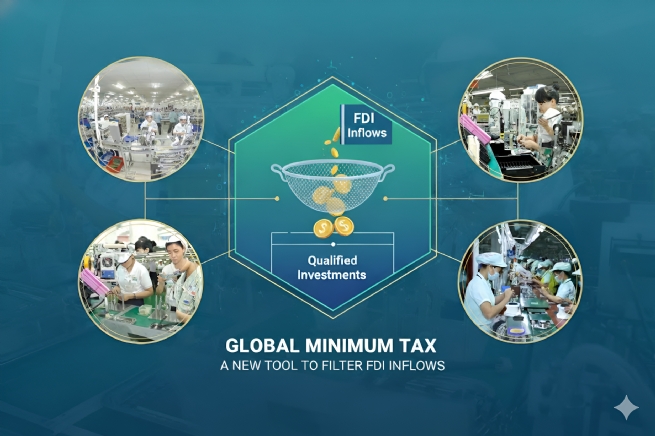
Global minimum tax and its impact on FDI
According to Dr. Bui Tat Thang, former President of the Vietnam Institute for Development and Strategy, the global economy is facing new challenges, including the adoption of the global minimum corporate income tax, which is expected to significantly affect FDI flows in the coming period.
The global minimum corporate income tax (commonly referred to as the Global Minimum Tax) is one of two key pillars of the Base Erosion and Profit Shifting (BEPS) Action Plan, launched by the Organization for Economic Co-operation and Development (OECD) in 2013. The Global Minimum Tax is set at 15% and applies to multinational corporations with consolidated global revenue of at least €750 million (US$800 million) in at least two of the previous four years.
The proposal was primarily driven by the fact that large multinational corporations, often headquartered in advanced industrial economies, were investing in countries with low corporate tax rates to maximize profits by minimizing their tax obligations. This created unfair competition and deepening income inequality. The objective of the minimum tax is therefore to ensure a fairer, more transparent global business environment while reducing income disparities.
For developed countries hosting these multinational corporations, overseas investment resulted in a loss of tax revenue compared with if the investment had remained domestic. Additionally, as competition in high-tech, strategic sectors such as semiconductors and artificial intelligence has intensified, the Global Minimum Tax, though proposed over a decade ago, has only recently come into effect. This is why the BEPS Action Plan comprises two pillars: taxing digital business activities based on market allocation and establishing a 15% Global Minimum Tax for multinational corporations. Many countries, including Vietnam, committed to implementing the tax beginning in 2024.
According to Vietnam’s Department of Taxation (Ministry of Finance), over 1,000 foreign-invested enterprises in Vietnam have parent companies subject to the Global Minimum Tax. Of these, around 120 large enterprises were directly affected when the policy took effect in 2024, with an estimated additional tax liability of approximately VND14.6 trillion. Importantly, if Vietnam does not collect this tax, other countries will do so. Consequently, since the Global Minimum Tax was adopted in 2024, foreign investors have found Vietnam’s tax incentives less attractive.
At the same time, Vietnam continues to seek greater FDI inflows, especially in priority sectors such as high technology and clean technology. As tax incentives have lost much of their effectiveness, the government must now adopt alternative measures beyond taxation to create a more favorable and competitive investment climate, measured by the net benefits investors ultimately receive compared with other host countries, including the home countries of multinational corporations.
In essence, collecting the additional tax is more of a “technical adjustment” than an increase in state budget revenue. This is because the host country must introduce new forms of support to maintain investor interest. When quantified, these support measures will likely amount to the same scale as the additional tax collected from multinational corporations investing in Vietnam.
Seeking mechanisms to replace tax incentives in attracting FDI
According to data from the National Statistics Office (Ministry of Finance), between 2020 and 2024, foreign direct investment consistently accounted for about 16.2% of total social investment, contributed roughly 20.2% of GDP annually, and made up around 73% of Vietnam’s total export value.
Despite a global decline in FDI, particularly in some regions, Vietnam has continued to attract growing inflows since the COVID-19 period. To maintain this appeal, Dr. Bui Tat Thang emphasized that Vietnam must provide overall incentives equivalent to those previously offered through tax reductions, at least matching the 15% Global Minimum Tax benchmark. In other words, with tax cuts losing their competitiveness, alternative measures must be developed. Additional tax revenue collected under the Global Minimum Tax should be used to fund these new incentives and sustain Vietnam’s investment attractiveness.
Dr. Bui Tat Thang suggested that non-tax incentives could include investment facilitation through further administrative reforms to accelerate licensing procedures and reduce pre-investment costs. Vietnam has already achieved progress with one-stop-shop mechanisms and clear licensing timelines, yet investors continue to call for deeper reforms.
He also highlighted digitalization of investment procedures to enhance transparency and predictability, noting: “The most effective measure at this stage is to accelerate the use of information technology to provide more comprehensive and transparent information for investors and for Vietnam’s investment environment. The goal is a stable and transparent policy framework that allows investors to forecast costs and avoid legal and compliance risks.”
Other measures include land access and industrial park readiness, such as establishing land reserves to accommodate incoming investors in line with approved industrial park planning, and reconsidering infrastructure responsibilities. While industrial park operators have typically managed internal infrastructure and local governments external infrastructure, some functions could now be shifted to local authorities to reduce both costs and processing times while improving quality oversight.
Additional support could also come from facilities and workforce development, such as building social housing in and around industrial parks to reduce costs for manufacturing investors; simplifying visa and work permit procedures for foreign experts in high-tech projects; and enhancing training programs to meet labor demand.
To fund these non-tax measures, Dr. Bui Tat Thang referred to the Investment Support Fund established under Decree 182/2024/ND-CP. He emphasized that the main challenge now is to implement the fund effectively so it can quickly replace tax-based incentives in the Global Minimum Tax era, strengthening Vietnam’s ability to attract and retain FDI.
By Quynh Chi, Vietnam Business Forum






 Vietnamese





