

11:28:12 AM | 11/12/2025

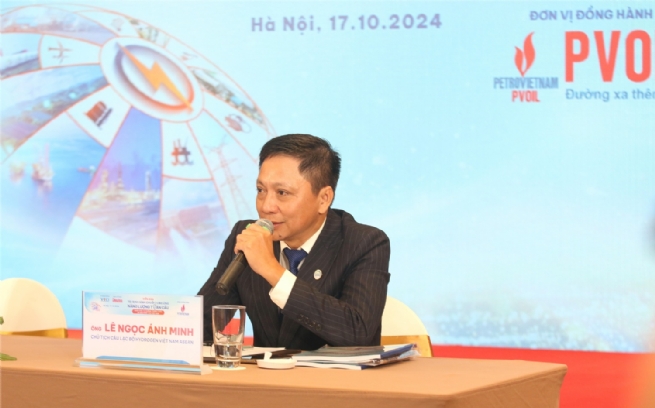
Low-emission hydrogen is anticipated to become a “strategic feedstock” that ensures energy security while driving the growth of green industries. In an interview with Business Forum Magazine, Le Ngoc Anh Minh, Chairman of the Vietnam ASEAN Hydrogen Club (VAHC), emphasizes that Vietnam’s natural resources and logistics advantages position it to emerge as the region’s hydrogen hub, but this requires “moving fast” through international cooperation and “moving steadily” through domestic technology localization.
How can hydrogen become a “new pillar” for Vietnam’s energy security and green economy, and what are the targets to not only follow but lead the region?
Low-emission hydrogen produced from wind, solar, biomass, gas with CO₂ capture, or nuclear, or from natural deposits is both a flexible energy carrier (for large-scale storage) and a clean feedstock for hard-to-abate sectors such as steel, cement, chemicals and heavy transport. Combined with Vietnam’s coastal renewable-power advantage and logistics capacity, hydrogen can help the country reduce fossil-fuel dependence, strengthen energy security and open a new export frontier.
The International Energy Agency (IEA)’s Global Hydrogen Review 2025 highlights the role of ASEAN, in which Vietnam stands out with domestic production-consumption and export potential to Northeast Asia.
The Vietnamese government has set targets for the 2025 to 2030 period: produce 100,000 to 500,000 tons per year by 2030-2035, progressing toward 10 to 20 million tons by 2050; ensure that at least 15 to 25% of electricity used in electrolysis comes from renewable sources by 2030; and achieve 30 to 40% domestic value-added in the electrolysis supply chain during 2030-2035. These objectives are fully achievable with coherent, integrated solutions and decisive, effective implementation.
During the 2025-2035 period, what are the “breakthrough” sectors where hydrogen can make a transformational impact on Vietnam’s economy?
The breakthrough will occur in heavy industry (steel, cement, chemicals, fertilizers): hydrogen will substitute traditional fuels for oxygen-free processes and green fertilizer production, delivering the largest reduction in emissions and stable demand.
Also, maritime transport & logistics: shifting shipping fuel to ammonia/hydrogen on regional routes; Vietnamese ports could become bunkering hubs for the Western Pacific.
Heavy & urban transport: long-haul trucks and urban buses, segments where batteries are constrained, will benefit from hydrogen fuel cells or ammonia-fueled engines.
Green-energy exports: establishing coastal H₂ hubs, leveraging land availability and competitive renewable-energy cost to produce and export hydrogen and derivatives (ammonia, methanol). This could become a strategic foreign-currency earner if costs fall. The IEA assesses Vietnam as especially promising at major industrial-port zones such as Ba Ria-Vung Tau, Dung Quat, Nghi Son, Hai Phong, and Hon Khoai (Ca Mau).
Major global corporations from Europe, the US, China, Japan, and Korea are ramping up hydrogen investments. Should Vietnam pursue a “move fast” strategy through international cooperation or a “move steadily” approach with technology self-sufficiency and gradual localization?
In my view, Vietnam needs a pragmatic strategy: do both “move fast” and “move steadily” in parallel.
Move fast through international cooperation: Attract investment, technology and demonstration projects from the EU, Japan, Korea, the United States, China and Australia to quickly build infrastructure and market. Pilot projects help Vietnam test commercial, logistics and export models early. In reality, companies such as PetroVietnam Gas (PV Gas) and Obayashi Corporation have already begun; this must be expanded into power, urban transport, long-haul trucking, maritime and rail.
Move steadily through localization: Invest in R&D, training, develop components (electrodes, electrolyzers, storage, ammonia logistics). The goal is to reduce dependence on imported technologies within a decade. At the same time, diversify hydrogen sources, not only electrolysis but also natural hydrogen exploration as in the Philippines and Indonesia. Water is also a key issue: to produce 1 kg of pure hydrogen needs over 9 liters of ultra-pure water. In the context of climate change, Vietnam needs to integrate seawater-filtration or artificial-reservoir technology to both supply hydrogen production and address household and agricultural water needs (especially in the Mekong Delta).
A combined strategy: Prioritize a “technology import with transfer” model through public-private cooperation that includes mandatory clauses on technology transfer, joint ventures, and localization. In practice, VAHC works regularly with international companies, from major corporations to startups, to negotiate local manufacturing and technology transfer while encouraging Vietnamese engineers to enhance and upgrade systems in collaboration with partners.
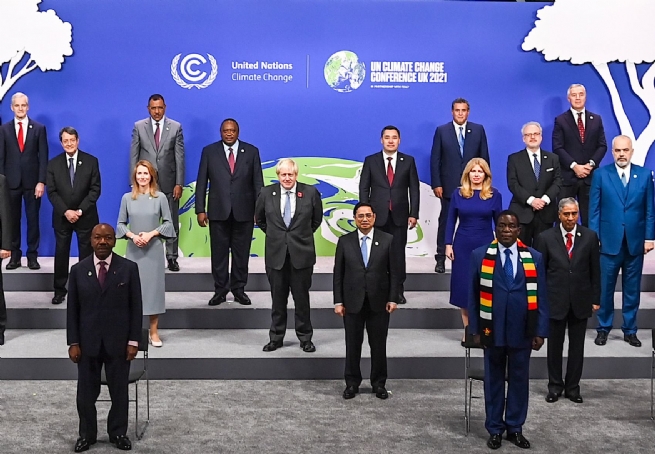
Prime Minister Pham Minh Chinh and other leaders attend the COP26 Conference
What is the biggest barrier to hydrogen becoming a genuine industry?
Not only Vietnam but many countries face major bottlenecks:
- Incomplete legal framework & incentives: no reference price for H₂, no preferential public procurement mechanism, no export policy for H₂/ammonia. Lacking technical standards, safety norms and licensing for production, storage and transport.
- Lack of domestic market (demand signal): no binding green procurement, no roadmap to phase out “dirty” fuels, no regulation for hydrogen/ammonia-fueled engines (ships, buses, ports, airports). Without a framework for consumption, it is hard to build a market.
- Financial and cost challenges: Production costs remain high and risks are significant, causing many international projects to be postponed or canceled. Governments find it difficult to maintain long-term subsidies. With a limited budget, Vietnam needs innovative mechanisms: monetizing land and water-use rights for investors, encouraging companies to develop secondary revenue streams (such as O₂, graphene from LNG, and materials from recycled aluminum). Hydrogen should serve not only as a main product but also as a valuable by-product of emerging technologies.
Priority solutions:
1. Establish a clear legal framework across the entire supply chain, guarantee origin, safety & quality standards.
2. Develop pricing & carbon-credit mechanisms. If price support is not yet feasible, support through resource rights or long-term offtake contracts with domestic, Japanese or Korean partners.
3. Build Hydrogen Hubs near major ports (on the Japan model) to co-locate production, equipment, logistics, consumption and export.
4. Forge strategic cooperation with the Hydrogen Council and the IEA and major associations; proactively send Vietnamese representatives to shape global standards and mechanisms.
What breakthrough proposals has VAHC put forward to help the Government unlock bottlenecks?
Against the backdrop of global energy transition, Vietnam is gradually building a green hydrogen value chain toward its net-zero-2050 goal. However, implementation still faces many bottlenecks, requiring coordinated action by both government agencies and enterprises. In response, we have proposed breakthrough solutions to open new pathways for the domestic hydrogen industry.
Diversify incentive mechanisms, don’t rely on old models: Vietnam should not default to models many countries once used (such as fuel-price subsidies or focusing only on electrolytic hydrogen). International experience shows mandatory price subsidies often lack sustainability. Instead, the hydrogen industry in Vietnam should expand incentives that enable companies to research, develop technology and reduce costs. At the same time, the domestic hydrogen industry should exploit multiple sources: agriculture, coal, gas (with full CO₂ capture), and natural hydrogen exploration, rather than relying solely on electrolysis.
Strategic international cooperation: We emphasize that trade cooperation in low-emission hydrogen with countries possessing strong production capacity and infrastructure, such as China and Russia, provides a fast and effective pathway. Russia’s experience demonstrates that leveraging existing gas storage and transport infrastructure can reduce costs, shorten deployment timelines, and enhance safety.
Domestic technical & policy framework: We are ready to collaborate with regulatory agencies to develop the technical and policy framework for government review. The objective is to create a step change to remove mechanism bottlenecks while shaping safety, quality and emissions standards across the hydrogen value chain.
Boost R&D and international investment: In addition to cooperating with domestic and international research institutions, Vietnam needs to facilitate outbound investment by companies, particularly in countries with favorable renewable energy conditions such as Australia and several African nations. Active participation in global value chains will allow Vietnamese firms to accumulate technology, strengthen competitiveness, and narrow the gap with advanced economies.
Think-tanks and high-quality human resources: One of our core proposals is to establish think-tanks or private research institutes dedicated to monitoring hydrogen and new-energy policies and technologies globally. From this, domestic companies can develop strategic plans or engage in M&A of leading technology firms to capture core technologies and proactively manufacture supply-chain equipment. Additionally, attracting top international hydrogen experts will help Vietnam master technology and build a robust foundation for a sustainable green-hydrogen value chain.
With the above solutions, VAHC expects to contribute to a leap-forward, enabling Vietnam’s hydrogen industry to develop in a coordinated, sustainable and proactive manner, while positioning itself on the map of clean-energy leadership regionally and globally.
On the journey to Net Zero 2050, should Vietnamese companies remain mere “technology followers” or strive to become “strategic partners” in the global hydrogen value chain?
First, enterprises need to identify a suitable competitive niche: for example, offering integrated EPC + O&M services for hydrogen projects across the region; manufacturing components such as plate stacks for electrolyzers; or developing mid-scale green ammonia projects. In practice, some Vietnamese companies (for example Lilama Corporation) have already participated in large-scale electrolyser equipment fabrication, demonstrating they can keep pace with the global market.
Second, companies need to form international alliances to both learn technology and expand their export channels. Countries such as Russia, China, Japan and Korea are potential partners due to geographic proximity and large green-energy demand.
Third, to engage deeply in global supply chains, firms must invest heavily in standards, QA/QC to meet strict export market requirements.
With the right strategy and policy support, Vietnamese companies can advance toward exporting comprehensive green solutions, from modular hydrogen plants and electrolyzer equipment to operational services for ports and maritime bunkering. In practice, several Vietnamese consultancies have secured wind, solar, and hydrogen contracts in the Philippines, Taiwan (China), and Africa, while major firms such as PetroVietnam Technical Services Corporation (PTSC) export structural components and undertake offshore wind EPC projects internationally. These are clear indicators that Vietnamese enterprises are not merely followers but are positioning themselves as strategic global partners in the hydrogen industry.
How do you evaluate Vietnam’s prospects for engaging in the global hydrogen value chain, particularly in relation to the major hydrogen production hubs in the Middle East, Australia, and Northeast Asia?
Vietnam has the opportunity to upgrade its role into a regional goods-preparation and logistics hub thanks to its geographic proximity to Northeast Asian markets, coastal land availability, major ports and competitive labor costs. However, to link with hubs in the Middle East/Australia/Northeast Asia, Vietnam needs to develop conversion hubs (turning hydrogen into ammonia/liquid fuels for long-haul transport) as well as CO₂-certification and traceability systems to ensure origin integrity. It must establish those standards and legal frameworks urgently and reliably to engage in international cooperation. Though Australia’s green-hydrogen projects claim large scale, they too face investment and incentive constraints. Vietnam, beyond focusing on domestic production, can also explore policies to attract investment from countries such as Australia and some African or Latin American nations with strong renewable-energy incentives to produce and export into Europe or Northeast Asia. Regarding the Middle East, I believe they are a strong competitor because they already have longstanding hydrogen/ammonia fertilizer production based on oil & gas platforms and substantial financial resources. Cooperation with them via trade into ASEAN may be more appropriate.
How will VAHC become a “strategic roundtable” for both government and industry in transforming the Net Zero 2050 vision into specific, feasible action?
In my capacity as Chairman, I envision VAHC as a “strategic roundtable” connecting government and business communities, built on three key pillars: (i) policy development, (ii) public-private-international collaboration, and (iii) standardization and training.
1. Policy development and ongoing dialogue: organize forums and workshops with government and international partners, providing concrete recommendations on pricing mechanisms, investment incentives, and safety standards based on economic modeling, global experience, and Vietnam’s realities.
2. Promote PPPs and Hydrogen Hubs: attract investment for large-scale demonstration projects (port, electrolysis, export centers); propose establishing Hydrogen Hubs in Ba Ria–Vung Tau, Nghi Son, Dung Quat, Gia Lai, and Van Phong.
3. International connectivity and carbon-neutral cities: build partnerships between leading hydrogen cities in Japan and ASEAN and Vietnamese localities; expand business-to-business cooperation.
4. Training and standardization: establish an H₂ training and certification center with foreign associations; develop a best-practice handbook for SMEs joining the supply chain.
5. Mobilize green finance: connect JETP funds, multilateral development banks, and green bonds; engage major corporations to launch demonstration projects.
With these three pillars, VAHC will serve not only as a forum but as a strategic bridge turning the Net Zero 2050 vision into concrete, achievable, and globally relevant action.
Thank you very much!
Source: Vietnam Business Forum





 Vietnamese





