

4:06:21 PM | 11/11/2025

In Vietnam’s green energy landscape, PetroVietnam Gas Joint Stock Corporation (PV GAS), a member of the Vietnam National Industry – Energy Group (Petrovietnam), is emerging as a forerunner in developing the hydrogen (H₂) economy, a sector seen as a new pillar in the global energy transition. From research and pilot testing to policy proposals and international cooperation, PV GAS is steadily laying the foundation for a national H₂ value chain, contributing to Vietnam’s goal of achieving net-zero emissions by 2050.
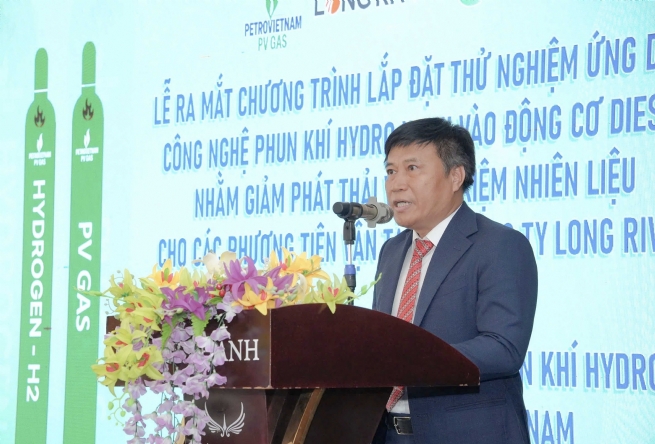
PV GAS Deputy General Director Hoang Trong Dung shares the company’s goals and orientation in the green hydrogen sector
The core of Vietnam’s hydrogen strategy
Under the National Hydrogen Energy Development Strategy approved by Decision 165/QD-TTg on February 7, 2024, PV GAS was assigned by Petrovietnam to lead hydrogen research and strategy proposals and to participate in developing the national energy policy framework through 2030, with a vision to 2050. This responsibility positions PV GAS at the center of Vietnam’s hydrogen value chain, from production, storage, and transportation to industrial, transportation, and power-generation applications.
At the Dinh Co Industrial Park in Ho Chi Minh City, PV GAS is developing a 1 MW green hydrogen production project, the first pilot model in Vietnam that combines renewable energy sources such as wind and solar with water electrolysis to produce pure hydrogen. The project is scheduled to begin operation in the first quarter of 2026 and will provide the first domestic source of clean fuel for public transport, processing industries, and energy centers in the Southeast region.
In mid-2025, PV GAS successfully conducted a hydrogen-blending trial by injecting hydrogen into diesel engines at Vung Ang, Ha Tinh. The results showed significantly lower fuel consumption and CO₂ emissions while maintaining engine performance, opening the way for applying hydrogen blending in industrial transport and power generation. This effort demonstrates PV GAS’s sustainable approach to leveraging existing gas infrastructure to gradually transition toward clean energy and reduce dependence on fossil fuels.
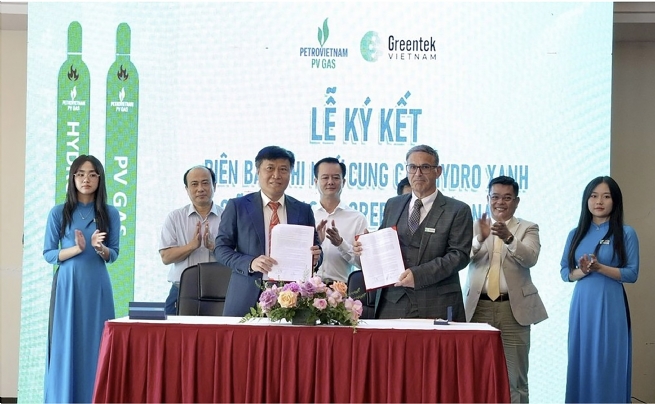
PV GAS Deputy General Director Hoang Trong Dung and Greentek Vietnam representatives at the signing of an MoU on green hydrogen supply
Beyond production and pilot testing, PV GAS is expanding into practical hydrogen applications in urban life. The company has proposed that the Ho Chi Minh City People’s Committee approve a pilot project to develop hydrogen supply infrastructure and refueling stations for public buses during 2026-2028. If approved, it will be the first public transportation project in Vietnam powered by hydrogen, marking a milestone in the green transition of major cities. The project aims to create a modern hydrogen refueling network along key transport routes, supply clean fuel, cut CO₂ and NOₓ emissions, and standardize operational data for future expansion to other cities.
Experts noted that hydrogen-powered buses offer clear advantages over electric ones in driving range, refueling time, smooth operation, and environmental performance, as their only emission is water vapor. Once implemented, the project will not only deliver environmental benefits but also help create a new economic value chain covering production, storage, operation, maintenance, and industrial safety.
Aligning national goals with a regional vision
PV GAS considers hydrogen not just a new type of fuel but a complete economic ecosystem that includes production, storage, distribution, and multi-sector applications. With extensive experience in managing Vietnam’s national gas infrastructure, including pipelines, storage facilities, compressor stations, and the transportation of LNG and LPG, PV GAS is turning these advantages into a strong technical foundation for the country’s future hydrogen system.
The company is also strengthening international cooperation through forums and joint research programs, such as the “Vietnam - Australia H₂ Workshop: H₂ Mobility & Decentralized System,” which fosters collaboration in decentralized storage, transport, and distribution technologies. At the same time, PV GAS is actively promoting public-private partnership (PPP) models for clean energy development, aiming to build a domestic H₂ value chain that connects producers, transporters, and consumers, laying the groundwork for Vietnam’s hydrogen market in the coming decade.
According to the Global Hydrogen Report 2025, Southeast Asia is becoming one of the most dynamic regions for hydrogen energy development, as countries such as Japan, South Korea, Singapore, Malaysia, and Indonesia are accelerating their national hydrogen strategies. In this context, Vietnam, with its favorable geopolitical position, abundant renewable energy potential, and well-developed gas infrastructure, has the opportunity to become a new hydrogen hub in the region. As a pioneer, PV GAS serves as a key driving force in turning this vision into reality.
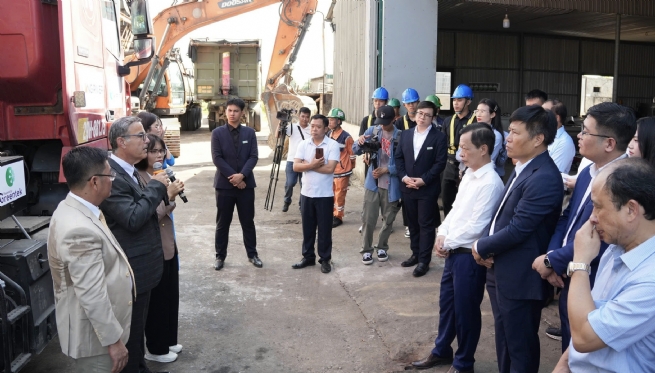
An expert demonstrates how the hydrogen injection system operates in diesel engines
Beyond its role as an investor and technology developer, PV GAS also acts as a consultant, policy advisor, and strategic partner for leading global energy corporations in cross-border hydrogen projects. Through its early initiatives, including the Dinh Co green hydrogen project, the Vung Ang pilot, and the proposed hydrogen bus project in Ho Chi Minh City, PV GAS has demonstrated its capability to achieve concrete results, gradually turning the concept of a hydrogen economy from vision into reality in Vietnam.
The hydrogen journey of PV GAS is not only a story of technological advancement but also a reflection of Vietnam’s aspiration for energy transformation. In this vision, PV GAS stands as a trailblazer leading the nation into the green hydrogen era, where clean energy drives sustainable development, circular economy growth, and progress toward a net-zero future.
In Vietnam’s energy transition, hydrogen is regarded as the final piece needed to achieve the Net Zero 2050 target. With strategic vision, solid technical capacity, and a pioneering mindset, PV GAS is shaping the nation’s energy future, where natural gas, LNG, and green hydrogen advance together toward a low-carbon, sustainable, and globally connected economy. The future of green energy is no longer distant. It begins today with PV GAS.
By Ngo Khuyen, Vietnam Business Forum


 Vietnamese





