

1:11:00 PM | 12/3/2025

Vietnam’s auto industry development strategy through 2030, with a vision to 2045, raises high expectations for a manufacturing sector capable of technological autonomy and active participation in global value chains. To turn this vision into reality, however, Vietnam must overcome its greatest challenge: establishing a robust supporting industry ecosystem.
Forming a deep supply chain
Ministry of Industry and Trade recently finalized a draft of the Auto Industry Development Strategy, identifying five pillars: environment, technology, infrastructure, human resources, and market. Most notably, supporting industries are placed at the center, with localization targets increased to 55 to 60% by 2030 and 70 to 80% by 2035.
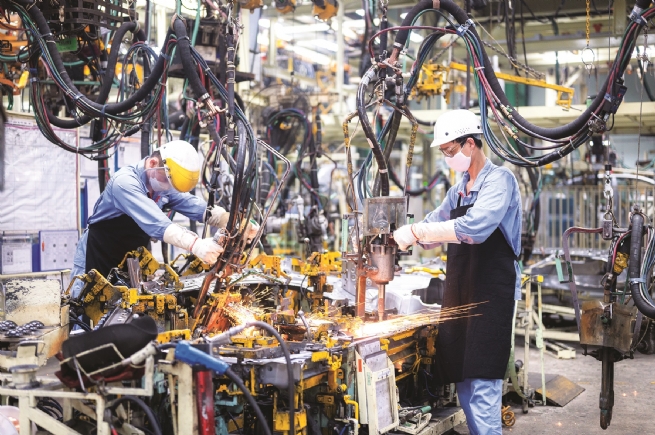
This is a decisive step after more than three decades during which Vietnam’s auto sector has not developed a fully domestic supply chain. Without control over components, Vietnamese automakers will face difficulties in gaining competitive advantage. Looking at highly industrialized countries such as Japan and South Korea, the common factor is clear: they all have strong supporting industry ecosystems with thousands of precision-component manufacturers.
The new strategy emphasizes the creation of five supporting industry clusters nationwide as technology hubs connecting manufacturers, suppliers, and research institutions. Vietnam aims to move into high value segments such as electronic components, powertrains, new materials, batteries, and control modules for electric vehicles.
Vietnam is expected to consume 800,000 to 900,000 vehicles per year by 2030, 1.5 million by 2035, and over 5 million by 2045. Such a large market provides a long-term order base to drive the growth of supporting industries.
However, to meet localization requirements more than twice the current level, small and medium enterprises, the backbone of supporting industries, must overcome major challenges: limited capital, insufficient technology, and management capacity. Auto components, particularly electronic parts, require extremely high standards that very few Vietnamese firms currently meet.
Leading firms needed to pave the way
In Vietnam, some large-scale manufacturing centers are generating new momentum. THACO’s complex in Chu Lai operates with an annual capacity of 100,000 vehicles, with localization rates of 25 to 40% and a target of 45% for key models. VinFast, with complexes in Hai Phong and Ha Tinh, has already achieved over 60% localization for electric vehicles and is expected to reach 84% by 2026.
The presence of leading firms such as THACO and VinFast strengthens confidence that Vietnamese manufacturers can secure large orders for domestic suppliers. This is also crucial for SMEs to invest in machinery, technology, and management to integrate into global value chains.
The role of the state remains crucial. According to Phan Dang Tuat, Chairman of Vietnam Association for Supporting Industries (VASI), to build a competitive supply chain, SMEs need comprehensive support including credit, land, technology, human resources, and governance. The government must provide a stable legal framework, reduce investment costs, and prioritize technology transfer and specialized training programs.
At the same time, industry associations should serve as bridges, helping firms access technical standards, market information, and cooperation opportunities with major manufacturers. When the three links namely the state, leading firms, and SMEs, move in concert, supporting industries can truly take off.
The effect of supporting industries will extend beyond the auto sector. A strong ecosystem will stimulate foundational industries such as precision mechanics, metallurgy, electronics, chemicals, and new materials, which form the core production capacity of a modern economy.
Global trends in electric vehicles and the green transition also present a major opportunity for Vietnam. This creates prospects in segments such as batteries, control modules, and electronics, where Vietnamese firms can quickly catch up. However, this window of opportunity will not remain open for long. Without accelerated action, Vietnam risks missing a golden phase in the global restructuring of the auto industry.
Bui Lien (Vietnam Business Forum)
 April 24–25, 2026
 Kinh Bac Cultural Center, Bac Ninh Province


 Vietnamese





