

4:29:30 PM | 12/13/2025

Recently, in Can Tho City and Ca Mau Province, IUCN organises a 2-day knowledge-sharing and networking event titled “Unlocking Sustainable Financing for Hybrid Nature-Based Solutions to Increase Coastal Resilience in the Mekong Delta.” The event brings together local government representatives, farmers, agribusinesses, financial institutions, and media to accelerate sustainable aquaculture and large-scale mangrove restoration opportunities in Viet Nam.
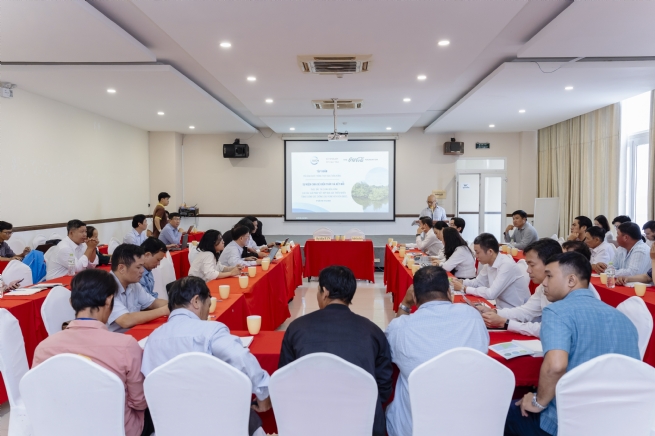
It includes a training session followed by site visits to eight shrimp farms in Soc Trang (now part of Can Tho) and Bac Lieu (now part of Ca Mau) Provinces that are piloting Integrated Multi-Trophic Aquaculture Recirculating Systems (IMTA-RAS) combined with mangrove restoration.
This event is part of the 3-year project “Increasing Coastal Resilience in the Mekong Delta through Mangrove Restoration and Hybrid Nature-based Solutions” funded by The Coca-Cola Foundation (TCCF), the global philanthropic arm of The Coca-Cola Company.
Mangrove loss in the Mekong Delta (which is home to 75% of Viet Nam’s mangroves) is driven by sediment supply reduction, sea level rise, and other human interventions such as the building of sea dikes, shrimp farming and groundwater pumping that leads to subsidence. Flat and low-lying, Soc Trang and Bac Lieu are suffering the fastest mangrove loss with the greatest impacts on communities and enterprises.
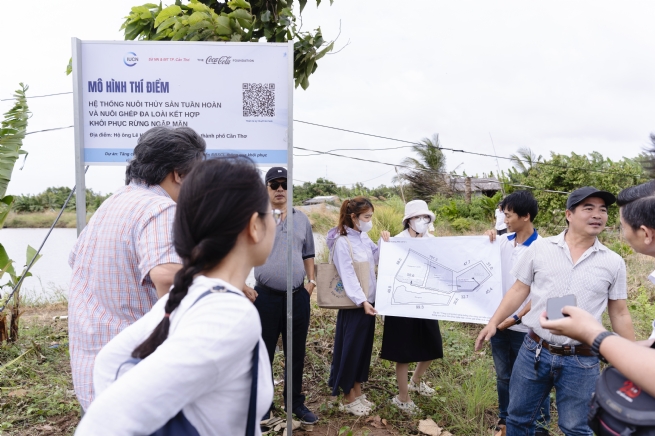
Along these coastlines, mangroves are being squeezed between dikes on one side and rising sea level on the other, a phenomenon known as the coastal squeeze. Any new mangroves planted outside the sea dike are quickly eroded. Restoring mangroves along these highly vulnerable mangroves requires a new approach that makes business as well as environmental sense.
Testing this new approach, IUCN is implementing the TCCF project, which aims to expand the area of mangrove inside the sea dike in Soc Trang and Bac Lieu by testing and scaling up a hybrid nature-based solution (NbS) that combines mangrove restoration (through natural and assisted regeneration) and the conversion of shrimps production from large, open-air ponds to IMTA-RAS, which produce 20-time more shrimp per unit area basis with much lower disease risk. This conversion will eliminate or greatly reduce the need to pump groundwater to dilute pond water, thereby reducing land subsidence which at 2.5 cm/year is five times greater than global sea level rise.
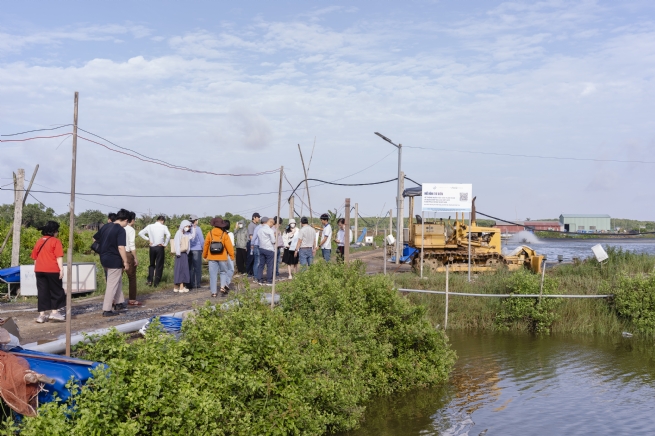
The project’s primary output is to demonstrate the technical and financial feasibility of hybrid NbS with 45 shrimp-farming households managing 45 hectares of land. With strong provincial government support, by November 2025 the project has helped 21 farms convert to IMTA-RAS with mangrove restoration. A financial analysis on IMTA-RAS conversion has been completed to calculate the Return on Investment (ROI) and inform future investment decisions.
Based on initial project achievements, the event will: Showcase successful IMTA-RAS conversion and highlight their environmental and financial benefits; Raise awareness among the public and media of hybrid NbS and sustainable aquaculture; Engage investors and banks by presenting IMTA-RAS with mangrove restoration as a bankable, scalable NbS.
The event will showcase project results, share success stories with media and financial institutions, and mobilise funding for local farmers. Can Tho and Ca Mau together manage 200,000 hectares of shrimp farmland. Restoring mangroves on just 5% of this area would add 10,000 hectares of new mangrove forest—representing the largest mangrove restoration opportunity in Viet Nam.
By Van Luong, Vietnam Business Forum


 Vietnamese





