

11:50:25 AM | 12/17/2025

Built on the strong foundation of friendship established by President Ho Chi Minh and President Sukarno, people-to-people exchanges have grown steadily over the decades. They have become a lasting pillar that now extends into education, culture, the economy, and tourism between Vietnam and Indonesia.
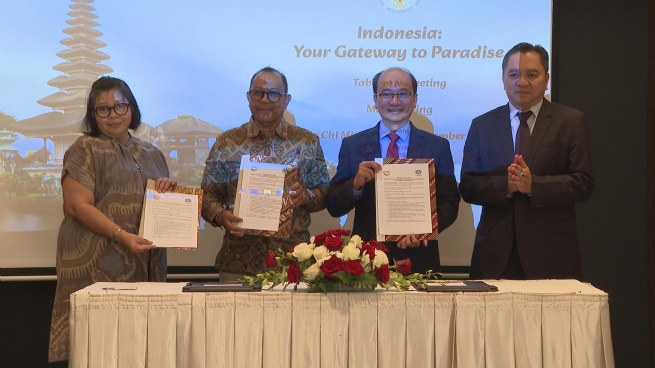
The MoU signed by the Indonesian Tour and Travel Association (ASITA) and the HCMC Tourism Association
People-to-people and educational exchanges: Foundation for strategic trust
Vietnam-Indonesia relations were shaped by the two countries’ shared aspirations for independence and their common vision for a peaceful and stable Southeast Asia. Since the establishment of diplomatic relations on December 30, 1955, President Ho Chi Minh and President Sukarno laid the foundation for a long-standing friendship between the two peoples. Their reciprocal visits in 1959 marked the start of deeper cooperation and created the basis for stable, long-term development of bilateral ties.
Bilateral cooperation mechanisms such as the Vietnam-Indonesia Joint Commission on Bilateral Cooperation (JCBC), together with later agreements on economic, cultural, and maritime cooperation, helped define a comprehensive partnership framework. This framework has become an essential political and diplomatic foundation for expanding people-to-people exchanges and tourism cooperation in the modern era.
Today, people-to-people exchanges continue to grow through academic and educational initiatives. Ho Chi Minh City Open University, in partnership with the Consulate General of Indonesia, has established the Bahasa Indonesia Culture and Language Club. This provides students with opportunities to engage more deeply with Indonesian culture, language, and local values.
Indonesia also maintains the BSBI Cultural and Arts Scholarship Program, which attracts many Vietnamese students to participate in traditional dance, musical instrument training, and performing arts programs in Yogyakarta, Bali, and Makassar. Major universities such as FPT and UEF continue to expand cooperation, building networks for faculty and student exchanges between the two countries.
At the same time, cultural and artistic exchange activities such as “Cultural Exchange - Art - Connecting Businesses Vietnam - Indonesia” have helped deepen mutual understanding and build stronger ties between the two business communities, bringing them closer to each nation’s cultural life. These initiatives have reinforced the foundations of people-to-people relations, making them an increasingly important contributor to the Vietnam-Indonesia Comprehensive Strategic Partnership.

The “Colors of Indonesian Culture” contest
Rapidly expanding tourism cooperation
As global tourism recovers, Vietnam and Indonesia are seeing strong momentum in their tourism cooperation. Speaking at a tourism promotion program in Jakarta, Ha Van Sieu, Deputy Director General of the Vietnam National Authority of Tourism, said that the two countries share significant cultural and natural similarities and are both committed to sustainable tourism development. This creates a broad foundation for deeper bilateral cooperation.
According to the Vietnam National Authority of Tourism, Vietnam welcomed more than 184,000 Indonesian visitors in 2024, confirming Indonesia as one of Vietnam’s emerging key tourism markets. During the first ten months of 2025, the number of Indonesian visitors to Vietnam increased by about 12.9% compared with the same period in 2024. Ho Chi Minh City alone welcomed approximately 79,677 Indonesian visitors, accounting for nearly half of all Indonesian arrivals to Vietnam.
Travel by Vietnamese tourists to Indonesia has also increased. Travel companies report growing demand for destinations such as Bali, Java, Yogyakarta, and Lombok, reflecting a shift toward resort, cultural, and spiritual tourism experiences in Indonesia.
Building on this trend, the expansion of direct flights between Hanoi and Jakarta, Ho Chi Minh City and Jakarta, and new connections to Bali/Denpasar has created major breakthroughs. With shorter travel times, tourism businesses in both countries can develop joint products such as Bali-Hanoi, Bali-Da Nang, and Bali-Ho Chi Minh City tour packages, targeting high-end leisure travelers, cultural and spiritual tourism segments, adventure travelers, and MICE customers.
Vietnamese and Indonesian cuisine also presents opportunities for developing cross-border tour packages that meet the leisure, cultural, and spiritual needs of Muslim travelers. Leveraging this strength can help tourism businesses enhance service quality, expand people-to-people engagement, and attract more international visitors, contributing to deeper bilateral tourism cooperation.
At international promotion events such as ASEAN Travel Exchange (TRAVEX) as part of the ASEAN Tourism Forum in Yogyakarta, Vietnam actively showcased its tourism products and the “Vietnam - Timeless Charm” brand, attracting strong interest from Indonesian media, businesses, and travelers. According to Ha Van Sieu, strengthening tourism cooperation “not only brings economic benefits but, more importantly, expands people-to-people connections, which are essential to building strategic trust and mutual understanding between the two countries.”
Recognizing the significant potential for cooperation, Director of GoldenTour Pham Tien Dung said that Indonesian visitor numbers to Vietnam continue to rise, especially among young travelers and families. “With more direct flights and service packages that meet Halal standards, we believe the market can grow strongly between 2025 and 2027. This is an ideal time for businesses in both countries to collaborate, develop new products, and enhance service quality.”
According to Dung, many Indonesian businesses are particularly interested in tours to Hanoi-Ha Long-Ninh Binh, Da Nang-Hoi An, and Ho Chi Minh City-Mekong Delta. Conversely, GoldenTour reported growing demand from Vietnamese travelers seeking leisure, cultural, and spiritual tourism experiences in Bali and Java.
Over the past seven decades, Vietnam-Indonesia relations have grown increasingly comprehensive and substantive, with education, culture, and tourism serving as strategic bridges. By continuing to tap into shared potential, bilateral cooperation is poised to deepen further, becoming even stronger and more enduring.
By Giang Tu, Vietnam Business Forum


 Vietnamese





