

2:34:09 PM | 12/19/2025

In the development journey of Dien Bien province, ethnic affairs and religious affairs have always been top priorities tied to the goal of strengthening national unity, maintaining political stability, and creating momentum for socioeconomic growth. The coming period requires updated management thinking, stronger coordination, and better use of the internal strengths of ethnic communities, along with the positive role of religious groups in community life.
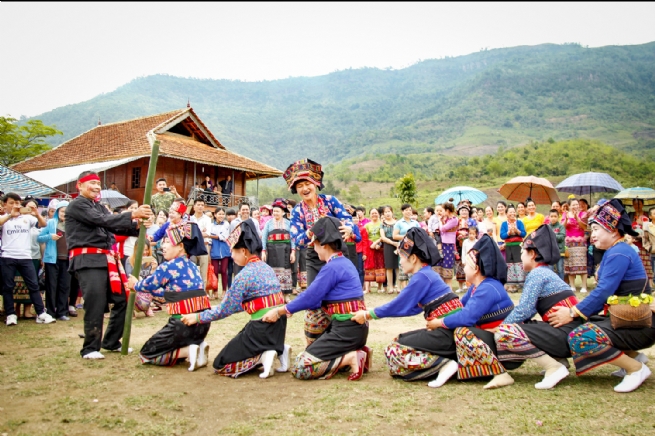
Bun Huoi Nam Festival of the Lao ethnic community in Dien Bien province
Core tasks in ethnic and religious affairs
Department of Ethnic and Religious Affairs was created when the former Provincial Committee for Ethnic Affairs took over the state management function for religious affairs from the Department of Home Affairs, and it officially began operations on March 1, 2025. This new model brings together two highly specialized fields, so the department identified rapid organizational stabilization and staffing as its top priorities.
The entire sector has reviewed operations, assigned clear tasks and responsibilities, and aligned duties with job positions to maximize each staff member’s capacity and prevent overlap. The department advised the Provincial People’s Committee to issue regulations on its functions, duties, and organizational structure, and reorganized its specialized divisions toward a streamlined and efficient model. Regular briefings have been maintained to strengthen administrative discipline and promptly address issues at the grassroots level.
At the same time, Department of Ethnic and Religious Affairs has focused on training and professional development, enhancing political awareness and state management skills among its staff. Internal unity is consistently emphasized, aiming to build a responsible and dedicated team capable of meeting task requirements in the new context.
According to Nguyen Thanh Son, Director of Department of Ethnic and Religious Affairs, the two-tier local government model is an important step toward administrative reform, streamlining operations, and improving state management efficiency. For ethnic and religious affairs, the new model enables more unified and centralized direction, shortens coordination processes among agencies, and enhances execution quality.
To ensure smooth operations, the department has implemented several key measures, such as strengthening guidance, inspections, and oversight of policy implementation at the grassroots level to ensure consistent execution of programs and initiatives. It has organized training courses on professional knowledge and skills for local officials working in ethnic and religious affairs, especially skills in citizen engagement and in handling ethnic and religious matters. In addition, the department has expanded the use of information technology in its two-way reporting system and maintains communication channels with commune and ward level officials to resolve emerging issues promptly.
“In addition, we work closely with the Vietnam Fatherland Front and socio-political organizations on public outreach and mobilization. We also strengthen inspection and supervision of policy implementation, and identify effective models to replicate. We remain committed to the principle of being close to the people, understanding the people, and serving the people, ensuring that every policy reaches the right beneficiaries and delivers real impact,” Nguyen Thanh Son emphasized.
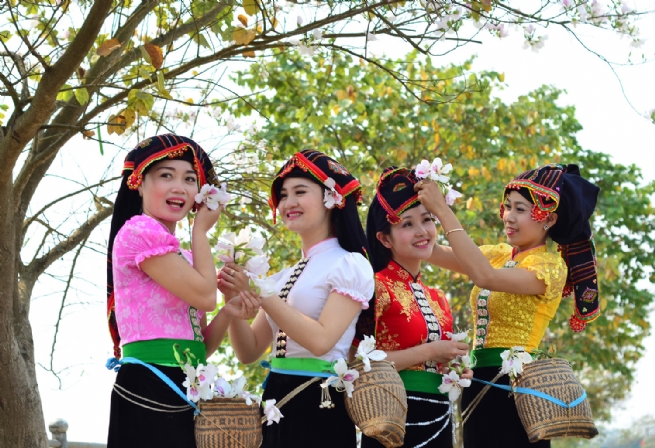
Young Thai ethnic women participating in the Ban (Bauhinia) Flower Festival in Dien Bien province
Expectations for the new period
Dien Bien Province has more than 82% of its population belonging to 19 ethnic minority groups. This is both a source of pride and a major responsibility for implementing ethnic policies comprehensively and sustainably.
In recent years, the province’s ethnic affairs have achieved significant results. The National Target Program for Development of Ethnic Minority and Mountainous Areas has been strongly implemented, with total resources for the 2021-2025 period exceeding VND4,714 billion. As of July 31, 2025, the disbursement rate had surpassed 72%. Infrastructure in ethnic minority areas has improved markedly. The share of paved roads leading to commune and village centers has reached 75%. The proportion of health stations meeting the Ministry of Health’s infrastructure standards increased from 76% in 2021 to an estimated 100% in 2025. The poverty rate among ethnic minority households fell from 44.95% in 2021 to 27.39% in 2024.
In addition, 94% of the population now uses clean and hygienic water. Living standards are steadily improving. Traditional culture is actively preserved and developed, with many community-based tourism models becoming successful highlights. Although challenges remain, self-reliance among ethnic communities has grown stronger. Many value chain-based production models have emerged, and local specialty products are increasingly accepted by the market.
For the coming period, the province will focus on five key tasks:
First, effectively implement phase two of the National Target Program for the 2026 to 2030 period, with priority given to raising household incomes.
Second, encourage the development of ethnic minority entrepreneurs and support start-ups and trade promotion activities.
Third, develop culture linked with sustainable tourism and transform cultural heritage into economic resources.
Fourth, modernize communication using digital technology and promote the role of respected community leaders.
Fifth, strengthen the development of ethnic minority officials who are capable, responsible, and committed to local development.
The ultimate goal is to improve the living conditions of ethnic communities, strengthen trust in the Party and the State, and build a prosperous and modern Dien Bien while preserving its traditional cultural identity.
Nguyen Thanh Son said that ethnic and religious affairs are closely connected to the spiritual life, customs, and beliefs of the people. This requires officials to possess both strong professional expertise and integrity, along with a respectful attitude. A sense of responsibility, scientific working methods, and a service-oriented approach are most effective when leaders set the example.
To build a disciplined, dedicated, and professional workforce, Department of Ethnic and Religious Affairs focuses on key tasks such as political education and public service ethics, while encouraging staff to stay close to the people and communicate openly with them. At the same time, it reinforces discipline and evaluates performance based on results and citizen satisfaction.
In parallel, the department promotes administrative reform and digital transformation to reduce processing time and improve service quality. Emulation movements must be practical and aligned with the department’s specific mission to strengthen ethnic unity and maintain religious security. It also emphasizes creating a modern and respectful working environment that values differences and fosters innovation.
“We believe that when every official understands the pride of this profession and the responsibility they carry for the community, Department of Ethnic and Religious Affairs will become a trusted institution for the people and will contribute to building a modern and service oriented public administration,” Nguyen Thanh Son added.
By Thai Duong, Vietnam Business Forum


 Vietnamese





