

2:38:30 PM | 1/19/2026

In the highly volatile garment and textile industry, where markets, labor, and supply chains change constantly, competitive advantage comes from more than scale or technology alone. With over 80 years of development, Garment 10 Corporation (Garco 10) has taken a different path by turning corporate culture into a long-term competitive strength. From disciplined operations to a workforce of nearly 12,000 employees, its culture is not just an identity, but a foundation for stability, adaptability, and lasting brand value.
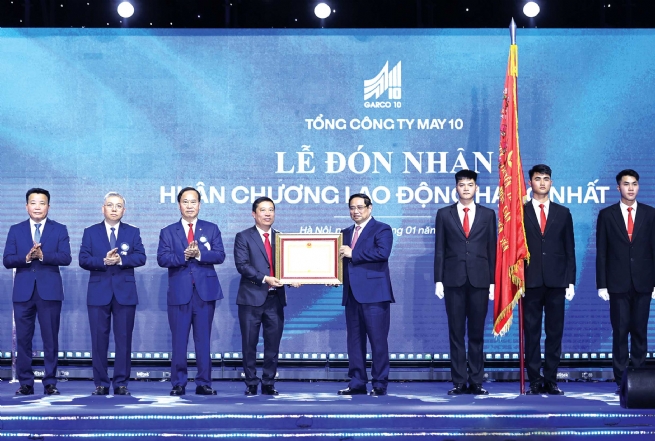
Disciplined operations
Established in 1946, Garco 10 began its development journey under unique conditions, where discipline, responsibility, and trust were formed as core values. For more than 80 years, these values have not been diluted by expansion or changes in governance models; instead, they have been preserved as the company’s operating backbone.
In the garment and textile industry - an area strongly influenced by market cycles, cost pressures, and global supply chain shifts - the ability to maintain organizational stability is a rare advantage. At Garco 10, discipline goes beyond regulatory compliance; it reflects consistency between commitments and actions, and between individual responsibility and collective credibility. This structured approach allows the company to sustain stable production, ensuring schedules, quality, and reputation through repeated periods of industry volatility.
Viewed this way, culture is no longer an abstract concept but an internal mechanism that guides and regulates operations. With a value system that is broadly shared and consistently applied, Garco 10 can adapt to change without undermining its core operating structure. This foundation enables the enterprise to remain resilient over the long term, rather than relying on short-term, reactive measures.
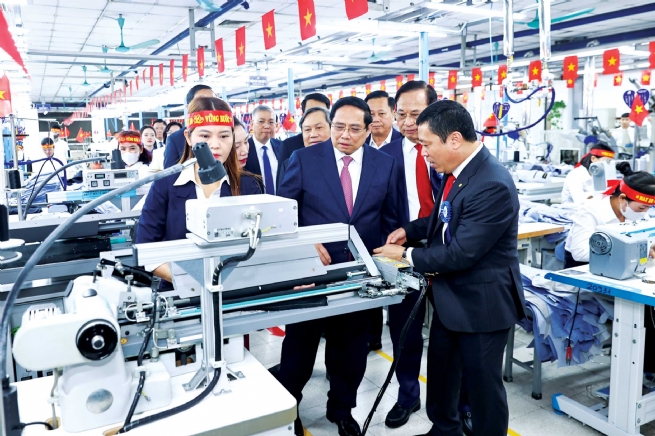
Prime Minister Pham Minh Chinh visits the factory of Garco 10, January 8
Human-centric culture: A competitive asset
Built on this disciplined framework, Garco 10 has cultivated a people-centric culture. Today, the company employs nearly 12,000 managers, staff, and workers across units nationwide. The true value, however, lies not in the absolute number but in the depth of employee commitment and workforce continuity - qualities that are rare in an industry characterized by high labor turnover.
The presence of families with two or even three generations working at Garco 10 reflects the depth of labor relations, where the enterprise and its employees are connected through long-term commitments. This continuity creates a distinctive form of organizational capital: skills accumulated over time, stable production discipline, and an institutional memory that helps sustain consistent quality standards.
This human capital delivers a competitive advantage that machinery or financial investment alone cannot replace. While many companies are forced to trade quality for speed in responding to volatility, Garco 10 can adjust flexibly without undermining its operational foundation. This capability underpins the company’s ability to maintain trust with domestic and international customers and partners - an essential requirement in global supply chains.
Importantly, stability in people and discipline does not hinder innovation at Garco 10. On the contrary, a strong cultural foundation creates a safe buffer for controlled innovation, spanning management thinking, technology adoption, process optimization, and improvements in labor productivity. Innovation at Garco 10 is therefore evolutionary rather than disruptive - a process of continuity and advancement that allows the company to adapt while preserving its identity.
From a strategic perspective, culture at Garco 10 is not merely a spiritual value or historical legacy; it is a core competitive capability, accumulated over time and translated directly into operational efficiency, market credibility, and brand strength. This intangible asset is difficult to replicate, yet decisive for the company’s resilience and its capacity for sustainable development amid deepening global integration.
By Ngo Khuyen, Vietnam Business Forum


 Vietnamese





