

9:37:21 AM | 3/27/2026

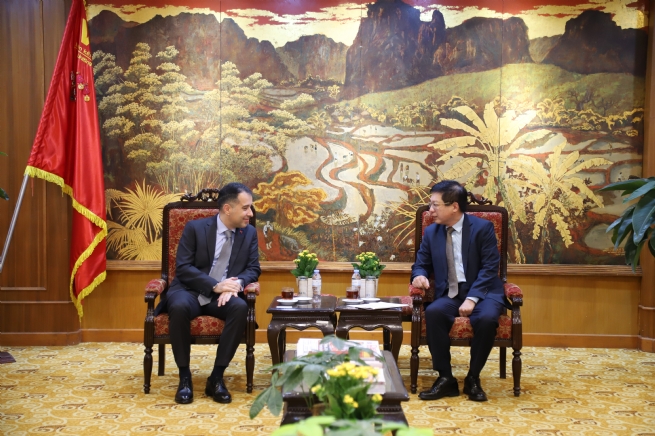
Economic cooperation between Vietnam and Turkey is opening up new growth opportunities, particularly in trade and investment. Concrete directions to advance bilateral ties in a more substantive, balanced and sustainable manner were outlined by President of the Vietnam Chamber of Commerce and Industry (VCCI) Ho Sy Hung and Turkish Ambassador to Vietnam Korhan Kemik at a recent working session at VCCI headquarters.
Strong ties and market opportunities
Speaking at the meeting, Ambassador Korhan Kemik highlighted steady progress in bilateral diplomatic and economic relations, emphasizing that high-level visits have strengthened political trust and laid the foundation for deeper economic cooperation.
In recent months, Turkey has stepped up high-level engagements with Vietnam, including the official visit by Minister of National Defense Yaşar Güler in September 2025. On the Vietnamese side, high-level exchanges have also continued, including the official visit to Turkey by Vice Chairman of Vietnam’s National Assembly Nguyen Duc Hai in September 2025. These engagements have strengthened parliamentary ties and supported expanding trade and economic cooperation. Both sides aim to further promote high-level exchanges to deepen bilateral relations.
According to Ambassador Kemik, bilateral trade has grown steadily but still falls short of its potential. Data shared at the meeting showed that two-way trade reached over US$2 billion in 2025, with Vietnam’s exports accounting for approximately US$1.6 billion. Both sides aim to expand trade further while moving toward a more balanced structure.
Turkey is currently the world’s 19th-largest economy, with nominal GDP of approximately
US$1.3-1.32 trillion and purchasing power parity (PPP) GDP of around US$3.6 trillion, supported by a population of about 86.4 million. Its diversified economic structure includes services (61%), industry (32%), and agriculture (7%). Beyond being a sizable domestic market, Turkey serves as a strategic gateway connecting Europe, the Middle East and North Africa, providing access to a broader regional market of roughly 1.5 billion people.
Meanwhile, Vietnam is emerging as one of Asia’s fastest-growing economies, with a population exceeding 100 million and per capita income of over US$5,000. VCCI President Ho Sy Hung noted that Vietnam is both an attractive consumer market and an increasingly important manufacturing and export hub within global supply chains.
Ambassador Kemik shared this view, describing Vietnam as a highly attractive investment destination in Asia. However, both sides acknowledged that limited awareness among businesses still constrains cooperation potential.
Strengthening business connectivity and two-way investment
Enhancing bilateral investment cooperation was identified as a key priority. As of now, Turkey has 36 active investment projects in Vietnam, with total registered capital exceeding US$1.7 billion, ranking 23rd among foreign investors in the country.
Notable projects include Hayat Kimya’s US$250 million manufacturing facility in Binh Phuoc province and Bora Lastik’s investment in Da Nang Rubber Company. Significantly, IC Içtaş, a subsidiary of IC Holding, leads the Vietur consortium that secured the VND35 trillion contract for construction and installation of the passenger terminal at Long Thanh International Airport, one of Vietnam’s flagship infrastructure projects.
The Turkish side also raised concerns over difficulties faced by its enterprises during project implementation and expressed a desire for continued support from Vietnamese authorities to address bottlenecks and improve the investment climate. According to Ambassador Kemik, around 30 Turkish companies are currently operating in Vietnam, while many others are closely watching the market before making investment decisions.
Conversely, Vietnamese investment in Turkey remains modest but promising. Leveraging its position as a bridge between Europe, the Middle East and North Africa, Turkey offers a domestic market of over 86 million people and a strategic platform for accessing broader regional markets. A potential cooperation model discussed involves Vietnamese firms partnering with Turkish companies to produce goods for export to third markets.
Both sides agreed to strengthen business connectivity through trade promotion activities, including seminars, business forums and networking events in both countries. In recent years, VCCI has worked closely with the Turkish Embassy to support the establishment of the Turkish Business Association in Vietnam (TurkCham), which serves as a bridge between the two business communities.
Another important agenda item is the signing of a Memorandum of Understanding (MoU) between VCCI and the Union of Chambers and Commodity Exchanges of Turkey (TOBB). The draft MoU has been submitted and is under review, and both parties expect it to be signed during upcoming high-level visits, providing a long-term framework for business cooperation.
At the conclusion of the meeting, both sides reaffirmed their commitment to close coordination in supporting businesses and promoting trade and investment, aiming to elevate Vietnam-Turkey economic relations in line with the potential of both economies.
Thu Huyen (Vietnam Business Forum)





 Vietnamese





