

9:04:06 AM | 4/6/2026

Lao Cai views culture not only as a spiritual foundation but also as an “internal resource, a powerful driving force, and a pillar” that strengthens the province’s competitiveness. Instead of relying on broad resource exploitation, the province has shifted to a growth model based on added value from heritage, identity, and people, elements that cannot be replicated.
Tran Son Binh, Deputy Director of the Lao Cai Department of Culture, Sports and Tourism, said: “When the role of culture is correctly understood, it creates a sustainable, distinctive, and long-term path for tourism and the local economy.”
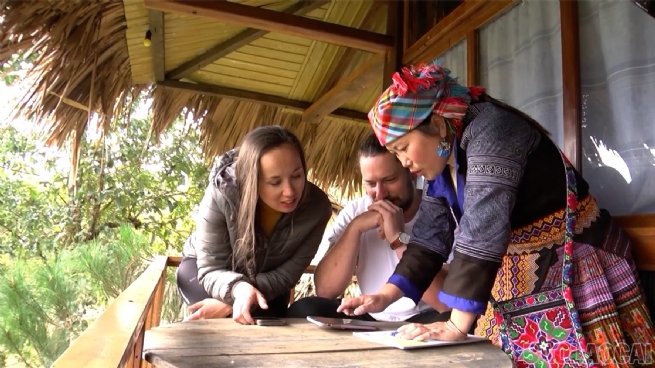
International visitors explore Lao Cai’s destinations and cultural identity through digital platforms in local villages
Turning heritage into assets - A strategic choice
Lao Cai possesses rich cultural heritage resources with strong diversity and ethnic identity, including 56 items of national intangible cultural heritage, four heritages recognized by UNESCO, and 207 historical and cultural relics at various levels. Yet the province has reached a clear conclusion: if preservation remains only protective, heritage will struggle to fully contribute to contemporary life. Lao Cai therefore chose a different approach, bringing heritage into everyday life and turning it into a resource for the creative economy and high-quality tourism.
The province has gradually turned the concept of linking cultural development with economic development into concrete actions, promoting both the preservation and the use of cultural heritage values to support tourism growth, while step by step forming an orientation that treats heritage as a development resource.
“We do not view heritage as a ‘display item’ but as a living resource. When heritage exists in harmony with the community and businesses, it naturally generates economic value, creates livelihoods for residents, and sustains the cultural space itself,” said Tran Son Binh.
In practice, during the 2021-2025 period, revenue from cultural tourism, festivals, and visits to historical sites grew steadily. In 2025 alone, Bao Ha Temple welcomed more than one million visitors and pilgrims; Cat Cat village tourism site received 500,000 visitors; and Bac Ha market attracted 600,000 visitors seeking cultural experiences. More importantly, the cultural values that have been “activated” have helped extend visitor stays and increase average tourist spending instead of focusing only on visitor numbers.
A distinctive feature of Lao Cai’s culture and tourism development strategy is community-based tourism linked with the preservation of traditional cultural spaces, in line with Resolution 11-NQ/TW on the development of the Northern Midlands and Mountainous Region. Cultural tourism destinations such as Cat Cat, Ta Phin, and Lam Thuong have shown clear results: local residents have become both the creators and the direct beneficiaries. In Cat Cat village alone, more than 98% of the workforce involved in tourism activities comes from families in the village. “Community tourism is truly sustainable only when culture is respected, the community benefits, and businesses act responsibly,” Tran Son Binh said.
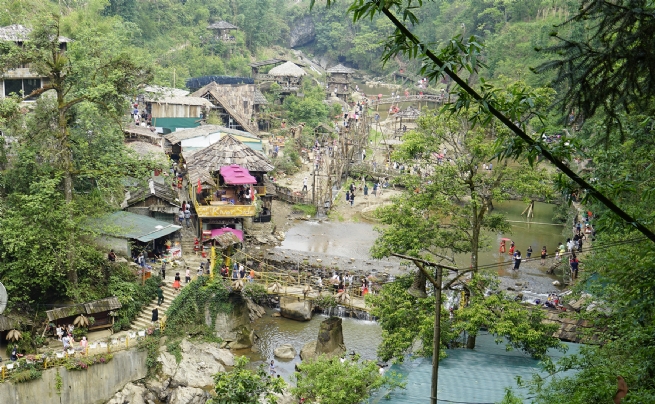
Thanks to efforts to preserve traditional cultural space, Cat Cat village attracts many domestic and international visitors
Culture plan for long-term growth
To translate central government orientations and resolutions into concrete actions, particularly Resolution 80-NQ/TW and newer directions for cultural development under current conditions, and to ensure culture truly becomes an internal resource and driver of development, Lao Cai province has been implementing a cultural and human development plan for the new period. The plan has a clear overall goal: to build a healthy cultural environment, effectively promote heritage values, and shape the people of Lao Cai into well-rounded individuals able to meet the demands of integration and sustainable development.
The plan identifies three central pillars: preserving and promoting cultural heritage values in connection with sustainable livelihood development for residents, gradually turning heritage into an important resource for socio-economic development; building the Lao Cai people of the new era with the qualities of “Solidarity, Patriotism, Discipline, Civility, Hospitality,” rich in identity, dynamic, creative, and open to integration; and developing cultural industries and cultural tourism into sectors that make an increasingly significant contribution to the province’s GRDP structure.
Based on this framework, the province has directed focused investment in cultural and sports infrastructure from the provincial level to grassroots communities in a coordinated and gradually modernized manner; strengthened the preservation, restoration, and promotion of representative traditional festivals; developed distinctive cultural and tourism products linked to specific subregions and ethnic communities; and encouraged businesses and other economic sectors to invest in cultural industries, performing arts, digital content creation, and digital transformation in the cultural sector.
The plan also assigns culture an important role in development governance, viewing it as the “glue” that connects government, businesses, and residents, and as a foundation for building a disciplined, cooperative, and creative society.
As part of implementing the National Digital Transformation Strategy, Lao Cai has identified digital transformation as a key breakthrough to raise the value of culture and tourism. To date, all of major tourism areas and destinations have Wi-Fi coverage and integrated cashless payment systems, while many historical sites have been digitized and equipped with QR codes.
During the 2021-2025 period, the tourism information portal recorded more than 1.55 million visits, Google Maps registered 8.6 million views, and the specialized YouTube channel exceeded 1.24 million views. These figures show that Lao Cai’s culture is being shared through the language of the digital era, reaching both domestic and international markets more effectively.
Beyond attracting visitors, culture and tourism also help shape Lao Cai’s image as a safe, friendly, and reliable destination for investors.
Entering the 2026–2030 period, Lao Cai aims to welcome 15 million visitors by 2030, generate VND70,000 billion (US$2.8 billion) in tourism revenue, contribute 17-20% of GRDP, and create around 80,000 jobs. Culture and tourism will continue to serve as key pillars alongside industry, logistics, and the border-gate economy.
Building on its cultural foundation, with innovative thinking and systematic implementation, Lao Cai is gradually strengthening its distinct identity on the development map, turning cultural advantages into internal strength and creating momentum for a green, harmonious, identity-rich, and prosperous future.
By Trinh Long - Ha Thanh, Vietnam Business Forum


 Vietnamese





