

9:11:01 AM | 4/8/2026

Amid the strong momentum of tourism development across Vietnam in general and Lao Cai Province in particular, Cat Cat village in Sa Pa ward, a small village nestled along the slopes of the Hoang Lien mountain range, has been telling a story distinctly its own: a journey of preserving identity, placing people at the center, and building a sustainable, happy community.
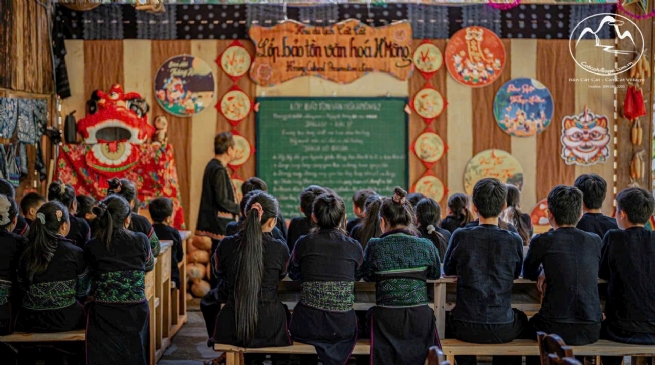
Deputy Director Nguyen Trung Kien encourages students in a cultural preservation class organized by the company
This approach also reflects how Cat Cat One Member Co., Ltd. has brought to life the spirit of Resolution 33-NQ/TW on building and developing Vietnamese culture and people to meet the requirements of sustainable national development, while also putting into practice the Cultural Development Strategy toward 2030 and Lao Cai Province’s sustainable tourism development programs.
Nguyen Trung Kien, Deputy Director of Cat Cat One Member Co., Ltd., shared a perspective that has guided the village’s formation and growth: “Culture is the foundation, people are at the center, and tourism is simply a means to preserve, spread, and enrich the Mong people’s cultural values.” This model also aligns with the philosophy that Chairwoman Nguyen Phuong Lan has consistently followed for the past 16 years.
From a poor village to a self-reliant, prosperous community
Cat Cat was once a poor highland village. The village had 102 households with about 500 residents, steep terrain, and almost no infrastructure; livelihoods relied mainly on hillside farming. From an initial workforce of 25, the company has now created stable employment for 250 local staff and workers, including elderly artisans, women, young people, and children.
| “We have traveled to many places, but Cat Cat gives a very different feeling. Everything here is not forced; it feels very natural and very charming. Culture is not something staged for display; it is part of everyday life. What we will remember most is the friendliness and the pride local people have in their culture. We hope this place will continue to be preserved this way, because these are very rare values,” shared Wen Mengsi and Su Yuning, Taiwanese visitors to the Cat Cat Tourist Area. |
As of now, Cat Cat no longer has poor households. There is no longer any harassment of tourists, begging, or street vending. The village is clean and orderly with stable social conditions, and many families have purchased cars, acquired valuable assets, and renovated their homes in ways compatible with tourism.
The fundamental distinction of the Cat Cat model lies in this: culture is not “displayed” as a static artifact but renewed, practiced, and shared within the daily life of the community.
Traditional Mong crafts such as hemp spinning, weaving, indigo dyeing with beeswax, brocade embroidery, blacksmithing, and silver jewelry making have not only been preserved but have also become real livelihoods, generating stable income for residents.
In particular, the live outdoor performance “The Cat Cat Show” serves as a vivid example of creative, humane, and sustainable tourism. Everyday Mong activities, from working the fields and wedding customs to playing the khene and spinning hemp, are recreated by local villagers themselves, not staged in a distant or artificial way but presented with closeness and authenticity. There is no longer a divide between audience and performers, between guests and hosts; instead, there are radiant faces, extended circles of arms, and a feeling that everyone carries away: a moment that is unmistakably Vietnamese, unmistakably Cat Cat, and deeply touching for visitors.
“We do not choose professional actors. The villagers themselves, from elderly people to young adults and children, are the ‘soul’ of these cultural values,” Nguyen Trung Kien added.

Cultivating people from the roots for cultural preservation and sustainable social welfare
One of the most distinctive and humane values pursued by the Cat Cat model is placing people at the center, viewing cultural preservation not only as a responsibility but also as a way to create livelihoods and build a future for children in the village.
The Mong Ethnic Cultural Preservation Class was established in response to the problem of children leaving school to sell goods or ask tourists for money. The company made a decision: “If culture is to live, children must first be nurtured from the roots.”
Here, children learn the Mong script, traditional musical instruments, beeswax painting, and brocade weaving. More importantly, they gain confidence that their culture is worthy of respect and pride through lyrics in the songs “Nguoi Meo On Dang” and “Bon Phuong Troi” (“Mong People Are Grateful to the Party” and “All Corners of the World”), performed in three languages: Vietnamese, Mong, and English.
Each day they attend class, the children receive support of VND100,000 per day; they have a proper lunch and wear uniforms representing their own ethnic culture.
Ma A Minh, a 13-year-old Mong student, shared: “I have studied here for three years. It takes about two days to complete a beeswax painting. I can learn a craft while also earning some income to help my family, and I hope to stay connected with the village and the company for a long time.”
Tourism linked to social responsibility and international integration
Beyond cultural preservation, Cat Cat One Member Co., Ltd. has also demonstrated a clear sense of social and humanitarian responsibility as a business: proactively accepting people who have completed prison sentences, providing lifelong support for people with disabilities who cannot work, and actively assisting local authorities in efforts related to site clearance, rural road construction, and the repair of schools and medical stations.
Nguyen Phuong Lan, Chairwoman of the company’s Members’ Council, said: “We are not simply operating a tourism business. We are working together with local residents to build a happy village, where every person has a job, an income, confidence, and serves as an ambassador for their own village.”
At a time when Vietnam already has several villages recognized by UN Tourism as “Best Tourism Villages,” she said Cat Cat still has considerable potential to further develop the distinctive cultural values of the Mong people while moving toward international standards without losing its identity.
Cat Cat has been studying the expansion of evening and nighttime tourism products while continuously renewing visitor experiences to meet the diverse flow of travelers from Europe, the United States, Japan, South Korea, China, and Taiwan (China).
By Ha Thanh - Trinh Long, Vietnam Business Forum


 Vietnamese





