

9:20:02 AM | 4/22/2026

As artificial intelligence (AI) reshapes economies and societies rapidly, Vietnam is stepping up efforts to develop the digital economy as a core driver of growth. Against this backdrop, the International Conference on “Digital Economy in the Era of Artificial Intelligence”, organized by Hanoi Open University on April 21, 2026, in Hanoi, brought together leading scholars, policymakers, and practitioners to discuss the institutional reforms, innovation, and human capital strategies needed for a more resilient, inclusive, and sustainable digital future.
Vietnam is entering a critical phase in its development trajectory, where digital transformation is no longer optional but necessary to sustain growth and enhance global competitiveness. Across sectors, from manufacturing to services and public governance, digital technologies and data-driven models are reshaping how value is created, delivered, and used.
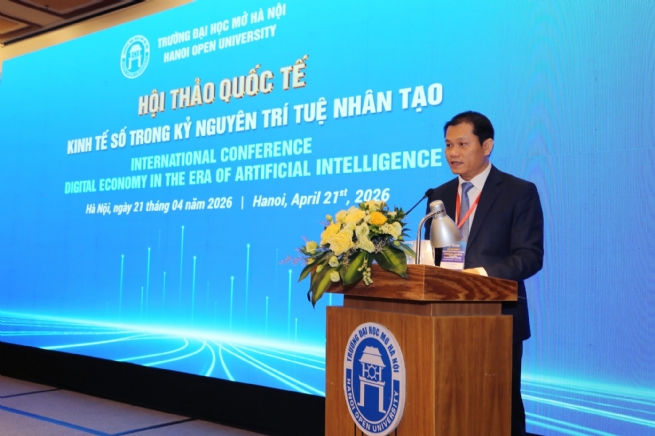
Dr. Bui Thanh Son, Vice President of Hanoi Open University
Experts noted that this transformation is not simply about adopting new technologies, but about reshaping how the economy works. It requires a shift in mindset, new institutional frameworks, and stronger coordination between the government, businesses, and academia.
At a recent high-level academic forum, these issues were highlighted. In his remarks, Dr. Bui Thanh Son, Vice President of Hanoi Open University, emphasized that the digital economy has become a key pillar of productivity growth and sustainable development.
He pointed out that AI, digital platforms, and data-centric technologies are fundamentally changing how firms innovate and how societies create and share value. In this context, understanding and managing this transformation is both an academic challenge and a strategic priority.
The strong academic engagement surrounding these discussions shows their urgency. A total of 86 research papers were submitted by scholars and research institutions, with 68 selected for publication after a rigorous peer-review process. Ten outstanding papers were presented at the conference, along with a keynote policy address offering insights into digital economic development and AI governance.
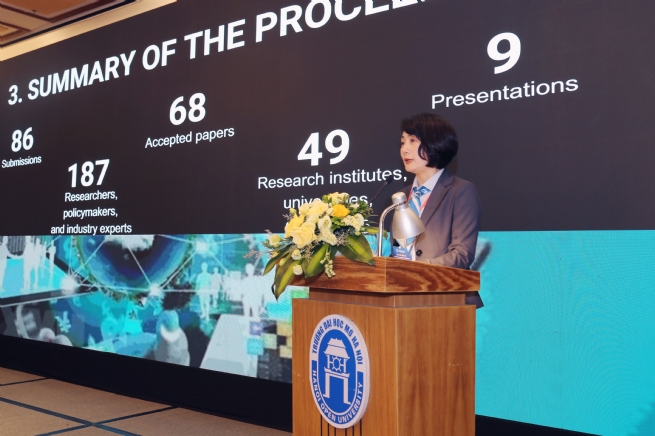
The conference program featured plenary discussions on policy frameworks, digital marketing innovation, and building an open and inclusive digital society. Two thematic sessions further explored institutional frameworks, digital infrastructure, international cooperation, and human capital in the digital age.
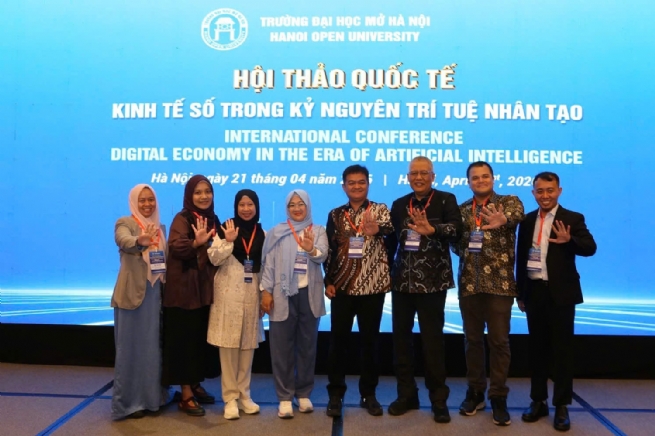
Turning Vision into Action in Digital Economy
A central theme emerging from the discussions is the importance of institutional reform in enabling digital transformation. While Vietnam has made significant progress in developing policies and legal frameworks, the challenge now lies in turning them into effective action. At the policy level, Mr. Nguyen Huy Dung, Alternate Member of the Party Central Committee and Full-time Member of the Central Steering Committee for the Development of Science, Technology, Innovation and Digital Transformation, underscored that Vietnam is entering a pivotal phase in its digital transformation journey. He emphasized that the digital economy is no longer viewed merely as a supporting element of digital transformation, but as a strategic driver of growth, productivity, and national competitiveness. In this context, Vietnam has set a target for the digital economy to account for around 30 percent of GDP by 2030.

Mr. Dung also noted that Vietnam has built a relatively comprehensive legal and policy framework for digital development, comprising 17 major legal documents, including laws, resolutions, ordinances, and decrees. Yet the central challenge now lies not in formulating new policies, but in strengthening implementation capacity so that policy orientations can be translated into tangible and measurable outcomes at the local and enterprise levels.
He further highlighted four foundational pillars of the digital economy: a development mindset that recognizes digital technologies as a core growth engine; data as a strategic resource and a matter of national sovereignty; institutions that ensure legal clarity, statistical consistency, and policy coherence; and implementation capacity that converts strategic orientation into real productivity and economic value. Taken together, these pillars suggest that the digital economy should be understood not simply as a technological trend, but as a broader transformation in Vietnam’s development model.
Bridging Gaps and Enhancing Competitiveness
Beyond macro-level policy discussions, the conference also highlighted practical challenges faced by businesses, particularly in cross-border e-commerce. A research paper presented by Nguyen Ngoc Minh An from Hanoi Open University examined Vietnam–China cross-border e-commerce from the perspective of policy asymmetry.

The study found that differences between the two countries extend beyond market size to include variations in regulatory frameworks, strategic priorities, and policy instruments. These factors shape logistics efficiency, compliance capacity, and overall competitiveness.
China has developed a highly integrated ecosystem supported by digital customs systems, pilot zones, bonded warehousing, and export-oriented logistics networks. In contrast, while Vietnam has made progress in legal recognition, consumer protection, and platform taxation, its governance structure remains more fragmented.
To address these gaps, the research identified three key policy priorities: improving interoperability between data systems, tax frameworks, and digital platforms; developing near-border warehousing and smart logistics solutions; and implementing single-window data exchange mechanisms.
Importantly, the study suggests that Vietnam does not need to replicate China’s model entirely. Instead, it should focus on reducing critical policy asymmetries, enabling small and medium-sized enterprises to compete based on compliance, traceability, and service quality rather than price alone.
Participants also emphasized that strengthening competitiveness in the digital economy requires sustained investment in digital infrastructure, innovation ecosystems, and workforce skills. At the same time, international cooperation will play an increasingly important role as digital markets become more interconnected.
Looking ahead, experts expressed optimism about Vietnam’s prospects. With a dynamic economy, a growing digital ecosystem, and strong political commitment to digital transformation, the country is well positioned to play a more active role in the global digital economy.
However, realizing this potential will depend on the ability to strengthen institutions, improve policy implementation, and ensure that digital transformation delivers inclusive and sustainable benefits across society.
By fostering dialogue and collaboration among stakeholders, the conference reaffirmed the important role of academia in shaping policy and advancing knowledge, helping to chart the path toward a more innovative, resilient, and inclusive digital future.
Nguồn: Vietnam Business Forum
 April 24–25, 2026
 Kinh Bac Cultural Center, Bac Ninh Province


 Vietnamese





