

11:16:17 AM | 4/28/2026

Bac Ninh is reshaping its investment attraction strategy in a more selective direction, using fiscal and budget policy as a tool to create a transparent and competitive environment, while strengthening its role in supporting investors throughout the project lifecycle. According to Vu Thi Phuong Thao, Deputy Director of the Bac Ninh Department of Finance, this approach is intended not only to improve the efficiency of capital attraction but also to lay the foundation for sustainable growth with broader spillover effects.
How will Bac Ninh’s fiscal and budget policies be designed to support investment attraction and help shape FDI flows toward higher value-added and spillover-oriented projects?
In the coming period, Bac Ninh sees state fiscal and budget policy not only as a tool for managing revenue and expenditure, but also as a means to create a transparent, stable, and competitive investment environment. On that basis, the province is implementing coordinated solutions to both attract capital effectively and proactively screen and select projects with high quality, high added value, and strong spillover potential for the economy.
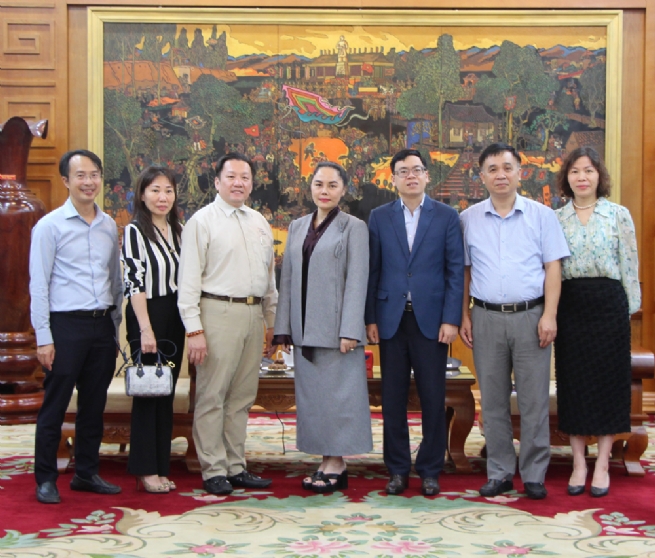
Deputy Director of Provincial Department of Finance Vu Thi Phuong Thao (center) meets with investors
First, the province continues to fully and promptly implement business support policies, especially tax extensions, exemptions, reductions, and land rent relief. At the same time, it is reviewing the entire system of investment incentives in the province to adjust and improve them in a more transparent, accessible, and competitive direction compared with other localities in the region.
The province’s approach is not to attract investment at any cost, but to focus on selectivity, prioritizing large-scale projects with high technology content, modern governance, meaningful budget contributions, high-quality job creation, and strong integration into global value chains.
At the same time, administrative reform in the financial sector continues to be treated as a breakthrough area. The province is focusing on cutting and simplifying procedures related to taxation, customs, and land to create the most convenient conditions for enterprises. These efforts are being carried out consistently to improve the business environment and enhance provincial competitiveness in line with Government direction. Shorter processing times and lower compliance costs not only help enterprises save resources but also improve the appeal of the investment environment.
A key focus is the stronger use of information technology in fiscal, budget, and tax management. Bac Ninh is implementing coordinated solutions such as electronic tax declaration and payment, electronic tax refunds, electronic invoicing, and online business registration. This is gradually creating a modern, transparent management environment that reduces direct contact and improves management efficiency, a factor highly valued by foreign investors.
In addition to direct fiscal policies, the province is giving special attention to human resource development, a key factor in investment quality. In 2025, the Bac Ninh People’s Council issued Resolution 113/2025/NQ-HDND on vocational training support and human resource development in semiconductors, artificial intelligence (AI), and digital technology for the 2025-2030 period. The 2026 budget allocates about VND26 billion (US$1.04 million) for international cooperation programs and high-quality workforce training. This is a strategic step that not only meets the needs of major investors but also improves local labor quality, creating a foundation for sustainable development.
With a coordinated approach from institutional improvement and administrative reform to human resource development, Bac Ninh is gradually shifting from an “investment attraction” mindset to a more selective and supportive approach toward investors.
How will the province design mechanisms to mobilize and allocate resources to ensure infrastructure and industrial park projects are implemented on schedule?
Bac Ninh defines a clear guiding principle: public investment is not only a budget spending tool but also serves as “seed capital” to lead and activate private and FDI capital flows.
In 2026, with total planned capital of about VND16,500 billion (US$660 million), the province has allocated funds from the beginning of the year in a focused and targeted way, prioritizing key sectors such as transport, healthcare, and education, which form the foundation for improving the investment environment.
In particular, the province is concentrating resources on key regional connectivity infrastructure projects such as the Hanoi Ring Road 4, Kenh Vang Bridge, and inter-provincial transport routes. These projects not only expand development space but also improve connectivity, reduce logistics costs, and strengthen competitiveness, thereby becoming a natural draw for investors.
In implementation, the province has accelerated investment since the beginning of the year, assigned clear responsibilities to each level and sector, and flexibly managed capital plans to promptly reallocate resources to projects with strong implementation capacity.
Bottlenecks in land clearance, investment procedures, and construction material supply are being actively addressed. At the same time, administrative reform is being pushed forward to shorten project timelines, improve transparency, and increase investment readiness.
Alongside state budget resources, the province continues to promote public-private partnership (PPP) and socialized investment, thereby maximizing the effectiveness of “seed capital.” Bac Ninh’s viewpoint is that public investment must go one step ahead to create new development space and attract high-quality capital.
In the current period, how will Bac Ninh innovate its investment promotion activities?
As investment competition shifts from scale to quality, Bac Ninh sees innovation in investment promotion as essential to improving growth quality.
After administrative consolidation, Bac Ninh now has a larger scale in terms of space, population, and resources, creating opportunities to restructure investment promotion strategies in a more systematic, in-depth, and effective way.
The core change is a shift from “inviting investment” to “proactively selecting investors and preparing the necessary conditions for them.” Promotion activities focus on priority sectors such as high technology, semiconductors, electronics, digital technology, and modern logistics, targeting large corporations with strong financial and technological capacity.
The province is focusing on preparing coordinated foundational conditions, especially land availability and industrial infrastructure. Bac Ninh currently has 39 industrial parks, 64 industrial clusters, and 99 social housing projects, providing favorable conditions for both investors and workers.
Key infrastructure projects such as Gia Binh International Airport are being implemented alongside the development of urban areas, high-tech industrial zones, R&D centers, and logistics hubs.
At the same time, promotion methods are being refined in a more focused and in-depth direction, with attention to global capital flow trends and the use of existing enterprises as an effective communication channel. Dialogue and partnership mechanisms with enterprises continue to be maintained, helping build trust and long-term engagement.
After attracting large-scale investment projects, how will Bac Ninh monitor and support them to ensure proper implementation progress and real effectiveness?
Bac Ninh sees monitoring, evaluation, and investor support as a continuous process to ensure project progress, efficiency, and spillover impact.
Supervision is carried out through reporting systems in line with Ministry of Finance regulations, combined with online and periodic reporting to update and consolidate data for management. Relevant agencies closely monitor legal compliance, project progress, land use, and environmental protection.
The Department of Finance has been assigned to study the development of a project monitoring software system to improve connectivity and management efficiency from approval to operation.
Evaluation is conducted throughout the entire process, from advisory stages to investment decisions. Comprehensive assessments are carried out on financial capacity, funding plans, and socio-economic efficiency as a basis for consideration by competent authorities. During implementation, periodic evaluations continue to allow timely adjustments or handling of violations.
In terms of support mechanisms, the province has established multi-channel systems for receiving and handling information, including online platforms, hotlines, periodic dialogues, and business associations. Feedback is classified and resolved promptly; issues related to mechanisms and policies are compiled and submitted to competent authorities for consideration.
In addition, Bac Ninh focuses on developing the business ecosystem, supporting domestic enterprises in improving capacity and participating more deeply in FDI supply chains, thereby increasing localization rates and competitiveness.
With a coordinated approach from policy design to implementation, Bac Ninh is gradually ensuring that investment projects are not only on schedule but also deliver real effectiveness and sustainable spillover impacts.
Thank you very much!
By Vietnam Business Forum


 Vietnamese





