

11:02:00 AM | 1/19/2026

Since July 1, 2025, Bach Long Vi Special Zone has officially operated under a special administrative model, marking a key milestone in Hai Phong’s maritime and island development strategy. Situated in open waters and formerly a “living milestone” for strategic sovereignty, the zone is now poised to become a hub for the marine economy, fisheries logistics, and renewable energy, in line with guidance from Party General Secretary To Lam.
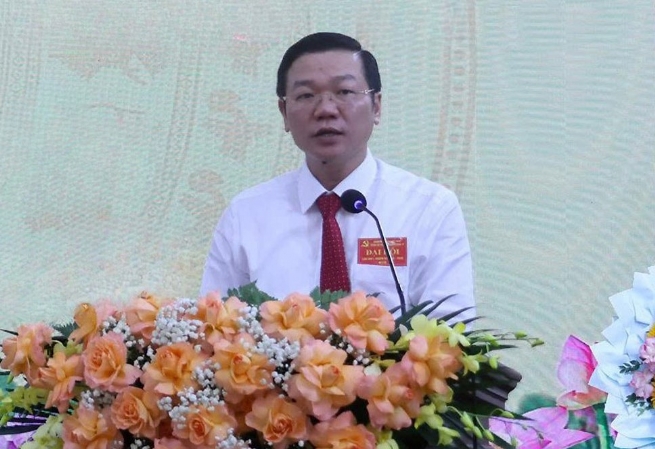
To learn more about the vision, strategic priorities, and ambition to make Bach Long Vi a model of sustainable development, our reporter interviewed Dao Minh Dong, Chairman of the Special Zone People’s Committee.
 |
How do you assess the strategic significance of the special administrative model at Bach Long Vi for Hai Phong’s maritime and island development vision and the national agenda?
The shift of Bach Long Vi’s governance to a special administrative and economic model is more than an administrative adjustment; it demonstrates political resolve and strategic vision for harnessing maritime potential. At the national level, Bach Long Vi occupies a relatively independent position in the Gulf of Tonkin, playing an important role in sovereignty, maritime security, and resource management. The special zone model enables flexible governance, rapid adaptation to marine economic development needs, and strengthened management capacity to ensure security and defense in maritime areas, as directed by the General Secretary. Locally, as a “new growth pole,” Bach Long Vi is set to become a gateway and key anchor for Hai Phong’s fisheries, logistics, and marine energy value chains over the coming decade.
Bach Long Vi is expected to become a new growth center linked to the marine economy, fisheries logistics, and renewable energy. To realize this vision, which priority tasks and projects have been identified?
Following General Secretary To Lam’s guidance, we have identified three pillars of sustainable development for urgent implementation:
First, critical infrastructure development: completing safe harbors for vessels, upgrading water and power systems (prioritizing clean energy, microgrids combining solar panels and offshore turbines), and digital infrastructure to enable remote management.
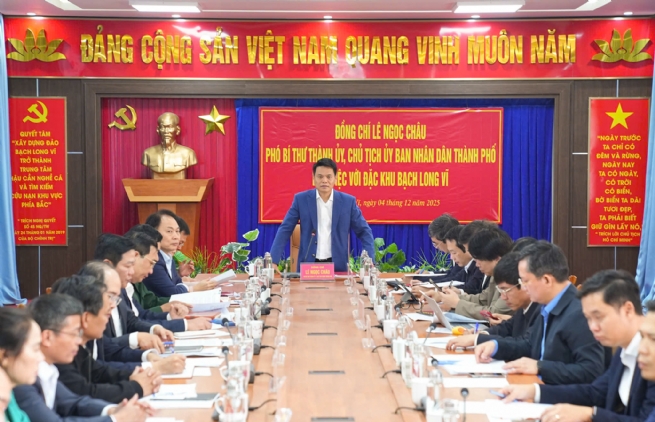
Chairman of Hai Phong People’s Committee Le Ngoc Chau directs Bach Long Vi to focus on completing three pillars of sustainable development
Second, fisheries logistics and marine services: building specialized small ports, processing facilities, cold storage, and logistics service chains to enhance fisheries value and reduce post-harvest losses.
Third, investment in renewable energy and marine technology: promoting sustainable aquaculture, high-value processing, and controlled eco-tourism projects. These priorities are paired with programs to enhance local workforce capacity, business support policies, and administrative reform to create a transparent investment environment.
Bach Long Vi holds special significance for defense, security, and maritime sovereignty. How do you assess the need to combine economic development with ensuring maritime security and safety in implementing the special zone model?
This relationship is inseparable. Security and sovereignty provide the foundation for marine economic development, while sustainable economic growth and improved local livelihoods, in turn, strengthen security. We will carry out maritime spatial planning that integrates security considerations, clearly zoning areas for economic development, military use, and safe navigation. Close coordination with border guards, the navy, and coast guard forces will ensure effective patrolling and monitoring, supported by continuous maritime surveillance technology to detect and respond promptly to incidents. Economic development will be pursued alongside disaster resilience measures to ensure safety at sea.
One of the major expectations for the special zone is to create a transparent and attractive investment environment. What breakthrough mechanisms and policies will be implemented to attract investment and promote innovation?
We are completing a framework of incentives covering taxes, land, and administrative procedures, ensuring transparency, efficiency, and compliance with national laws. Specific directions include: (1) an integrated “one-stop” mechanism for online processing of investment procedures; (2) time-bound incentives for strategic investment projects in renewable energy, high-end seafood processing, and green logistics; (3) support to connect marine tech startups with funds, research institutes, and international partners; (4) experimental sandboxes for marine technology, energy, and port management to test initiatives for later scaling. All aim to reduce market entry costs, accelerate project implementation, and ensure balanced benefits for investors, communities, and the environment.
Within Hai Phong’s development space for 2025-2030, how do you envision the role and position of Bach Long Vi Special Zone? What contributions are expected toward green growth, sustainable marine economy, and deep international integration?
I believe Bach Long Vi will be positioned as Hai Phong’s “green marine economic and ecological hub”: a logistics gateway for nearby waters, a small but specialized center for high-quality seafood processing, and a site for coastal renewable energy projects. For green growth, we pursue a circular development model, reducing environmental impact, preserving marine ecosystems, and combining controlled eco-tourism to increase value. For integration, Bach Long Vi will open to international cooperation in marine science, port technology, clean energy, and specialized workforce training. Sustainable development of the zone will contribute to regional production growth, create jobs for local residents, and strengthen Hai Phong’s position on the national and regional marine economic map.
Thank you very much!
Ha Thanh (Vietnam Business Forum)
 April 24–25, 2026
 Kinh Bac Cultural Center, Bac Ninh Province


 Vietnamese





