

11:38:40 AM | 4/28/2026

In the wave of global supply chain restructuring, Bac Ninh is emerging as a strategic destination for new-generation foreign direct investment (FDI) flows. With cumulative FDI exceeding US$25 billion and contributing about 70-75% of export turnover, Bac Ninh is no longer only a manufacturing base. It is steadily becoming a center for transit, coordination, and value creation within the regional industrial ecosystem. Behind this shift is a structured strategy for urban spatial planning and transport infrastructure development.
Restructuring urban space to address growth pressure
Bac Ninh currently has 16 planned industrial parks, with key zones such as Yen Phong, Que Vo, and VSIP reaching occupancy rates of 85-95%. Development space is therefore under increasing pressure, particularly as the migrant population in industrial areas grows by an average of 8-10% per year, in some places two to three times higher than the resident population.
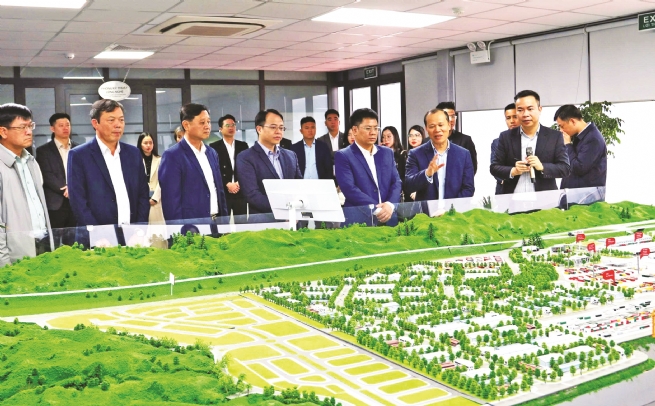
In this context, the Bac Ninh Provincial Planning for the 2021-2030 period, with a vision to 2050, has defined a development model based on multi-polar, integrated, and compact growth, shifting from spatial expansion to optimizing land use efficiency.
Nguyen Viet Hung, Director of the Bac Ninh Department of Construction, said that construction infrastructure in the new phase should play a more proactive role, not only meeting development demand but also shaping economic spatial structure. Under this orientation, each industrial park is not seen as an isolated production area but as an organic part of the urban and service system, forming integrated development complexes.
In practice, in Tu Son, a gateway urban area to the west, the development of urban service zones linked to industrial parks has helped reduce housing and transport pressure while creating an attractive living environment for foreign experts. Similarly, in Yen Phong, where major technology corporations are concentrated, social housing and new urban projects covering dozens of hectares are being developed, helping retain a high-quality workforce.
If urban development in Bac Ninh previously focused mainly on housing demand, the criteria have now shifted toward improving quality of life and building urban identity.
The share of land allocated to green space and water surfaces in new urban areas is being raised to 10-15%, approaching standards of a first-tier urban area. Major projects integrate public facilities such as schools, hospitals, shopping centers, and community spaces.
A typical example is new urban areas where street networks are developed in a synchronized manner, technical infrastructure is placed underground, and pedestrian spaces are combined with modern urban landscaping. This not only improves the urban appearance but also increases property values and investment attractiveness.
Expanding space and a “dual growth engine”
Transport infrastructure is the strongest driver helping Bac Ninh overcome spatial development limits. The province currently has one of the highest road densities in the country, with a system of national and provincial roads providing strong connectivity to Hanoi and neighboring provinces.
In particular, the Ring Road 4 project of the Capital Region (Hanoi and surrounding provinces), with total investment of about VND85,000 billion (US$3.4 billion), is expected to create a new development axis upon completion. The section passing through Bac Ninh alone, more than 35 km long, will open thousands of hectares for urban and industrial development and reduce travel time to Noi Bai Airport to 30-40 minutes.
Alongside this, the Hanoi-Bac Ninh expressway, Noi Bai-Ha Long expressway, and the system of provincial roads and inner-city ring roads are being upgraded, helping reduce logistics costs, which account for 15-20% of business production costs.
A practical example is the transport of electronic components from factories in Yen Phong to Hai Phong Port, which now takes about 2-2.5 hours, 30-40% faster than before. This helps FDI enterprises optimize supply chains, reduce inventory, and improve responsiveness to global orders.
Beyond transport, Bac Ninh is moving toward developing a modern logistics ecosystem. According to its orientation, by 2030 the province will establish regional logistics centers serving as cargo transit hubs connecting Hanoi, Hai Phong, Quang Ninh, and industrial provinces in the north.
Toward a centrally governed city: challenges and opportunities
Bac Ninh aims to become a centrally governed city before 2030, an ambitious target with a solid foundation. The province’s urbanization rate has already exceeded 45%, higher than the national average, and is expected to continue rising in the coming years.
However, to meet the criteria for a first-tier urban area and centrally governed city, Bac Ninh still needs to complete key technical and social infrastructure components, from public transport and environmental treatment to high-quality healthcare and education systems.
From a governance perspective, the challenge lies not only in resources but also in how resources are allocated and used effectively through scientific, coordinated, and long-term planning, which is currently a key focus of the province.
Overall, Bac Ninh is carrying out a comprehensive spatial restructuring, in which urban architecture, planning, and transport infrastructure not only support development but also drive growth. This is not merely an expansion in scale but an upgrade in development quality, from a production hub to a “strategic connectivity hub” in the global FDI supply chain, where modern infrastructure, livable urban space, and a dynamic, sustainable economic ecosystem converge.
By Vietnam Business Forum


 Vietnamese





