

1:30:13 PM | 4/28/2026

After more than 20 years of development, Thang Long Packing Import - Export and Production Joint Stock Company (TL Packing) has expanded its capabilities, integrated into the FDI supply chain, and shifted to a data-driven operating model, enhancing its management capacity. Through digitalization and real-time control, the company has reduced errors, improved stability, met the requirements of FDI clients, and positioned itself for global expansion. These insights were shared by Nguyen Minh Ngoc, General Director of TL Packing, in a conversation with our reporter.
In your view, what turning point truly changed the quality of the enterprise?
Over more than 20 years (since 2005), TL Packing has gone through several distinct transformation phases.
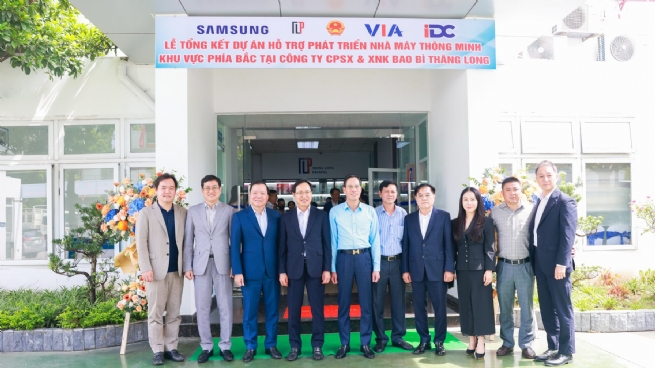
A delegation of experts pays a working visit to TL Packing
The initial phase focused on expanding capacity through investment in factories, machinery, and human resources to meet market demand. This stage increased “quantity” but did not fundamentally change operational methods.
After 2010, when joining the FDI supply chain, the company entered a standardization phase. Becoming a partner of FDI enterprises required TL Packing to upgrade its entire system to international standards, from product quality and control processes to transparency and traceability. This marked a shift from a domestic production mindset to operations aligned with global standards.
The most significant turning point was the transition to a data-driven operating model. Previously, decisions were largely based on experience and personal judgment. Today, decisions are grounded in data and trend analysis. This represents not only a change in tools but also a shift in management thinking.
Data has also transformed quality from a subjective concept into a measurable and controllable factor. Instead of qualitative assessments, the company applies specific metrics, control charts, and methods such as SPC and Six Sigma to ensure stability and continuous improvement.
At the same time, digitalization and process standardization have reduced dependence on individuals. When data and processes are stored in systems, operations remain stable even when the workforce changes. Capabilities are no longer tied to a few individuals but are embedded across the entire system.
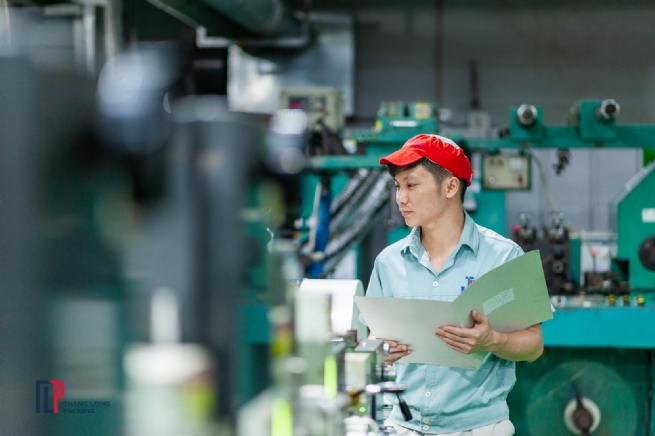
Inspecting production line operations at TL Packing
In summary, while scaling expanded “quantity” and participation in the FDI supply chain enabled standardization, data-driven operations have created a transformation in “quality,” supporting sustainable development and strengthening long-term competitiveness.
Looking back before and after the transformation, where does the biggest difference lie between a factory that “fulfills orders” and one that “meets global supply chain standards”?
The most significant difference lies in how production is organized and controlled.
A factory that fulfills orders typically operates reactively. Production begins when orders arrive, issues are addressed as they occur, and many decisions rely on individual experience. This approach offers flexibility but lacks consistency, carries higher risks, and is difficult to sustain as quality and delivery requirements become more stringent.
In contrast, a factory operating under global supply chain standards functions proactively and systematically. Activities are planned in advance through forecasting and S&OP, while production is driven by data from systems such as ERP and MES. Processes and quality are monitored in real time, reducing dependence on individuals and ensuring stability across the entire supply chain.
This shift from reactive to proactive operations, from experience-based to data-driven decision-making, together with comprehensive process standardization, has enabled TL Packing to become a reliable link in the global supply chain.
During the implementation of the smart factory project with Samsung Electronics, what was the most challenging aspect?
The most difficult aspect was not technology investment or process restructuring, but changing the understanding and management of “quality.” Previously, quality was mainly assessed at the end of the process and addressed when defects occurred, with many decisions based on individual experience. This approach suited an order-fulfillment model but struggled to meet the strict requirements of global supply chains.
Through participation in the smart factory program, TL Packing digitized data, standardized processes, and shifted its approach from subjective control to real-time, data-driven control, and from end-of-line inspection to monitoring throughout the entire production process. Operational decisions are now made based on ERP and MES systems and measurable indicators.
The core transformation lies in mindset, turning quality from an inspection outcome into a factor that can be measured, controlled, and continuously improved across the entire system. This has been both the greatest challenge and the key turning point enabling TL Packing to strengthen its capabilities and meet global supply chain standards.
Given the nature of the packaging industry, where small deviations can affect the entire chain, what is the core value of digital transformation?
The core value of digital transformation at TL Packing goes beyond reducing errors. Through collaboration with FDI clients, particularly corporations such as Samsung Electronics, the main goal is to build an operating system capable of committing to and maintaining stability at an industrial scale. Error reduction is a result, while what customers truly expect is consistency across batches and the ability to control variability throughout the entire process.
Digital transformation turns quality from a subjective concept into a data-driven control system maintained throughout production. As a result, the factory can operate proactively, anticipate risks, and ensure every product meets international standards, independent of individual experience or chance. This is the core value expected by FDI manufacturers when partnering with supporting industry enterprises such as TL Packing.
In your view, what “capability threshold” must supporting industry enterprises overcome to move forward in the FDI supply chain?
To move forward, not only to participate but also to sustain and grow within the FDI supply chain, enterprises must overcome a systemic capability threshold rather than rely on isolated improvements. This threshold is defined by three pillars: equipment, management systems, and operational control, with the level of integration and maturity across all three being the most critical factor.
In terms of equipment, the shift must be from “adequate” to “stable and measurable.” Machinery must meet capacity requirements, operate with high stability, minimize variability, and allow sensor integration, data collection, and parameter-based control instead of relying entirely on operator skill.
Regarding management systems, the transition must move toward standardized, system-based management. This includes process standardization (SOPs, WIs), deployment of ERP and MES systems, data-driven decision-making mechanisms, and operations aligned with international standards such as ISO 9001 and ISO 14001, combined with continuous improvement methods such as Lean Manufacturing. The key is that these systems must function effectively, not simply for evaluation or audit purposes.
For operational control, the shift must be from end-of-line inspection to real-time monitoring, tracking the entire production process and detecting and addressing variations as they occur. This is the decisive factor in ensuring consistency, stability, and the ability to demonstrate quality in line with strict FDI requirements.
Only when these three pillars reach a mature level and are effectively integrated can enterprises truly overcome the capability threshold, deepen participation, maintain their position, and achieve sustainable growth in the global supply chain.
Thank you very much!
|
TL Packing – A Trusted Packaging Supplier for FDI Corporations Established in 2005, TL Packing is now one of Vietnam’s leading packaging manufacturers, with a factory spanning more than 25,000 square meters, over 650 employees, and total investment exceeding US$15 million. Annual revenue surpasses US$33 million, reflecting a solid foundation and strong market credibility. Its diverse product portfolio includes plastic bags, stretch film, LDPE, PP, OPP, EPE/EVA foam, paper boxes, paper bags, and anti-static bags, serving industries such as electronics, food, and cosmetics. The company applies ERP and MES systems to control quality in real time, ensuring compliance with international standards. A core strength lies in its ability to maintain stability and consistency in production. Through digitalization and process standardization, TL Packing can commit to quality for FDI clients such as Samsung Electronics, Canon, and Foxconn. Located in Dinh Bang industrial cluster, Bac Ninh province, near ports and raw material sources, and supported by a 5S-standard warehouse system, the company benefits from fast, flexible operations and expanding export capabilities, gradually reinforcing its role as a reliable link in the global supply chain. |
By Vietnam Business Forum


 Vietnamese





