

10:08:07 AM | 4/29/2026

As part of the roadmap to make Vietnam an industrialized country with upper-middle income by 2030, and later a high-income developed economy by 2045, the Vietnamese business community as a whole, and the supporting industries sector in particular, is expected to take a leading role in production and business activities. Nguyen Hoang, Chairman of the Hanoi Supporting Industries Business Association (Hansiba) and Chairman of N&G Group Vietnam, shared his views with our reporter on this issue.
 |
How do you assess the development and internal capabilities of Vietnam’s supporting industry enterprises in recent years?
Over the years, the Party and the Government have issued a range of policies and mobilized resources to accelerate the development of industry in general and supporting industries in particular. These include key documents such as Resolution 23/NQ-TW dated March 22, 2018 on orientations for national industrial development policy through 2030, with a vision to 2045; Decree 111/2015/ND-CP dated November 3, 2015 on the development of supporting industries; Decision 68/QD-TTg dated January 18, 2017 approving the supporting industry development program for 2016 to 2025; and Resolution 115/NQ-CP dated August 6, 2020 on solutions to advance supporting industries. These legal frameworks provide an important foundation for government agencies and businesses to implement and carry out.
Vietnam benefits from political stability and participation in a wide range of new-generation trade agreements, along with comprehensive strategic partnerships with major global economies. There is also strong market potential in manufacturing and processing components for supporting industries. The country also has a skilled workforce that is competitive by global standards, supported by a population of more than 100 million and a high labor participation rate.
Vietnam’s supporting industry sector currently includes nearly 2,000 enterprises, organizations, and business households producing supporting industry products, and this number is expected to continue rising in the coming period.
After 40 years of renovation, while the results have not fully matched the country’s potential or the efforts of its business community, internal capabilities have improved significantly. It is time to move past the view that Vietnam cannot produce even a screw, as domestic enterprises now participate widely in global value chains, including as satellite suppliers to major domestic and international corporations such as Toyota, Honda, Samsung, Canon, VinFast, and Thaco. From traditional sectors such as agriculture, healthcare, and logistics to high-tech fields including aerospace components, electronics, servers, and especially semiconductors, Vietnamese enterprises are steadily strengthening their position and expanding their role in global production networks.
Despite this potential, why do many supporting industry firms still struggle to integrate into major supply chains?
The first opportunity for Vietnam’s supporting industries to develop passed when the country adopted its open-door policy to attract foreign direct investment (FDI) enterprises, particularly as large foreign corporations such as Toyota, Honda, Ford, Intel, and Panasonic entered the market. At that time, Vietnam had not yet fully developed policies to support domestic enterprises in joining supply chains for components and parts production. Mechanisms to encourage, or even require, these corporations to localize components for products manufactured in Vietnam were also limited.
From the perspective of FDI enterprises, due to various factors and profit considerations, as well as their deeply established positions within global supply chains, especially in their home countries, support for Vietnamese enterprises in supplying components has remained limited. For example, Samsung has announced demand for hundreds of products, and Toyota, along with other international and domestic corporations, has identified hundreds of required components, yet Vietnamese supporting industry enterprises have not been able to meet these demands.
In practice, while the direction and vision of macro-level policies are appropriate, the rollout of mechanisms to bring these policies into business operations has not kept pace or aligned closely with the realities of production and business activities in the supporting industries sector. Coordination among ministries, agencies, local authorities, and enterprises remains fragmented. At the same time, globalization brings both opportunities and significant challenges for Vietnamese enterprises.
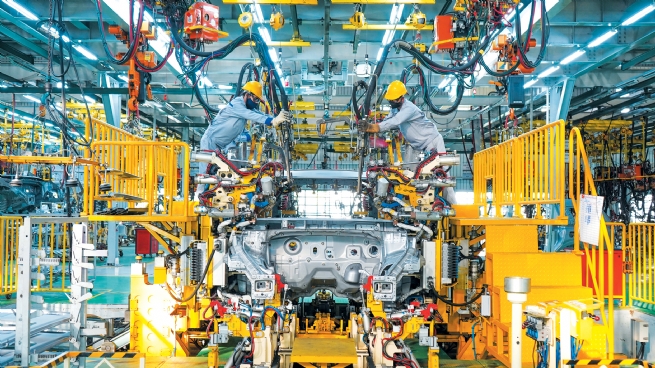
Domestic firms now widely participate in global value chains, capable of supplying major corporations such as Toyota, Honda, Samsung, Canon, VinFast, and Thaco
What should be done to strengthen effective linkages between Vietnamese enterprises and the FDI sector to advance supporting industries?
To better support businesses, the Government and relevant agencies need to speed up the translation of macro policies into practice by refining the legal framework, including decrees and circulars, so it aligns more closely with real-world conditions. This effort should go beyond the central level, with strong implementation at the grassroots level, including communes, provinces, and cities, to create a transparent business environment that supports enterprises in both favorable and challenging periods.
An important part of the development strategy is improving cooperation with foreign-invested enterprises. Mechanisms are needed not only to attract capital and create jobs but also to encourage and require FDI enterprises to actively support and guide domestic enterprises in joining production chains. Building a mutually beneficial relationship and strengthening linkages between FDI and domestic enterprises will help ensure that Vietnam is not just a manufacturing location but becomes a stable and important link in global supply chains.
In addition, developing high-quality human resources, particularly engineers and technical experts, is essential for modernizing supporting industries. Enterprises should work closely with training institutions and government agencies to build clear pathways for improving skills that meet the strict standards of high-tech sectors such as semiconductors and aerospace. The combination of effective macro policies, an open investment environment, and efforts to strengthen internal capabilities will provide a solid foundation for Vietnam’s progress in industrialization and modernization.
Beyond improving cooperation between Vietnamese enterprises and FDI companies, what concrete solutions are needed to develop supporting industries?
To advance supporting industries, particularly in high-tech and high value-added sectors in line with national orientations, the Government should promptly develop a law on supporting industries and submit it to the National Assembly for approval as soon as possible within the current term. A national-level steering committee should be established, chaired by a Deputy Prime Minister, or an advisory group to the Prime Minister on supporting industry development, with participation from relevant ministries, selected provinces and cities, representatives of supporting industry enterprises, and industry associations to ensure unified direction and timely resolution of challenges.
At the same time, a clear plan and roadmap should be developed to expand supporting industry enterprises, with a target for the 2026-2030 period to reach a share of 5% to 10% of the total number of Vietnamese enterprises.
There should also be tailored and urgent financial support packages, including loan interest rates, loan terms, credit limits, and collateral requirements, as current lending conditions, such as collateral, equity requirements, interest rates, and loan durations, continue to pose obstacles for supporting industry manufacturers. Support for high-quality workforce training is also needed, along with dedicated incentive policies for supporting industry enterprises, particularly in administrative procedures related to investment and post-investment operations.
In addition, there should be detailed planning for each economic region (North, Central, South), incorporated into specific programs to develop supporting industries, avoiding a fragmented approach in which all localities follow the same path, thereby minimizing resource waste and unnecessary competition.
Thank you very much!
Source: Vietnam Business Forum


 Vietnamese





