

8:19:11 AM | 4/30/2026

Tensions in the Strait of Hormuz are directly threatening the global oil supply, placing Vietnam under pressure to accelerate energy self-sufficiency. In this context, advancing biofuel production, starting with E10 gasoline, has moved beyond environmental goals to become a strategic pillar: reducing reliance on imported supply and creating new momentum for the domestic agricultural value chain.
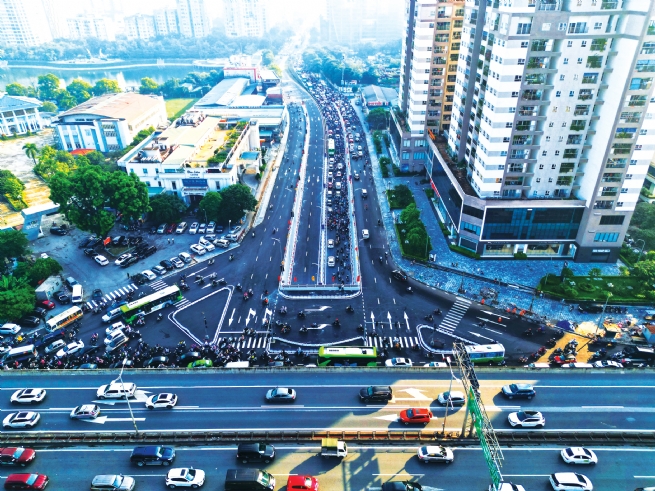
Biofuels help reduce greenhouse gas emissions in crowded urban centers by offering a cleaner alternative to fossil fuels
Vietnam’s economy is undergoing strong transformation, with rising demand for petroleum products. However, heavy dependence on imported fossil fuels places production at the mercy of external factors. In this context, biofuels have emerged as a strategic solution.
No longer experimental projects, biofuel development has become a practical requirement to strengthen national energy security. On February 26, 2026, the Prime Minister issued Directive No. 07/CT-TTg on promoting the production, blending, distribution, and use of biofuels. This is considered an important legal push that is reshaping the structure of Vietnam’s energy sector in a new era.
Following this direction, the Ministry of Industry and Trade (MoIT) issued Circular No. 50/2025/TT-BCT, setting out a clear roadmap for applying biofuel blending ratios. A representative from the Petroleum and Gas Trading Management Division, Domestic Markets Department, MoIT said the main objective is to ensure national energy security by increasing the share of biofuels, gradually reducing reliance on traditional fuels such as mineral gasoline, while making use of domestic production inputs.
The transition is designed around three principles: feasibility, phased implementation, and alignment with market conditions. Although the regulation took effect at the beginning of 2026, the timeline for the entire market to shift to E10 gasoline has been set for June 1, 2026, giving supply chain participants time to prepare.
With policy direction in place, the key question for major petroleum companies is execution capacity. Lessons from the earlier rollout of E5 gasoline have provided practical experience, allowing companies to take a more proactive approach to E10.
Vietnam National Petroleum Group (Petrolimex) has taken early, structured steps. Since August 2025, the company has piloted E5 and E10 gasoline in Ho Chi Minh City, the country’s leading economic hub. This pilot has helped gauge market response and test technical systems. A Petrolimex representative said the company currently has seven blending facilities ready to produce E10 nationwide. With a network of more than 2,800 fuel stations, Petrolimex has prepared the necessary infrastructure and developed a suitable transition roadmap.
On technology transfer, working delegations have been sent to countries with long-standing experience in biofuels such as Thailand, the Philippines, and the United States to study transport models, storage management, and especially quality control processes to ensure stable engine performance.
This level of preparation by key enterprises reflects readiness to move forward. However, from a macro perspective, distribution infrastructure is only a necessary condition; a sufficient condition lies in securing a stable domestic ethanol supply for blending. Bui Ngoc Bao, Chairman of the Vietnam Petroleum Association (VINPA), explained that with total fuel demand of about 26 million m³/tons per year, blending 10% ethanol (E10) would replace a substantial volume of imported fossil fuels.
“This is particularly meaningful for an economy where agriculture still accounts for a significant share. As the program expands to higher blends such as E15 or E20, the impact on reducing dependence on imported fuels will become even more evident,” he said.
However, the current picture still shows clear gaps. According to MoIT, total gasoline consumption in 2025 reached approximately 11.37 million cubic meters. With the E10 roadmap taking effect from June 2026, ethanol demand is expected to reach 1.1 million m³. Meanwhile, Vietnam’s domestic capacity currently meets only about 40% of this figure. Of the six existing plants, only three are operating at limited capacity, producing a maximum of around 400,000–500,000 cubic meters. The remaining 60% gap, which must be met through imports, remains a major challenge for the biofuel sector.
From an operational perspective, Pham Van Tuan, Director of GreenHouse Co., Ltd, said his company in Dong Nai province is currently operating at 50% capacity for fuel ethanol and is ready to expand technology investment once the market stabilizes. A flexible strategy combining corn and cassava, along with both domestic and imported supply, is serving as a temporary adjustment model for producers.
Meanwhile, Do Van Tuan, Chairman of the Vietnam Biofuels Association, said that once the ethanol market operates steadily, rising demand for cassava and corn will naturally lead to the formation of sustainable raw material zones.
In the context of unpredictable geopolitics and global supply chains, developing biofuels and using energy derived from domestic agricultural resources provides a solid foundation for the economy. The E10 roadmap from June 2026 will mark the starting point. If coordination among the government, enterprises, and farmers is handled effectively, Vietnam can reduce import dependence while building a more self-reliant and environmentally sustainable economic ecosystem.
By Huong Ly, Vietnam Business Forum


 Vietnamese





