

11:44:38 AM | 4/29/2026

The trend of value chain development is becoming a central focus in next-generation investment attraction, requiring a shift from standalone foreign direct investment (FDI) inflows toward building a closely connected ecosystem between FDI enterprises and domestic firms. In Bac Ninh, this direction is being translated into concrete measures aimed at raising localization rates, increasing value added, and ensuring sustainable economic growth.
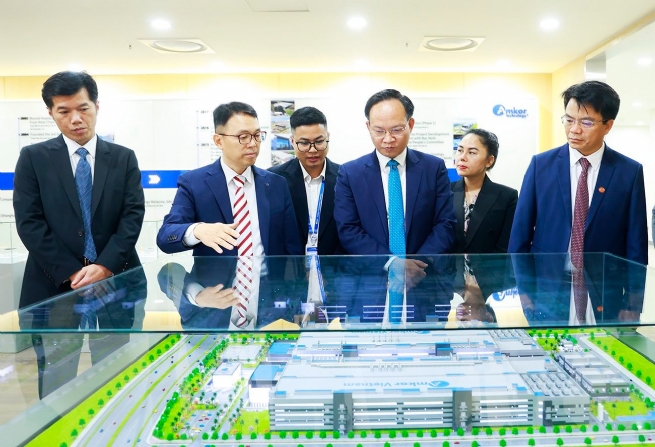
Vice Chairman of the Bac Ninh Provincial People’s Committee Pham Van Thinh visits an FDI factory in Bac Ninh province, January 2026
Foundation and position of Bac Ninh
According to Pham Van Thinh, Vice Chairman of the Bac Ninh Provincial People’s Committee, the province continuously innovates, focusing on improving the quality of public services, strengthening a transparent, safe, and business-friendly investment and business environment, and accelerating the reduction and simplification of administrative procedures and business conditions.
Thinh stressed that the province’s consistent investment attraction approach is based on a “five-readiness” policy: ready land, ready infrastructure, ready workforce, ready administrative reform, and ready business support. Alongside this, a “green lane” mechanism for administrative procedures has been effectively implemented, helping build strong confidence among both domestic and foreign investors.
The authorities and people of Bac Ninh consistently stand alongside enterprises, providing maximum support and protecting the comprehensive interests of investors, reaffirming that “Bac Ninh is an attractive and trusted destination, where the spirit of cooperation, innovation, and long-term sustainable development converges.” The province sees the success of enterprises and investors as its own success.
Investment attraction results continue to reach high levels, regularly ranking among the top in the country. Bac Ninh has become a destination for leading global technology corporations such as Canon, Samsung, Amkor, Luxshare, Foxconn, and Goertek, playing an important role in global value chains and supply networks.
To date, the province has attracted 3,545 active FDI projects with total registered capital of US$49.48 billion. It has also attracted 3,467 domestic investment projects with total registered capital of VND950 trillion. The province is home to more than 51,000 active enterprises with total registered capital of about VND820 trillion, of which domestic enterprises account for over 90%. This provides an important foundation for increasing localization rates and deeper participation in global value chains.
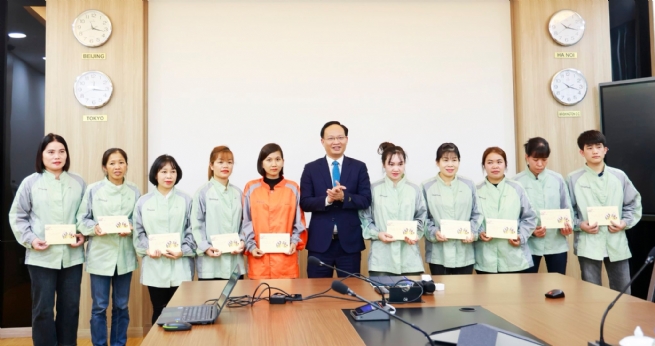
Provincial People’s Committee Vice Chairman Pham Van Thinh presents gifts to workers
Synchronized solutions for connectivity
To build an effective ecosystem linking FDI enterprises and domestic firms, thereby improving localization, value creation, and growth sustainability, Bac Ninh is committed to breakthrough institutional and policy measures, including:
First, Bac Ninh is committed to continuing investment in completing synchronized and modern strategic infrastructure, accelerating administrative reform, and improving a transparent, safe, and business-friendly investment environment, while ensuring the most favorable conditions in procedures, land access, and policy mechanisms. This continues to reaffirm that “Bac Ninh is an attractive and trusted destination, where the spirit of cooperation, innovation, and long-term sustainable development converges.”
Second, the province continues to prioritize and improve planning quality, developing next-generation high-tech industrial parks that serve not only as production sites but as innovation ecosystems, focusing on key sectors such as semiconductors, artificial intelligence, and digital technology, with the presence of R&D centers and leading technology enterprises.
Third, Bac Ninh is accelerating the preparation and development of a new-generation free trade zone linked with Gia Binh International Airport, an open economic gateway operating under international standards where flows of goods, services, capital, and technology are maximized. The zone is oriented toward becoming a hub for logistics, trade services, high-tech industry, aviation industry, international finance, and modern airport urban development, while promoting high-tech industry, logistics, innovation, digital transformation, and green growth, positioning Bac Ninh as an important link in global supply chains.
Alongside this, the province focuses on developing specialized economic zones in line with approved planning, linked with the North-South economic corridor and strategic transport routes, forming a system of industrial parks, eco-industrial and circular industrial zones, supporting industrial parks, regional innovation centers, non-tariff zones, and modern eco-urban and service areas, together with housing for workers and development of supporting industries.
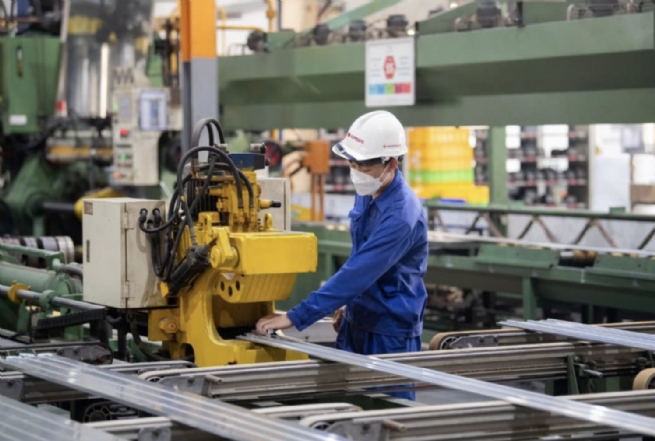
Bac Ninh shapes a supporting industry hub driven by FDI and infrastructure
Fourth, Bac Ninh is positioning itself as a regional trade, logistics, and cargo transit hub with a synchronized network of road, rail, air, and seaport connectivity. It is developing inland container depots, logistics centers, and regional trade hubs serving domestic circulation and import-export activities.
Fifth, the province prioritizes developing high-quality human resources, particularly in semiconductors, artificial intelligence, and digital technology, supported by a diversified and large-scale vocational education system. The province currently has 15 universities, 32 colleges, 35 intermediate schools, 14 vocational and continuing education centers, and 18 vocational training institutions, supplying a steady stream of well-trained labor each year. Bac Ninh also continues to attract reputable institutions such as Hanoi University of Science and Technology (HUST), Hanoi Medical University (HMU), Hanoi Law University (HLU), and Foreign Trade University (FTU), contributing to improved workforce quality.
On December 10, 2025, the Provincial People’s Council issued Resolution No. 113/2025/NQ-HDND on policies to support vocational training and human resource development for semiconductors, artificial intelligence, and digital technology for the 2025–2030 period.
From this foundation, Bac Ninh is moving toward a new growth model: “FDI-led growth, domestic direct investment (DDI) development, internal strength breakthrough, technology as the foundation, innovation as the driver,” with the goal of not only maintaining high growth but more importantly ensuring substantive growth, strengthening economic resilience and autonomy, and maintaining its position as a leading industrial and electronics hub in the country.
Source: Vietnam Business Forum


 Vietnamese





