

9:35:00 AM | 5/8/2026

In 2026, Vietnam is targeting total trade turnover of over US$1 trillion. As logistics costs rise, moving beyond fragmented thinking to build a regionally connected ecosystem for industrial parks (IPs) and economic zones (EZs) is key to sustaining export gains and growth.
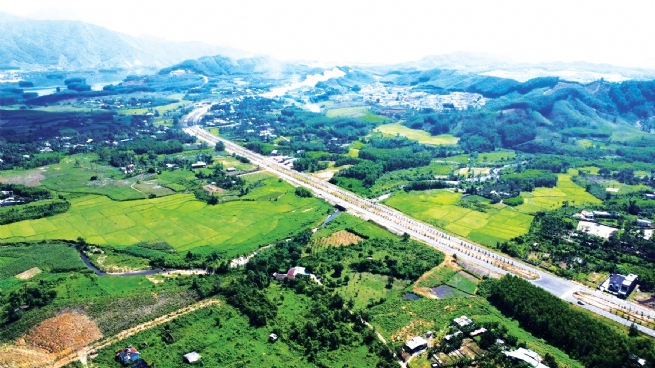
Building a regionally connected ecosystem for industrial parks and economic zones is key to sustaining export gains and growth
Regional connectivity - the key to lowering logistics costs
In this context, regional connectivity provides the foundation for optimizing three core flows: logistics, resources, and data. When localities within the same economic region coordinate effectively, they can share infrastructure such as seaports, airports, and expressways, creating a unified and efficient production ecosystem.
According to the World Bank (WB), Vietnam’s logistics costs account for around 16-20% of GDP, significantly higher than the 10-12% seen in many developed economies, putting strong pressure on the competitiveness of Vietnamese goods. Regional connectivity allows the development of interprovincial “logistics corridors,” helping businesses reduce transit times and indirect costs.
A clear example of this approach is the development of Ho Chi Minh City’s Ring Road 3. This route acts as a central link connecting dozens of satellite industrial parks, cutting travel time from former Binh Duong’s production hubs to Hiep Phuoc port or Cai Mep-Thi Vai by up to 30%. Similarly, in the north, the Lao Cai-Hanoi-Hai Phong expressway corridor has turned northern mountainous provinces into production “rear bases,” directly connected to export “frontlines,” particularly the Lach Huyen deep-water port complex.
Gradually eliminating fragmented and localized planning
Despite various regional development resolutions, fragmented, locality-driven approaches in some areas remain a bottleneck to productivity. The race among localities to develop multi-sector EZs, build deep-sea ports, and establish nearby airports shows overlapping planning, leading to overloaded infrastructure in some places while others are left with underused industrial parks, resulting in inefficiencies in public investment.
This localized competition has broken up supply chains. The issue is especially clear in the central region, where a series of Class I seaports stretches from Da Nang to Quang Ngai within relatively short distances. For a long time, each locality operated its port independently, without clear roles between specialized container ports and bulk cargo ports, leading to lower-than-expected efficiency. Fragmented spatial planning, isolated investment, and limited coordination in industrial, urban, and transport planning remain major constraints, reducing infrastructure efficiency and regional productivity. This situation has also led to overlapping IP development, allowing FDI investors to push down tax incentives and land lease rates across localities.
To address cost challenges and fragmentation at their root, the development direction for IPs and EZs in the 2026-2030 period must align with economic corridors and logistics hubs. Experts suggest Vietnam should shift toward building large-scale, modern, and integrated industrial complexes that extend beyond administrative boundaries.
The Lach Huyen international gateway port and the Quang Yen coastal industrial park complex (Quang Ninh-Hai Phong) illustrate an effective connectivity model. With Hai Phong operating leading deep-water port infrastructure and Quang Ninh providing extensive industrial land along with coastal EZ incentives, the Ha Long-Hai Phong expressway connection has turned the area into a continuous green industrial zone, attracting major technology corporations such as Foxconn and Jinko Solar.
Regarding the East-West economic corridor and international border gate connectivity, upgrading national highways linking Da Nang port to the Central Highlands and neighboring countries such as Laos and Cambodia is turning inland industrial parks into strategic transshipment hubs within the Greater Mekong Subregion.
The Mekong Delta regional connectivity project, centered on Can Tho, is gradually forming a regional agricultural logistics hub, a collection point for goods from surrounding provinces for processing and formal export, replacing the previous model of fragmented transport to Ho Chi Minh City. In the north, the Deep C Industrial Zones (Hai Phong-Quang Ninh) exemplify the removal of provincial boundaries to develop a continuous green coastal industrial corridor, maximizing the advantages of deep-water ports and interprovincial expressways.
This new development model requires a clear definition of roles among localities. The formation of interregional IP and EZ clusters aligned with key expressway axes such as the eastern North-South expressway and emerging ring road systems will create strong combined momentum. Investors will no longer focus on the advantages of a single province but instead assess the logistics capacity of an entire economic corridor.
Beyond physical infrastructure, developing regional data corridors is necessary to ensure transparency, support the sharing of planning information, and enable real-time supply chain monitoring across localities. This helps reduce the increasing risks of global transport disruptions in 2026 while supporting businesses in adopting “green logistics,” an unavoidable trend for Vietnamese goods to expand further into EU and North American markets.
By Huong Ly, Vietnam Business Forum






 Vietnamese





