10:51:06 AM | 9/14/2026

Since setting up operations in Vietnam in 1995, GEODIS has steadily expanded its footprint and capabilities, evolving into a leading and trusted logistics provider in the country.
 Mr. Chandler So, Managing Director of GEODIS Vietnam |
Today, GEODIS employs nearly 200 staff across its offices in Ho Chi Minh City and Hanoi, and operates eight strategically located warehouses nationwide. Initially established to facilitate European customers’ import and export activities, GEODIS now supports leading Vietnamese, European, and American firms looking to manufacture, source, and distribute in and out of Vietnam.
A Journey of Growth and Transformation
At the heart of GEODIS’s global strategy is its purpose: to support clients in their growth by providing innovative, sustainable and ethical logistics. GEODIS is constantly reinventing itself, adapting its organization, processes and tools to address changing markets, customer demands and stakeholder expectations.
“GEODIS has evolved from a freight forwarding company into a comprehensive logistics partner, covering freight forwarding, contract logistics, last-mile delivery, and project logistics,” said Chandler, Managing Director of GEODIS Vietnam. “Over the past 30 years, we have grown together with Vietnam, from supporting manufacturing activities to helping global companies establish and expand their supply chains in the country.”
Today, GEODIS is recognized for its robust network and end-to-end solutions, serving customers across the automotive, industrial, high-tech, healthcare, retail, FMCG and luxury verticals. A pivotal milestone was the opening of the Ho Chi Minh City logistics hub, establishing a gateway for domestic and cross-border distribution.
“Our focus today is no longer just moving goods, but helping customers build more efficient and resilient supply chains through technology, digitalization, and lower carbon solutions,” Chandler added. “Our expansion of distribution centers and recent EV deployment are examples of how we are preparing for the next stage of growth.”
Accelerating Digital Transformation
GEODIS has made substantial investments in data, enterprise architecture and cybersecurity, to simplify life for customers and employees and to boost operational performance.
At the forefront of its innovation strategy is the use of artificial intelligence to enhance operational efficiency and deliver data quality. To streamline warehouse processes, increase productivity, and address operational challenges, GEODIS deploys advanced robotics and automated solutions, such as autonomous mobile robots and automated guided vehicles,
Equally important, GEODIS is dedicated to innovating and developing solutions that help identify and minimize the environmental impact of logistics operations across its network.
Driving Lower Carbon Logistics
Vietnam’s ambition to become a regional green logistics hub aligns closely with GEODIS’s corporate strategy. “We see sustainable logistics not only as an environmental responsibility, but also as an important part of Vietnam’s future competitiveness,” Chandler noted.
GEODIS was among the first in Vietnam to adopt EVs for urban deliveries, deploying the VinFast EC Van in 2026. The company works closely with local vehicle manufacturers and infrastructure stakeholders to support EV deployment, operational reliability, and future fleet scalability. Beyond EVs, GEODIS reduces its environmental impact through low-carbon alternative transport, multimodal solutions, and fuels such as biodiesel and sustainable air and marine fuels. Route optimization and energy-efficient warehouses—including solar energy—further exemplify its holistic sustainability approach.
On a global scale, GEODIS has committed to a 42% reduction in Scope 1 and 2 emissions by 2030, a target validated by the Science Based Targets initiative (SBTi). “Our focus is to work with customers to develop practical and scalable lower-carbon logistics solutions,” Chandler emphasized.
Overcoming Operational Challenges
Despite substantial government investment in Vietnam, several factors contribute to high logistics costs. Chandler explained, “Some of the main challenges are infrastructure bottlenecks, a fragmented logistics market, regulatory complexity, and heavy reliance on road transportation.”
Vietnam’s logistics sector is highly fragmented, with numerous small and medium-sized providers operating independently. This limits economies of scale and results in many manual processes. “Better infrastructure connectivity, more digitalization, and automation can help address these issues,” Chandler suggested.
Building Vietnam’s Future as a Global Logistics Hub
GEODIS sees tremendous potential for Vietnam in the global supply chain. Chandler highlighted several priorities: “Vietnam is well-positioned to further enhance its multimodal infrastructure by strengthening the connections between ports, airports, rail, and roads, creating even greater logistics efficiency. Continued progress in the digitalization and simplification of customs and regulatory processes will also help support trade and transshipment as the logistics sector evolves.”
He also highlighted the value of incentivizing sustainable logistics practices and investing in workforce development. “By integrating sustainability into future infrastructure and logistics planning, Vietnam can establish itself as one of the most connected, competitive, and sustainable logistics hubs in Southeast Asia”.
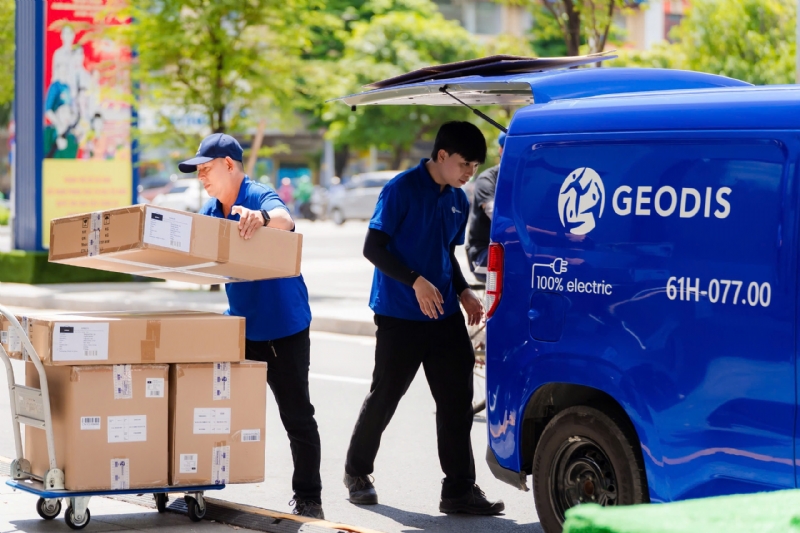
GEODIS is dedicated to innovating and developing solutions that help identify and minimize the environmental impact of logistics operations across its network
A Commitment to Innovation and Partnership
As GEODIS marks over three decades in Vietnam, its story is one of continuous adaptation and leadership. With global revenues of €10.6 billion in 2025, operations in 170 countries, and a workforce exceeding 48,000 worldwide, GEODIS’s local investments mirror its global strategy: driving innovation, enabling trade, and building a more resilient logistics ecosystem.
“GEODIS remains committed to supporting our customers by applying advanced technology, sustainable practices, and local knowledge to address the evolving needs of Vietnam’s logistics sector,” Chandler concluded.
By Le Phuong, Vietnam Business Forum