2:51:02 PM | 11/4/2026

Improving infrastructure, stronger government support, faster site clearance, and an abundant labor supply are strengthening Bac Ninh’s appeal to industrial investors. Developments at JUTECH Industrial Cluster and Chau Minh-Bac Ly-Huong Lam Industrial Park show that investment competitiveness depends not only on available industrial land but also on the ability to build an integrated production ecosystem that meets investors’ needs.
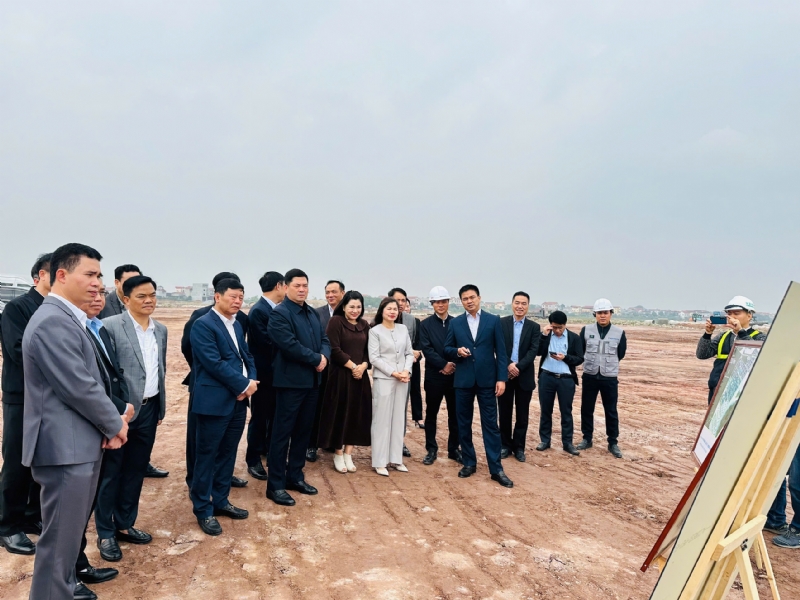
Bac Ninh City Party Committee Secretary Nguyen Hong Thai and officials inspect the Chau Minh-Bac Ly-Huong Lam Industrial Park infrastructure project and address implementation obstacles
Favorable Conditions and Strong Government Support
Located along Route 398 in Xuan Cam Commune, JUTECH Industrial Cluster covers 75 ha and has a total investment of approximately VND715 billion (US$27.5 million).
According to Doan Viet Cuong, Chairman of the Board of Directors of JUTECH Technology Investment and Development Joint Stock Company, the cluster has attracted nearly all its planned investors, achieving an occupancy rate of 96%. Approximately 70% of the businesses have built factories and commenced production.
Just 500 meters from JUTECH Industrial Cluster, another industrial area is taking shape: Chau Minh-Bac Ly-Huong Lam Industrial Park. Phase 1 covers 105 ha, with an investment of approximately VND1.26 trillion (US$48.46 million), while total investment across both phases is expected to exceed VND3 trillion (US$115.38 million). Since the project broke ground on October 10, 2025, its developer has accelerated site clearance and infrastructure construction while stepping up efforts to attract secondary investors.
The speed of the market response is particularly noteworthy. Although technical infrastructure is not yet fully complete, many secondary investors have already approached the developer to discuss building factories at the site. This reflects not only the developer’s business capabilities but also investors’ confidence in Bac Ninh’s investment environment.
According to Cuong, the area’s appeal stems from several mutually reinforcing factors: increasingly integrated technical infrastructure; decisive government action to remove administrative bottlenecks; greater attention to social housing for workers; a growing network of vocational training institutions; and stronger links between labor supplies in northern localities and industrial centers.
“With good infrastructure, good transport, a good workforce, and a government that honors its commitments, there is no reason development should not proceed,” Doan Viet Cuong said.
His assessment aligns with Bac Ninh’s industrial development strategy. The city is pursuing a model centered on eco-industrial parks, advanced technology, clean energy, stronger value-chain linkages, and projects with substantial technological content. During 2026-2030, Bac Ninh plans to develop 66 industrial parks covering approximately 20,223 ha and attract US$6.5 billion to US$8 billion in investment annually.
From Investor Incentives to Industrial Ecosystem Development
An FDI investor exploring and implementing a project in Bac Ninh said its concerns go beyond land rental rates and factory locations. More important are the ability to bring projects into operation promptly, streamlined and coordinated administrative procedures, housing conditions for workers, the availability of qualified labor, and transport and logistics systems capable of supporting supply chains. These factors have become key measures of investment competitiveness.
For secondary investors, an attractive industrial park is no longer simply one with available land. It must offer a complete production ecosystem, including cleared sites, electricity, water and environmental treatment facilities, transport connections, logistics services, an adequate workforce, worker housing, and a public administration committed to supporting investors.
Experience at JUTECH Industrial Cluster and Chau Minh-Bac Ly-Huong Lam Industrial Park shows that when these components are developed and coordinated effectively, investment can be attracted even before infrastructure construction is fully complete.
Bac Ninh is pursuing the same approach. The city identifies administrative reform, improvements to the business and investment environment, the attraction of high-tech projects, green industrial development, and higher-quality human resources as key pillars of a sustainable industrial ecosystem. Its 2026 investment promotion plan underscores its “Four Readiness” approach: readiness in land availability and human resources, an improved investment environment, and support for investors.
Not Just Attracting Investment, but Creating Investment Value
The development of JUTECH Industrial Cluster and Chau Minh-Bac Ly-Huong Lam Industrial Park is expanding Bac Ninh’s industrial base westward. However, the ultimate goal is not simply to fill available industrial land.
Cuong said: “At Chau Minh-Bac Ly-Huong Lam Industrial Park, the developer aims to build integrated, modern, green, and clean infrastructure, gradually develop renewable energy, and prioritize the attraction of electronics, high-tech, and semiconductor industries.”
This marks an important shift: from attracting more investment to attracting the right investment; from expanding industrial land to improving development quality; and from simply developing industrial parks to building a high-tech industrial ecosystem.
Bac Ninh has significant potential to achieve double-digit economic growth. However, to turn its advantages into long-term competitiveness, the city must continue to address bottlenecks in site clearance, investment and construction procedures, and environmental management, while ensuring public security, adequate social infrastructure, and a high-quality workforce.
Drawing on practical experience, Cuong proposed that authorities at all levels, relevant departments and agencies, and local administrations continue working with infrastructure developers to accelerate land handovers and shorten the time needed to process procedures for secondary investors. This would help projects begin operations sooner, convert registered investment capital into actual production capacity, and create new growth momentum.
By Ha Thanh - Trinh Long, Vietnam Business Forum