For a nation, the development strategy for all industries of the economy is not a strategy. Moreover, it is not feasible. So we need to select and give priorities in the process of building and developing industry connectivity and networking (Industrial Cluster). According to Dr Doan Duy Khuong, industry connectivity and networking is the direct strategy to enhance the competitiveness of the nation, industries, businesses and products. Vietnam Business Forum would like to introduce the article of Dr Khuong regarding this issue.
Overview
History of global trade has created a very diverse picture for the world economy with very uneven distribution of living standards and human development levels among the continents and countries around the world. Today, when talking about an economic sector or an industry, we can confirm that a country is more developed than another country. Is the competitive advantage of a country to another country something bestowed by nature, because of objective reasons? Some people may consider this true in some part. However, most economic managers in the world think that is not necessarily so. Especially in the current economic context, with developed production, industry creates more competitive products less dependent on natural resources. Conversely, the ability to create a higher productivity than competitors is the secret for a country to be more competitive than another country. The more industries with high labour productivity in a country the more competitive it is. One important indicator is the per capita GDP of each country. In Vietnam, President Ho Chi Minh during his life, also taught "work hard, save, avoid greed, be straight, public-spirited and selfless”. The word “work hard” denotes productive labour.
Thus, there is a question of how the economy or industries with low labour productivity and low competitiveness may be able to narrow this gap with more developed countries, especially in the context of international economic integration. However, before answering this question, we need to explain why people today talk more and are increasingly interested in international economic integration. According to economic analysts it is the strong development of science, technology, management and communication, and information technology that made the world a "small village" and become a premise for the economic integration. Industry and their businesses must seize the chance to improve labour productivity, improve competitiveness and gradually narrow the gap of economic development, to avoid danger of falling behind.
The reality shows the most difference when we go from an underdeveloped country to a developed country: it is the differential development of infrastructure, particularly in the transport sector, differences in the linkages as well as addressing duplication of the key transport hubs such as air, rail, road and waterway. A developed country will not build airport, roads, railways, subways, waterways diffusely, without appropriate linkages.
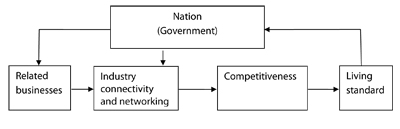
Today, it is hard to accept that when walking out of an international airport we can only find taxi and bus service, but cannot find a railway station. Furthermore, an important factor creating the modern city often is the river. We cannot develop a modern and sustainable urban area when ignoring the development of the river because this is one of the most important and basic environmental factors of the urban area. To solve that problem, in developed countries, people often associate waterways solution with other traffic solutions and develop the riverside areas to be more clean and beautiful. In the long term, the society will have to pay a very expensive price for the lack of linked development and the nation will lack competitiveness and sustainable development. In the best case, the country is only facing the trap of average growth compare with the rest of the world. However, theoretical economic management has shown a critical way to improve competitiveness through Industry connectivity and networking (shown in diagram 1). Thus, we can see that the Government can participate in improving competitiveness through microeconomic policies for business and macroeconomic policies or programs of international economic integration for the industries. However, Industry connectivity and networking (including related companies involve in the process of creating value for the product) is the direct strategy to enhance competitiveness of the nation, industries, businesses and products. This also means something very important in developing associations; that we should balance the development of members on the basis of Industry connectivity and networking (vertical) with a common interest of developing members with the basis of the same works (horizontal), because otherwise conflict and unfair competition or inefficiencies spread.
Diagram 1: Improving the competitiveness by Industry connectivity and networking
Development of industry connectivity and networking
For a nation, the development strategy for all industries of the economy is not a strategy. Moreover, it is not feasible. So we need to select and give priorities in the process of building and developing Industry connectivity and networking.
The selection and priorities to develop an industry should be based on the principle that this industry must preserve the fundamental values of the economy, ensuring traditional values and is stable in terms of economic, politic and creates the jobs for the society. Moreover, the industry also should be oriented toward dynamic development of supporting industries, improving human resources, and effective use of resources. In addition, it must clearly identify the areas where industry that can compete and cooperate to build a linkages development model. However, the prediction of the problems that the industry that may be encountered in the development process need to be predicted in order to take actions and solutions.
Industries Selection process can use the analysis tools in diagram 2. Analysis of advantages and difficulties help to identify the strengths and weaknesses as well as the challenges and opportunities of the industry.
Diagram 2: Industry selection, building and developing industry connectivity and networking
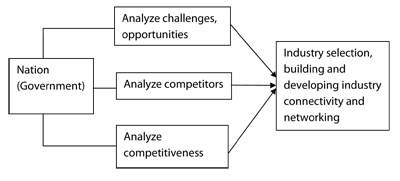
Analysis of competitors is to analyze the strategic competitors operating in the same industry sector in the region or in the world and we can get the information on the comparative advantages among competitors. Analysis of competitiveness played a decisive role in the selection of building and developing an industry. To analyze the competitiveness of an industry, identifying the market and market share of that industry has to be done first. In other words, the questions about the location, stability and ability to develop of the market, the customer’s targets, have to be answered. In addition, we need to analyze the conditions of the manufacturing industry which includes the basic input, direct, traditional costs, such as raw materials, fuel, labour and other indirect input costs, with the industry competitiveness such as services, packaging, quality, research, development, technology, finance and logistics. Moreover, competitive analysis is to analyze the alignment of the supporting and related industries such as research, training, promotion, transportation, finance, customs and land.
Conclusion
In transition economies from centrally planned, subsidized economy to a market-oriented socialism, enterprises often lack competitiveness; or often compete in the traditional ways of price and quantity based on the basic elements of the production of small producers, lack of professionalism. Along with the consistent policy of the Government on international economic integration as well as move the economy to market economy socialist orientation, as a rule, the relevant businesses with common interests will gradually unite, cooperate to create the Industry connectivity and networking. The competitiveness of the Industry connectivity and networking will be based on the factors of industrial production such as investment in technology, research and product development, marketing and quality.
However, to promote and improve the quality of building and forming Industry connectivity and networking to improve labour productivity and competitiveness, in addition to international linkages, the support of the government, associations, businesses and civil organizations play a decisive role. Government can influence the process of choosing and building priority industries, development through micro and macro -economic policy creating a favourable business environment for enterprises and industry. At the macro level, we need to promote and improve national overall planning standards in a consistent and sustainable way, especially in infrastructure development. In the transport sector, the air, rail, road and water ways (especially at the intersections at national and international level) need to be well prepared and done. The promotion organizations and professional associations should research industry linking models in order to develop activities to increase their own members. Thereby encouraging cooperation and enhance mutual trust between its members. The Vietnam Chamber of Commerce and Industry with the program of cooperation with industry associations and local authorities show a good step towards the trend. Businesses in relation to industry should focus deeper in the investment in technology, research, training and as well as building strong brands in the regional and international level.
Finally, civil society organizations also have an important role in the process of linking industries. The people, person are both a subject and an object of the Industry connectivity and networking, of sustainable development. The limitations in the development of Industry connectivity and networking affect quickly and early into the people's quality of life through economic, social and environmental basis problems. The most sensitive issues of sustainable development, of the inadequate Industry connectivity and networking are often discovered by civil society organizations.
If we have the cooperation of all forces in the society, we can ensure the success of the process of improving national competitiveness through building and linking industries to perform well the tasks of industrializing and modernizing the country.
Dr Doan Duy Khuong
Vice Executive President of VCCI
Co-chair of VBCSD


 April 24–25, 2026
 Kinh Bac Cultural Center, Bac Ninh Province


 Vietnamese





