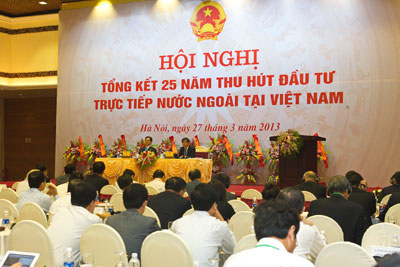
A meeting reviewing 25 years of FDI attraction in Vietnam was recently organised in Hanoi. The Ministry of Planning and Investment said as of the end of February 2013, Vietnam had attracted 14,550 FDI projects with a total registered capital of nearly US$211 billion, of which nearly US$100 billion has been disbursed. According to experts, FDI has left a positive effect on shifting economic sectors as well as sectoral restructures towards industrialisation and modernisation. Vietnam Business Forum has an interview with Mr Dao Quang Thu, Deputy Minister of Planning and Investment, to learn more about important issues of this meeting. Anh Phuong reports.
Could you brief the achievements Vietnam has made after 25 years it opened the door to foreign investors?
It is quite certain that foreign investment is considered the most dynamic sector with its growth higher than the country’s average. Its contributions to the country’s GDP increased from 2 per cent in 1992 to 12.7 per cent in 2000, 16.98 per cent in 2006 and 18.97 per cent in 2011. This sector also paid US$14.2 billion to the State Budget from 2001 to 2010. In 2012 alone, foreign investors paid US$3.7 billion to the State Budget, accounting for 11.9 per cent of total budgetary revenue.
Specifically, foreign-led industrial and construction sectors expanded 18 per cent annually on average, higher than the overall growth of the sector. Foreign capital played an important role in changing the face of agriculture, forestry and fishery thanks to product diversification and export value increase. In services sector, foreign investment generated a number of high-quality services such as telecommunications, international tourism, finance, banking, insurance and audit.
This sector created about 2 million jobs, regardless of 3-4 millions of indirect jobs. Foreign investment also helped improve human resource quality, restructure labour force, and step up the transfer of technologies, machinery, equipment, knowledge and management experience. Foreign investment also played an important part in reforming State-owned enterprises, administrative procedures, perfecting market economic institutions, building and improving State civil servants in charge of this sector.
Another plus of the FDI sector is it strongly propped up Vietnam's exports. Export-driven foreign investment attraction programme has given a strong boost to Vietnam’s export capacity. With this capital flow, Vietnam has joined and gradually improved its position in the global value chain. If the FDI sector contributed 45.2 per cent to the country’s total export turnover before 2001, including crude oil, it surpassed the domestic sector in 2003, and it accounted for 64 per cent in 2012. FDI firms have also played an important part in changing export structure, with a lower ratio of rudimentary products like minerals and a higher of manufactured items. The success of this sector also caused a ripple effect on expanding export markets to demanding countries like the US, the EU and Japan.
However, it is said that the FDI sector still has negative aspects. What do you think about this comment?
In my opinion, one of the largest gaps of foreign investment is the realised capital is always lower than the registered value. The realised FDI capital stood at just 47.2 per cent. And, in general, most FDI projects in Vietnam have medium and small scales. In the 1988 - 2011 period, a project averagely had US$15.4 million but the scale slid to US$13.47 million in 2011. This phenomenon is partly explained by irrational attraction orientation and disbursement. Accordingly, foreign investment was channelled into sectors using much manpower and resources, mainly aimed at taking advantage of industrial protection policies. The capital for high-valued high-tech sectors is humble.
This also partially shows the investment environment in Vietnam is much less attractive to foreign investors than some countries in the region Vietnam is still left behind by Thailand, Indonesia and Malaysia in attracting big projects. Taking into account 500 largest multinational corporations in the world, Vietnam has the presence of 100 corporations while China has 400 corporations.
Another minus is the slow updating of technology. Notably, over 80 per cent of FDI companies are using average technology of the world, only 5 - 6 per cent are employing high technology, and 14 per cent are using backward technology. Some FDI projects are dissolved before time and delayed and some investors even escape.
The income of FDI workers remains low although it is higher than the private sector but lower than the state sector. Poor incomes usually result in strikes, with 4,142 cases recorded from 1995 to date. Up to 75 per cent of strikes came from companies of Taiwan, South Korea and China.
Many FDI enterprises reportedly collude with parent companies in foreign countries to evade taxes by raising input prices. This caused much of tax losses of the State Budget.
So, could you tell us short-term and long-term solutions to maintain the "prosperity" of FDI inflows into Vietnam?
Currently, Japan is one of the largest foreign investors in Vietnam. Hence, attracting investors from this East Asian nation is the immediate solution. Specifically, in the second quarter of 2013, a legal document in place of Decision 12/2011/QD-TTg will be issued to catch the capital flow for subcontracting industries. Japanese investors are also very keen on this field in Vietnam.
In the long term, we need to fully address shortcomings in FDI attraction, including infrastructure, administrative procedure, and human resources. Regarding infrastructure, according to many experts, it takes four years to complete a project negotiation and another four years to complete it. The time is too long and it must be shortened. Regarding administrative procedures, we usually received complaints from foreign investors previously but things changed after the Decision 12 was issued with many incentives for them. As for human resources, FDI projects like Vietnamese workers for their low pays and industriousness but most of them are not trained professionally and systematically. The Ministry of Education and Training, the Ministry of Labour, Invalids and Social Affairs lacked coordination in human resource training to produce high-quality workers as foreign investors expect. In reality, Vietnamese workers need further training in the country and in foreign countries after they are recruit to assume more important positions. This leads to expenses for time and training for both employees and employers while training at school can handle it.
I think we have already had the policy. It turned clearer after Prime Minister Nguyen Tan Dung said to the conference that the Government and relevant bodies will provide the best conditions to please investors. We need to prepare for radical changes to address shortcomings to make FDI flow a growth engine of Vietnamese economy in the near future.




 Vietnamese





