

4:50:23 PM | 5/15/2020

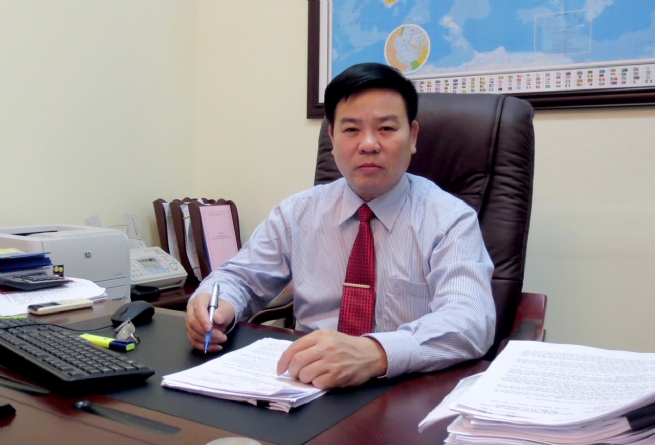
At 10:00 am on May 12, 2020, 22 regional State reserve departments affiliated with the General Department of State Reserves opened the second tender round to buy 182,300 tons of rice for the national reserve. The selection of contractors is universal to domestic suppliers. Tender invitations were publicly announced on April 16. The rice purchases are funded by the State budget. Our reporter has an exclusive interview with Mr. Le Van Thoi, Deputy General Director of the General Department of State Reserves, on this issue.
Could you please tell us the basis for the bidding price?
Under Article 19 of the Law on Pricing, national reserve goods are priced by the Government. Article 20 of the Law on Pricing provides for pricing principles:
Ensuring the coverage of actually reasonable production and business costs, having rational profits as compared with the market price and complied with State policies on socioeconomic development in each period. Promptly adjusting prices when price constituents change. Article 21 stipulates that the ground for pricing includes total product price, product and service quality at the time of pricing, expected profit level. The supply-demand relationship of goods, services and the purchasing power of money; solvency of consumers; domestic and world market prices and the competitiveness of goods and services at the time of pricing. Article 49 of the Law on National Reserves provides for buying prices and selling prices of national reserve goods: When buying and selling national reserve goods, if the market price fluctuations are higher than the maximum buying price, lower than the minimum selling price, the Minister of Finance shall consider and adjust the maximum buying price and the minimum selling price based on the proposal of the person in charge of national reserve goods.
Therefore, according to the current Law on Pricing and the Law on National Reserves, when determining the price for bidding to buy rice for national reserve, it must be based on the time of pricing. At the time of price determination, it must be based on the supply and demand of goods on the market, the quality of goods and the market price at the time of valuation that results in price determination.
How is the regulation on the bidding package launched on May 12, 2020?
In order to buy a sufficient amount of rice for the national reserve as assigned by the Government, the Ministry of Finance directed the General Department of State Reserves to open bidding on May 12, 2020.
At the present time, due to the outbreak of the Covid-19 pandemic, the demand for rice export is increasing. The Prime Minister allowed resumption of rice export from May 1, 2020. Therefore, businesses increased buying the grain for export while the supply from the winter-spring rice season has almost run out. The 15% broken rice is sold at VND10,300 - 10,500 per kilogram (without packaging, quality assurance, loading and unloading, loss, loan interest, corporate profit and freight to each national reserve warehouse).
Under the Law on Pricing, the Law on State Reserves, and enforcement instructions for purchase of rice for stockpiling, as a reasonable commodity, rice prices are highly dependent on market supply-demand and the harvest time. Therefore, in order to ensure the closest price to the market price and base on the valuation result of the Price Management Department on the pricing plan submitted by the General Department of State Reserves, on May 11, 2020, the Ministry of Finance decided the maximum purchasing price and also on May 11, 2020, based on market prices at a given time in a given area surveyed by regional departments of State reserves, consultative remarks on purchasing price for national reserves of provincial/municipal finance departments and the price level proposed by regional departments of state reserves, the General Director of the General Department of State Reserves decided on the price for each bidding package for each regional department of State reserves equal to the maximum purchasing price, fixed by the Ministry of Finance and concurrently sent to regional department of State reserves to open the bidding package on May 12 under the law. According to market movements, the pricing is lawful.
Could you please tell us how to prevent winning contractors from quitting their bids?
The transaction and supply of reserve rice is implemented in accordance with the Civil Code 2015, the Law on State Reserve 2012 and the Law on Bidding 2013. In case a winning bidder does not come to sign the contract, it shall have its guarantee withdrawn. If it signs the contract but does not deliver enough or fails to fulfil it, it shall face the foreclosure of its bid guarantee or be imposed a fine of 8% of the contract value. It shall also be banned from joining bidding in 3-5 years.
At the second round of reserve rice bidding held on May 12, 2020, in the bidding invitation, the General Department of State Reserves directed regional departments of State reserves to increase bonds to bidders when they join the bidding, the bid guarantee value was raised from 1.5% to 3% of the bid value. In the long term, we proposed amending the Law on Bidding to add more sanctions to contractors who violate the tender.
What were the bidding results on May 12?
According to quick reports by regional departments of State reserves, by 10:00 am on May 12, 2020, 22 regional departments of State reserves opened bids under the law. Many businesses that refused to sign rice supply contracts for the first phase also took part in this bidding because, according to the current law, they are not prohibited from participating in the bidding.
At present, regional departments of State reserves are urgently evaluating technical profiles, capacity and experience of bidders. Qualified bidders will be entitled to open financial profiles for selecting winners who must meet technical profiles, capability and experience requirements to supply the rice. The General Department of State Reserves sent an official letter to regional departments of State reserves to urgently assess bids and approve the bidder selection results before May 19 for the contracts signed before May 22 and contract fulfilment before June 30, 2020.
Thank you very much!
In the rice bidding for national reserve in 2020, for the first time, bid solicitors are obliged to apply the national technical regulations on reserve rice issued together with Circular 78/2019/TT-BTC dated November 12, 2019 of the Minister of Finance. Accordingly, the standard of reserve rice is higher than that of exported rice in terms of grain and food safety. But, bidding documents must be reasonable enough for many bidders to take part.





 Vietnamese





