

10:54:53 AM | 5/10/2021

The fisheries sector must achieve an output of 8.6 million tons of aquatic products (farming 4.75 million tons and catching 3.85 million tons) and earn US$8.5 billion from exports in 2021.
This is the goal that Deputy Minister of Agriculture and Rural Development Phung Duc Tien assigned to the Directorate of Fisheries at the Workshop on “Deploying solutions for livestock and fishery development in the new context” recently organized by the Ministry of Agriculture and Rural Development in Hanoi.
Capacity of 4.56 million tons
Mr. Tran Dinh Luan, General Director of the Directorate of Fisheries, said, aquacultural area totaled 1.3 million ha in 2020, including over 740,000 ha for brackish water shrimp farming, 450,000 ha for traditional fish farming, 5,700 ha for pangasius farming, and the rest for other species farming. The fisheries sector also had 10 million cubic meters of fish cages (7.5 million cubic meters for brackish and saline water farming and 2.5 million cubic meters for freshwater farming).
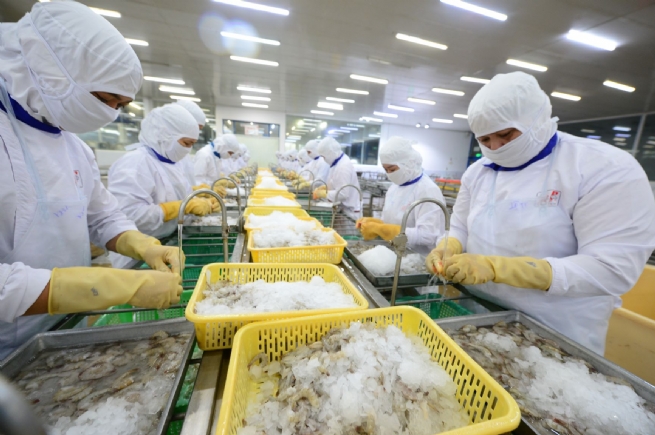
In 2020, despite being strongly affected by the Covid-19 pandemic, the fisheries sector still achieved positive results. The cultured output totaled 4.56 million tons, an increase of 1.5% over 2019. Specifically, pangasius output reached 1.56 million tons, and this product brought in an export value of US$1.5 billion (accounting for 18% of the sector’s total export value). The output of brackish water shrimp and black tiger shrimp reached 950,000 tons and 267,700 tons (up 1% year on year), respectively; and vannamei shrimp output was 632,300 tons (up 8.5%). Shrimp exports brought home US$3.7 billion (accounting for 44% of the sector’s total exports).
The marine culture consisted of 260,000 ha and 7.5 million cubic meters of cage, which produced 600,000 tons of products. Specifically, sea fish farming covered 8,700 ha and 3.8 million cubic meters of cages, which cultured 38,000 tons. Mollusks were cultured on 54,500 ha, harvested 375,000 tons in the year. Lobster was cultivated in 3.7 million cubic meters of cage, harvested 2,100 tons. Seaweed was farmed on 10,150 ha, harvested 120,000 tons.
The main aquatic seed production basically met the demand for commercial farming, according to Mr. Luan. The country had 2,362 brackish shrimp hatcheries, which turned out 79.3 million shrimp seeds. The Mekong Delta had about 120 producers of pangasius seeds with about 2 billion pangasius breeds. 60 million breeding fish were replaced for better reproductivity.
Maintaining 1.3 million ha of aquaculture area
Exports were disrupted by border lockdowns, closures of fast-food restaurants in major importers, delayed shipping, canceled or delayed orders. Some customers refused to place new orders, said General Director Luan when talking about difficulties and shortcomings of the fisheries sector.
In addition, input supplies for feed production were severely affected. The continuous rise of input prices resulted in higher production costs and weakened product competitiveness. The consumer demand for expensive aquatic products like lobster, babylonia areolata and groupers also decreased because they were mainly exported and cooked by restaurants.
He proposed the ministry's leaders direct the Department of Animal Health and the Plant Protection Department, which are responsible for inspecting quality and quarantine of imported inputs, to make full statistics on input costs and key importers.
It is necessary to advise the Ministry of Agriculture and Rural Development to work with relevant ministries and agencies on plans and solutions to negotiate with major suppliers of inputs for fish feed and animal feed production to have a stable and suitable input source and propose mechanisms and policies to support businesses to stabilize production in difficult times.
The Directorate of Fisheries also requested that the Department of Science, Technology and Environment under the Ministry of Agriculture and Rural Development, and research institutes, coordinate with enterprises to urgently study and find technological solutions and seek input sources to replace scarce and expensive inputs.
Together, localities need to pay attention to developing chain models to reduce intermediaries and production costs; strengthen inspection and control of conditions concerning establishment of producers and distributors of breeds, aquatic feeds and environmental treatment products; and strictly handle speculative and profiteering acts to force farmers to sell at undesirable prices and prevent the spread of false information.
Delivering a guidance keynote to the workshop, Deputy Minister Phung Duc Tien emphasized that there should be timely and drastic solutions to realize the sector’s goals in 2021.
Deputy Minister Tien assigned tasks to the fisheries sector in 2021: Keeping the aquaculture area of 1.3 million ha, including 450,000 ha for freshwater farming (5,700 ha for pangasius farming), 850,000 ha for saline and brackish water farming (630,000 ha for tiger shrimp farming and 110,000 ha for white-legged shrimp farming). The aquatic output will amount to 4.75 million metric tons in the year, 4.2% more than that in 2020 (1.55 million tons of pangasius, 980,00 tons of shrimp).
“It is necessary to further strengthen production connectivity to access high-quality input supply sources at reasonable prices, to reduce intermediaries, foster scientific application to increase productivity, lower costs, bring down feed conversion ratio and protect the water environment.
"The Directorate of Fisheries must strictly manage the quality of aquatic breeds and supplies; inspect producers of breeds, aquatic feeds, environmental treatment products used for farming; and strictly handle violations. The directorate must implement consistent solutions to control quality and price of aquatic feeds for farmers to stabilize production and prevent unreasonable pricing," he requested.
Deputy Minister Tien added that it is necessary to further apply new scientific and technological advances to enhance productivity, product quality and performance to meet domestic and international market needs.
Source: Vietnam Business Forum
 April 24–25, 2026
 Kinh Bac Cultural Center, Bac Ninh Province


 Vietnamese





