

8:30:22 AM | 5/14/2025

Ho Chi Minh City Infrastructure Investment Joint Stock Company (CII) has comprehensive financial, technical and know-how capabilities in urban infrastructure. The company has gradually deepened its participation in developing smart cities, green transportation and sustainable infrastructure and adapted to policy changes and future investment trends. Our reporter has an interview with Ms. Nguyen Quynh Huong, Deputy General Director of CII, to learn more.
 |
Ho Chi Minh City has maintained steady strong growth over the past 50 years. Could you please talk about impressive achievements and contributions of CII to that success?
CII, established in 2001, has effectively mobilized capital from various social channels, including the people and domestic and foreign financial institutions, to invest in infrastructure development.
Specifically, CII has raised more than VND30 trillion for transport infrastructure and water supply projects in HCM City and other localities. Particularly in the transport sector, CII has directly invested and implemented a series of connectivity projects that are development drivers for key areas, like Binh Trieu 2 Bridge and related roads, Dien Bien Phu-Kinh Duong Vuong Road, Saigon 2 Bridge, Rach Chiec Bridge, and expanded Hanoi Avenue.
At the same time, CII has also made practical contributions to the water sector through its projects like Tan Hiep 2 Water Plant, clean water distribution project for Cu Chi district and Thu Duc BOO project.
Over the past 24 years, CII increased its registered capital from VND300 billion (in 2001) to nearly VND3,198 billion in 2024, an increase of more than 10.6 times. This shows that CII has affirmed its good financial strength and capabilities to carry out gigantic projects and demonstrates its long-term vision and its trust to investors.
How have CII’s projects impacted HCM City’s socioeconomic development?
CII focuses on investing in strategic transport projects that help promote the socioeconomic development of HCM City and neighboring localities. Its typical projects include expanded Hanoi Avenue that links the downtown with neighboring provinces such as Binh Duong and Dong Nai and Trung Luong-My Thuan Expressway that helps reduce the travel time from HCM City to My Thuan to only about 90 minutes. This project has helped expand the supply chain and trade performance and significantly eased pressure on the western gateway of HCM City. At the same time, the project has also enhanced the efficiency of land use and real estate in the suburbs.
In 2025 alone, CII plans to take part in Ho Chi Minh City-Trung Luong-My Thuan Expressway Expansion Project. Costing nearly VND40,000 billion, the project is expected to help raise traffic safety and foster economic development between HCM City and the Mekong Delta. It will help increase the value of real estate in neighboring localities like Long An and Tien Giang and encourage the formation of satellite urban areas and the expansion of western urban spaces of HCM City.
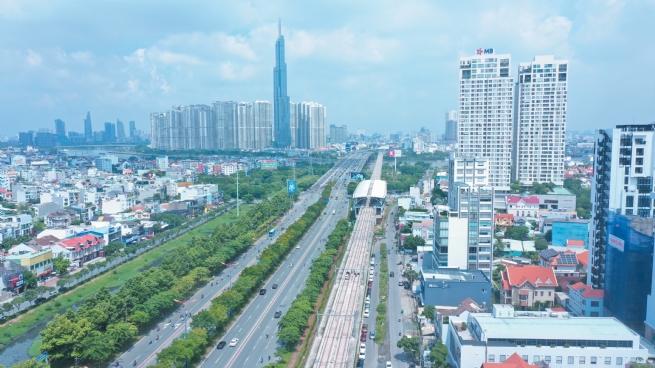
CII's sustainability strategy is the harmonious combination of long-term investment in traffic infrastructure and real estate development
What strategy does CII have to ensure the sustainable development of real estate and traffic infrastructure and cooperate with the city government in developing urban infrastructure?
CII's sustainability strategy is the harmonious combination of long-term investment in traffic infrastructure and real estate development. This not only improves investment efficiency but also creates a synchronous urban ecosystem, well-connected traffic and sustainable asset growth.
One of CII’s key projects is researching and developing Hang Xanh TOD (Transit-Oriented Development) Project-a compact urban model integrated with public transport, suitable for smart city and sustainable development trends. The project has a total preliminary investment fund of VND216 trillion (more than US$8.5 billion). This is one of a few TOD projects based on substantial improvements for existing residents, without trading off mass relocation or breaking local social structure. This clearly demonstrates the spirit of sustainable development pursued by CII.
In urban infrastructure, CII is an active partner of HCM City in many public-private partnership (PPP)-based development projects like expanded Hanoi Avenue, Rach Chiec Bridge and Saigon Bridge. These projects have helped ease congestion, improve traffic capacity and promote economic development in business districts.
At the same time, CII is always aware of its role as a socially responsible business. The company regularly carries out support programs like supporting free/reducing toll fees for households living near toll stations, which are greatly affected by toll collection, supporting communities affected by its projects and joining with the government in social security and charity programs.
Furthermore, CII also meets housing needs for middle-income earners. Most of CII's existing products are currently mainly affordable housing segments in peripheral areas like the Eastern part, Binh Chanh district and District 8. In addition, CII pays special attention to utilities, services and connectivity in mid-range housing projects.
What strategy does CII have to anticipate investment and development trends in HCM City?
CII has carried out a comprehensive, long-term and flexible development strategy, with a focus on five main pillars: Investing in strategic infrastructure projects with regional connectivity and urban connectivity, especially expressways, arterial roads and bridges in HCM City and provinces in the Southern key economic region; developing real estate with CII-invested infrastructure to optimize investment efficiency, ensure planning synchronization and improve the quality of life for residents; strengthening cooperation with international partners, not only in fundraising but also in project management, technology transfer and experience sharing; applying technology to management, construction and operation, improving governance efficiency, reducing costs, controlling quality and meeting smart urban development requirements; and strengthening financial capacity, risk management and commitment to transparency, complying with ESG standards and aiming for economically, environmentally and socially sustainable development.
With more than two decades of experience in infrastructure and urban projects, CII expects HCM City to reduce the time of settling administrative procedures, especially legal procedures for infrastructure and housing investment projects and new development models like TOD. The company hopes that the city has a clearer and more flexible mechanism in implementing PPP projects, especially those relating to capital recovery plans, risk sharing and output assurance.
Moreover, HCM City needs to actively support site clearance and resettlement; promote synchronous and long-term stable planning and create a basis for businesses to confidently make investments; establishes a regular government-business dialogue mechanism and encourages and supports businesses to innovate and apply technologies and sustainable urban models in investment and development in line with the city's future development orientation.
With strong support from the government, CII believes that not only CII but the entire business community will have more motivation to make long-term investments and create real value for the city and its people.
Thank you so much!
By Duy Anh, Vietnam Business Forum


 Vietnamese





