

11:57:20 AM | 5/26/2025

Although the agriculture and environment sector boasts a current workforce of over 11,400 scientists, its performance and output remain relatively modest. Given this reality, there is a pressing demand for policies that engage talents and the private sector in scientific and technological research to lay the groundwork for fresh breakthroughs in the agriculture and environment sector in the new era of development.
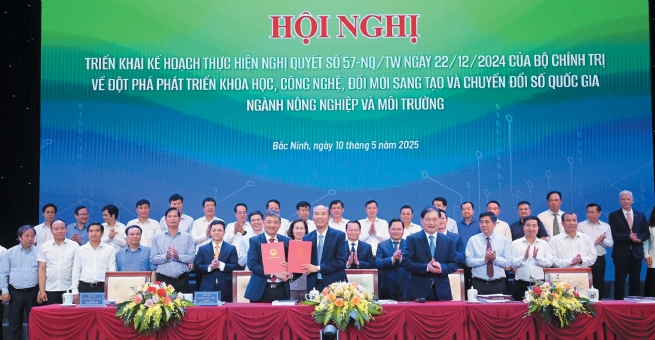
The MoU signing ceremony at the event
Golden opportunity for Vietnam to emerge as a developed nation
Speaking at a recent conference on implementation of the “Plan for execution of Resolution 57-NQ/TW of the Politburo on breakthrough development in science, technology, innovation and national digital transformation” in the agriculture and environment sector, jointly organized by the Ministry of Agriculture and Environment and the Bac Ninh Provincial People’s Committee in Bac Ninh province, Minister of Agriculture and Environment Do Duc Duy emphasized that Resolution 57-NQ/TW, issued by the Politburo on December 22, 2024, sets out a long-term strategic vision and recognizes science, technology, innovation and digital transformation not only as core drivers of sustainable development, but also as a pivotal opportunity for Vietnam to elevate itself into a powerful, prosperous and developed nation in the new era.
He pointed out that agriculture and the environment are currently under growing pressure from climate change, resource depletion, environmental pollution and water security challenges. Traditional models of agricultural production, characterized by manual labor, high input costs and low added value, are no longer suitable.
Minister Duy outlined five key focus areas for driving transformation in the agriculture and environment sector:
First, there is the need to improve the regulatory and policy framework and streamline administrative procedures to remove bottlenecks and unlock innovation flows across both the public and private sectors. The effective mobilization of domestic and international resources for science and technology will be a critical factor in this effort.
Second, it is important to identify and prioritize huge potential fields such as biotechnology and genetic engineering that can boost product quality, conserve resources and create added values for the agriculture and environment sector.
Third, public science and technology institutions will be reorganized to become leaner, more efficient and more competitive, and to have a stronger capacity to transfer know-how to the private sector. Research projects will be assigned through a demand-driven, competitive bidding model, closely aligned with actual production needs and geared toward commercialization.
Fourth, it is necessary to develop high-quality human resources in science, technology and digital transformation, with better integration between education, research and practical application.
Fifth, comprehensive digital transformation will be accelerated, from policy planning and governance to production and consumption, so that digital data, digital technology and the digital economy become truly competitive advantages in this new development phase.
Dr. Nguyen Van Long, Director of the Department of Science and Technology under the Ministry of Agriculture and Environment, said, although the sector has a workforce of over 11,400 scientists, its performance and output remain modest. One of the key reasons is the lack of competitive employment policies that incentivize innovation and talent development. The Ministry of Agriculture and Environment already acknowledged this issue and officially recommended the Ministry of Science and Technology revise the Law on Ministry of Science and Technology, aiming for a more open and practical framework.
He added that only about 46% of the total budget for science and technology is allocated directly to research. The remainder is spent on administrative operations, salaries and overhead, which significantly undermines the sector’s ability to produce commercially viable or practically applicable research outcomes.
“In reality, we have tremendous potential, but we’re still stuck with outdated management mindsets and lack meaningful autonomy for scientific organizations, in terms of finance, task assignments and human resources. While businesses can access capital and invest in research and development, research institutions remain constrained by inelastic administrative frameworks and limited decision-making power,” he noted.
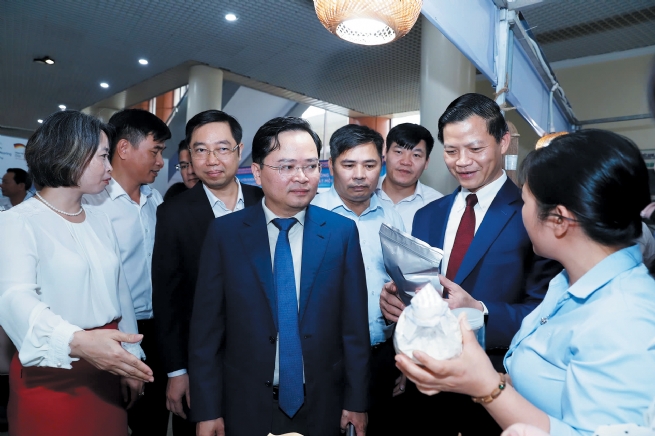
Delegates listen to a presentation on high-quality agricultural products applying science and technology in production
Businesses and the private sector eagerly embrace scientific and technological research
Speaking at the workshop, Professor Laurent Marc El Ghaoui, Vice Rector of VinUniversity (VinUni), said his university has made remarkable progress in research on urban transportation facilities, advanced marine aquaculture and meteorological monitoring.
“We are committed to investing intellectual and technological resources to translate scientific ideas into practical, actionable solutions. VinUni aims to continuously expand its role within the science and technology ecosystem, thus contributing to the development of green economy, smart agriculture, and sustainable society,” he added.
Dr. Nguyen Van Diep, CEO of AVAC Joint Stock Company, asked the government to assign more scientific and technological research tasks to businesses to develop new generations of more effective vaccines against African swine fever.
Mr. Nguyen Duc Truong, General Director of Dai Thanh Company, underlined existing pressing challenges in agriculture, namely the low operating accuracy of current agricultural machinery. For example, rice transplanters can’t plant in straight lines, drones struggle with precision flight, harvesters can’t calculate yield, and plows lack depth control. In the coming years, precision agriculture, powered by technologies like the Internet of Things (IoT), big data and AI analytics, will be vital.
Speaking at the event, Dr. Phan Xuan Dung, President of the Vietnam Union of Science and Technology Associations (VUSTA) and former Chairman of the National Assembly’s Committee on Science, Technology and Environment, said that VUSTA has 3.7 million members, including over 2.2 million intellectuals and 574 scientific and technological organizations nationwide. VUSTA has fostered a broad research movement that engages a lot of talent, especially in key areas like agriculture and the environment.
He proposed that central agencies place more research orders and effectively utilize scientific achievements, particularly those addressing real-world issues like poverty reduction and environmental protection. He also underscored the importance of public communications on science, especially in remote areas, and of recognizing the contributions of intellectuals to create stronger momentum for development in the new era.
By Bich Hanh, Vietnam Business Forum






 Vietnamese





