

10:39:16 AM | 7/26/2025

“Developing hi-tech supporting businesses offers great potential if strategically focused,” said Mr. Cao Dai Thang, Chairman of INTECH Group, about the development journey of INTECH Group and the future potential of Vietnam’s high-tech supporting industry.
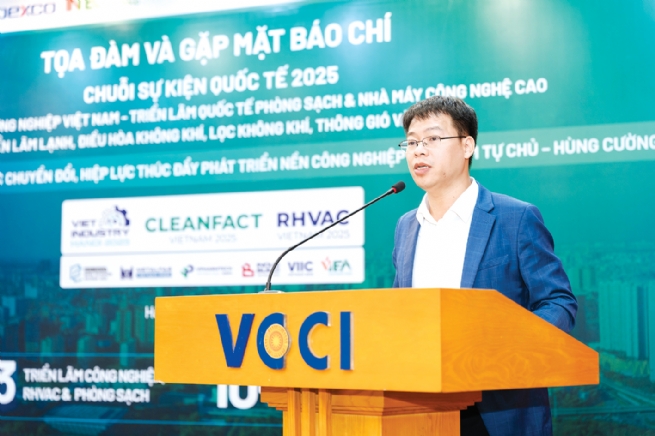
INTECH Group is known as a capable producer of cleanrooms - a core supporting industry for many other sectors. Could you please tell us why INTECH Group chose to focus on this area and what challenges it faced in business?
INTECH Group started investing in the cleanroom sector more than 10 years ago when we realized that, to enable Vietnam to truly meet sophisticated requirements from FDI investors and to deeply participate in the global supply chain in industries such as electronics, pharmaceuticals, healthcare and semiconductors, cleanrooms are a required infrastructure.
We do not see cleanrooms simply as technical products but foundational infrastructure for high-tech industries. Therefore, INTECH has made comprehensive investments, from R&D team, equipment design and manufacturing capabilities to integrated construction and post-project operation management. We control almost the entire value chain, from manufacturing cleanroom equipment to auxiliary equipment, aiming to localize production to reduce costs, enhance quality control and shorten delivery times.
In our operations, the biggest challenge we face is not meeting technical standards, but rather the ability to integrate solutions tailored to specific manufacturing technologies of each factory, especially in high-tech fields such as semiconductors, medical devices and pharmaceuticals. Many manufacturers in Vietnam lack qualified technicians or R&D experts to clearly define requirements. This means that implementation units like INTECH cannot just follow blueprints but must also act as technology partners who deeply understand production processes and support them from layout design, HVAC and pressure control to clean air supply and environmental condition management.
Another major challenge is the shortage of highly skilled technical personnel. Cleanroom engineers need not only to be proficient in electromechanics but also to be expert in international standards - something the current Vietnamese labor market cannot fully meet. Additionally, dependency on imported equipment increases investment costs and limits flexibility in deployment.
However, INTECH sees this as an opportunity to build our own core competencies. We have an in-house training center for specialized engineers and are simultaneously localizing cleanroom equipment. This allows us to better control quality, shorten project timelines and optimize costs for our clients.
Currently, INTECH is the first and only company in Vietnam to design and successfully construct a Class 1 cleanroom - the highest cleanliness level in the world, certified by NEBB of the United States. This is not only a milestone in technical expertise but also a testament to our long-term commitment to developing clean industrial infrastructure in Vietnam.
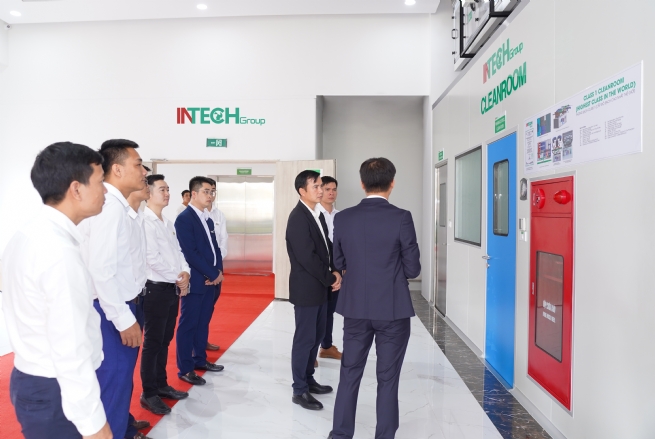
Deputy Minister of Science and Technology Bui The Duy visits INTECH Group's ISO Class 1 clean room project
Besides cleanrooms, would you share more about your products in the high-tech supporting industry and the future goals?
In addition to cleanrooms, one of our key focus areas, INTECH Group is currently developing integrated solutions for the high-tech supporting industry, especially in semiconductors, a sector regarded as the backbone of future industries.
Our expertise focuses on developing comprehensive solutions for high-tech factories: from strategic consulting, layout design and equipment line selection to the implementation of auxiliary technical systems, integrated monitoring and control systems, and other supporting technologies.
Currently, INTECH Group is also one of the very few private Vietnamese companies with a clear vision and long-term strategy in semiconductor manufacturing infrastructure consulting, ranging from front-end and back-end processes to training for operations and maintenance. We are actively cooperating with experts from the United States, South Korea, Taiwan, China and Malaysia to transfer technology, update standards, and learn from the practical experiences of leading countries.
Our goal is to become a strategic partner for both domestic and international investors, work alongside them from the initial stages to optimize infrastructure, ensure efficient operations and meet international standards. Our vision is to become a pioneering Vietnamese company with full capabilities in consulting, design and implementation for high-tech factories.
What is the potential of Vietnam’s high-tech supporting businesses, and what must be done to meet the requirements of upstream supply chain businesses?
Vietnam is transforming from an economy based on assembly and resource exploitation to one driven by the development of high-tech industries. This is an essential transformation, powered by national policies on digital transformation, the semiconductor industry development strategy, and deeper integration into global supply chains. Many giant tech firms are investing in Vietnam, leading to significant demand for a supporting ecosystem, from production infrastructure, cleanrooms and auxiliary equipment to specialized technical solutions.
I believe that high-tech supporting businesses in Vietnam have tremendous potential, not only due to opportunities from the global shift in manufacturing, but also due to our foundation to grow rapidly if strategically focused. Especially in areas such as precision engineering, automation, electrical-electronic equipment, industrial components and advanced materials, Vietnam can become an important link in the global value chain if properly invested.
However, to meet the stringent requirements of upstream businesses which always demand excellence in technical standards, timelines, quality control and management capacity, Vietnamese businesses must shift their mindset. They can no longer just fulfill orders, but they must actively build core competencies, expand R&D activities and strictly adhere to international standards such as ISO, CE, RoHS and NEBB.
In particular, for infrastructure and cleanroom development, if businesses only play the role of contractors without deeply understanding the production lines, manufacturing processes and key sector-specific factors, it will be difficult for them to meet the expectations of high-tech corporations. Therefore, learning from leading firms, connecting with domestic and international experts, and participating in technical and scientific forums is essential to uplift practical capabilities of technical teams.
One major bottleneck remains the workforce. According to industry surveys, only about 20% of mechanical businesses currently possess design capabilities yet this is a critical skill for participating in higher tiers of the supply chain. Therefore, it is vital to invest in deep training, strengthen linkages with universities, research institutes, and industry leaders.
For its part, the government needs to promptly enforce support policies outlined in Resolutions 57 and 68 through preferential credit programs, investment in shared technical infrastructure such as testing centers, laboratories, R&D facilities, and especially the creation of a transparent bidding environment to enable private companies to engage deeper in major projects.
At INTECH Group, we have chosen to make long-term investments in R&D, capacity building to localize equipment, and master integrated high-tech solutions. We believe that only when Vietnamese businesses become competitive in the domestic market can they confidently enter the international market, and that is the sustainable path toward building a self-reliant and resilient industrial sector as envisioned by the government.
Thank you very much!
By Lan Anh, Vietnam Business Forum


 Vietnamese





