

8:48:23 AM | 8/25/2025

At the recent 2nd National Obstetrics and Gynecology Conference 2025, Associate Professor Dr. Vu Van Tam, Vice President of the Vietnam Association of Obstetricians and Gynecologists (VAGO) and Director of Hai Phong Obstetrics and Gynecology Hospital, provided an update on maternal immunization practices. He emphasized the crucial role of maternal antibody transfer and its significance in helping protect infants during the first months of life.
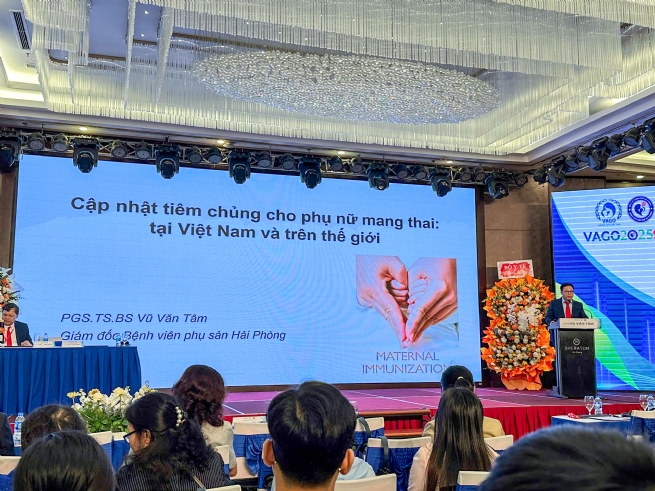
Associate Professor Dr. Vu Van Tam, Vice President of the Vietnam Association of Obstetricians and Gynecologists (VAGO) and Director of Hai Phong Obstetrics and Gynecology Hospital, delivers a speech
On this occasion, Pfizer Vietnam, in collaboration with VAGO, hosted a symposium “Maternal Immunization in Vietnam and Worldwide Today.” The event aimed to underscore scientific advances in preventive measures for pregnant women while enhancing the capacity of obstetric and gynecological healthcare professionals in providing counseling and ensuring the safe and effective implementation of immunization.
The symposium brought together leading experts in obstetrics and gynecology from across Vietnam, including Professor, Ph.D., Dr. Nguyen Viet Tien, President of the Vietnam Association of Obstetricians and Gynecologists (VAGO); Meritorious Doctor, Associate Professor, Ph.D., Dr. Huynh Nguyen Khanh Trang, Head of Obstetrics at Hung Vuong Hospital and Head of the Department of Obstetrics and Gynecology at Pham Ngoc Thach University of Medicine; Dr. Bach Thi Chinh, Medical Director of VNVC Vaccination Center; and Dr. Pham Thi Thuy Trang from the Medical Department of Pfizer Vietnam. The event also drew participation from many doctors and specialists in obstetrics and gynecology from across the country.
At the symposium, speakers addressed three pressing themes: the role, challenges, and future prospects of maternal immunization in protecting young children from infectious diseases; maternal immunity as a preventive approach to protect newborns from RSV-related pneumonia.; and strategies to strengthen community-wide protection against RSV.

Leading experts participated in symposium “Maternal Immunization in Vietnam and Worldwide Today”
Maternal immunity – Protecting newborns from the very first day
According to experts at the symposium, during pregnancy, changes in the body and immune system make mothers more vulnerable to infectious diseases, which can affect not only their own health but also that of their babies before and after birth.
Meanwhile, the first months of life are when newborns are most vulnerable to infectious diseases, as their immune systems are still immature and direct immunization at this stage is often less effective. During this period, babies rely mainly on passive antibodies passed from their mothers to stay protected until they can develop their own active immunity.
This is why maternal immunization is considered a key solution, providing protection for babies from the moment they are born through the transfer of antibodies from mother to child. Antibodies generated in mothers are not only stronger than natural antibodies but also last for at least six months after birth, helping reduce the risk of infection and mortality in newborns.
RSV – A leading threat to newborns
One of the leading causes of infections in newborns and young children worldwide is acute lower respiratory tract disease caused by respiratory syncytial virus (RSV). According to the World Health Organization (WHO), nearly all children will have been infected with RSV at least once by the age of two.
Statistics show that in 2019, there were an estimated 33 million cases of acute lower respiratory tract infections associated with RSV. Each year, RSV leads to more than 3.6 million hospitalizations and claims the lives of over 100,000 children under the age of five, with 97% of these deaths occurring in low- and middle-income countries where access to healthcare remains limited.
RSV is a leading cause of illnesses ranging from mild upper respiratory infections to severe, life-threatening lower respiratory tract infections.

General view of the conference
Speaking at the symposium, Meritorious Doctor, Associate Professor, Ph.D., Dr. Huynh Nguyen Khanh Trang, Head of Obstetrics at Hung Vuong Hospital and Head of the Department of Obstetrics and Gynecology at Pham Ngoc Thach University of Medicine, noted: “Hospitalizations due to RSV occur most frequently in the first three to six months of life, regardless of gestational age at birth. RSV-related lower respiratory tract infections in newborns can lead to both short- and long-term complications such as bronchiolitis, pneumonia, wheezing, acute otitis media 8, recurrent lower respiratory infections, impaired lung function, and asthma. Today, scientific advances have helped address an important unmet medical need, providing maternal immunization that generates specific polyclonal antibodies to protect infants throughout their first six months of life.”
Professor, Ph.D., Dr. Nguyen Viet Tien, President of the Vietnam Association of Obstetricians and Gynecologists (VAGO), stated that maternal immunization is now proposed by many major health organizations, including the Vietnam Association of Preventive Medicine, as an important measure to protect infants in their earliest months of life. Among these, new approaches to help protect against respiratory syncytial virus (RSV)help reduce the disease burden in newborns, the group at the highest risk of severe illness and mortality from RSV.
He also emphasized: “Despite its clear health benefits, maternal immunization for RSV still faces many barriers. For instance, a study conducted in Southern England showed that up to 88% of pregnant women have little or no knowledge about the disease. This is why healthcare professionals play a crucial role in counseling and educating the community, especially parents, about RSV and its serious complications, as well as the reality that there is currently no specific treatment beyond supportive care. Building immunity during pregnancy allows antibodies to be transferred through the placenta, protecting infants from birth and lasting for at least the first six months of life.”
Dr. Bach Thi Chinh, Medical Director of VNVC Vaccination Center, said: “To date, 60 countries have approved certain RSV prevention approaches for use in pregnant women to protect newborns. In its latest 2025 update, the World Health Organization (WHO) has considered the use of measures to prevent RSV-related lower respiratory tract disease in infants. Babies born with RSV antibodies transferred from their mothers are protected during the first six months of life, the period when they face the highest risk of severe illness.”
Mr. Darrell Oh, General Director of Pfizer Vietnam, shared: “At Pfizer Vietnam, we are committed to working alongside the community and healthcare professionals to prevent and treat infectious diseases, particularly among vulnerable groups such as pregnant women and newborns. We are honored to collaborate with the Vietnam Association of Obstetricians and Gynecologists to provide experts with updated scientific knowledge on RSV prevention and the vital role of preventive measures during pregnancy, thereby supporting capacity building for healthcare providers. Guided by our mission to deliver breakthroughs that change patients’ lives, we remain committed to bringing advanced scientific solutions to help protect the health of mothers and babies from the very beginning of life.”
Source: Vietnam Business Forum


 Vietnamese





