

11:23:25 AM | 12/18/2025

Building on 70 years of diplomatic relations, Vietnam and Indonesia have entered a dynamic phase of development marked by a key milestone: the elevation of their relationship to the Comprehensive Strategic Partnership. This step creates opportunities to expand trade and investment into new sectors, serving as a strong growth driver within ASEAN.
Trade accelerates, reflecting strong integration
Over the past decades, trade and investment relations between Vietnam and Indonesia have achieved significant progress. Indonesia is now Vietnam’s second-largest trading partner in ASEAN, while Vietnam ranks fourth among Indonesia’s trading partners. Bilateral trade has doubled, rising from US$8.07 billion in 2020 to US$16.7 billion in 2024, a growth rate rarely seen in the region.
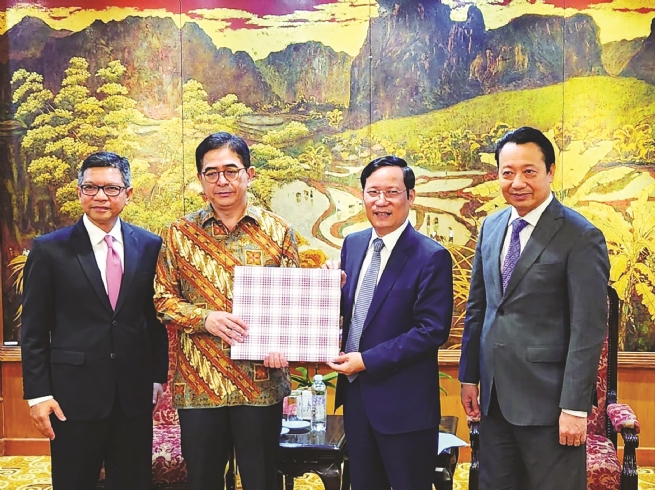
In March 2023, VCCI leaders hold a working session with the leadership of the Indonesian Chamber of Commerce and Industry (KADIN)
According to the statistics of Vietnam Customs, the country’s exports to Indonesia in the first ten months of 2025 reached more than US$4.74 billion, with a diverse range of products including rice, seafood, coffee, chemicals, plastics, footwear, textile raw materials, and steel. Notably, transport vehicles and parts totaled over US$616 million, up 74.7% and accounting for 13% of total exports, leading all export categories, followed by textiles at US$416.6 million, up 12.1%. Other sectors also recorded strong growth: chemicals increased 155.9%, rubber 92.6%, and livestock feed and raw materials 254.3%, reflecting the growing competitiveness of Vietnamese products in a market of over 290 million people.
The bilateral trade structure also ensures key “security” factors: Indonesia provides essential inputs for energy security and production, while rice agreements help stabilize food security. The share of electronic components in bilateral trade has risen, indicating positive integration into regional supply chains.
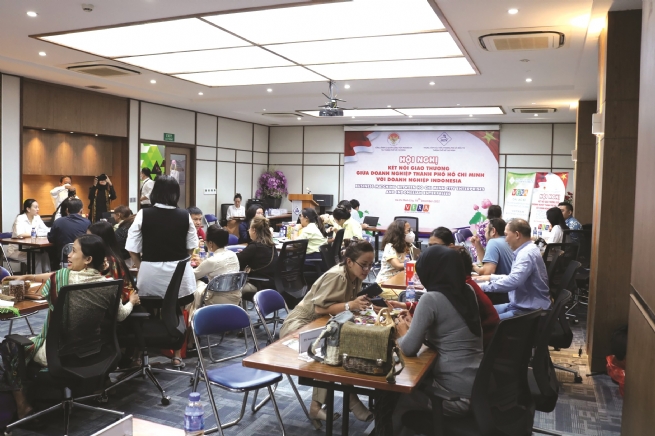
Economic experts consider Indonesia a strategic market for Vietnam in Asia due to its large consumption scale, especially in the Halal product segment, which still has considerable growth potential. Based on current foundations, the target of raising bilateral trade to US$18 billion in the near term is fully achievable.
Investment growth expands into new sectors
According to the Ministry of Industry and Trade, Indonesian enterprises have invested nearly US$700 million in Vietnam, primarily in food processing, energy, construction materials, logistics, and retail.
Indonesia has also become an attractive destination for Vietnamese businesses, particularly in information technology, consumer goods, high-tech agriculture, green industry, and manufacturing. Vietnamese investment aligns with Indonesia’s nine priority sectors, including renewable energy, downstream industries, food security, semiconductors, the new capital Nusantara (IKN), and the digital economy. Prominent areas include electric vehicles, mechanical engineering, new materials, renewable energy, trade, and hospitality. Several large-scale projects, such as VinFast plants, are being promoted, simultaneously developing an electric vehicle ecosystem and utilizing local nickel resources in line with Indonesia’s downstream industrialization strategy.
Opportunities from regional agreements
Both countries participate in the ASEAN Trade in Goods Agreement, ASEAN+ FTAs, and especially the Regional Comprehensive Economic Partnership (RCEP), significantly expanding access to Asia-Pacific markets while enabling Vietnamese and Indonesian businesses to strengthen global supply chain links in electronics, textiles, agricultural products, and green industries.
The 2024-2028 Action Plan for implementing the Comprehensive Strategic Partnership also opens new avenues for cooperation. In energy transition, Indonesia has significant natural carbon storage potential, suitable for developing carbon capture and storage (CCS) and carbon capture, utilization and storage (CCUS) models, as well as carbon credit markets. Vietnam has strong industrial capabilities and growing energy transition demand, creating favorable conditions to jointly build green value chains such as offshore wind and regional grid systems. In the Halal sector, harmonizing standards will allow Vietnamese agricultural and seafood products to penetrate deeper into the world’s largest Muslim market, creating further opportunities to expand into the Middle East.
Vietnam and Indonesia have upgraded their relationship to the Comprehensive Strategic Partnership, establishing a framework for deep cooperation and sustainable economic linkages. According to the Department of Foreign Market Development (Ministry of Industry and Trade), bilateral economic relations could achieve breakthroughs by focusing on four areas: strengthening policy dialogue and digitalizing trade procedures; enhancing production linkages in high value-added sectors such as pharmaceuticals, medical equipment, processed agricultural products, green energy, and logistics; promoting business connectivity through trade fairs, digital platforms, and innovation programs; and developing human resources and technology transfer related to smart manufacturing and supply chain management.
Huong Ly (Vietnam Business Forum)
 April 24–25, 2026
 Kinh Bac Cultural Center, Bac Ninh Province


 Vietnamese





