

1:55:06 PM | 12/18/2025

Amid a global downturn in foreign direct investment (FDI), Bac Ninh is emerging as a stable and attractive destination, leading the country in newly registered FDI, ranking second in total adjusted capital, and consistently securing billion-dollar projects from multinational corporations. This momentum requires the province to reposition its strategy by moving from expansion to refinement and from relying on incentives to competing through stronger institutions, better infrastructure, skilled human resources, and higher green standards.
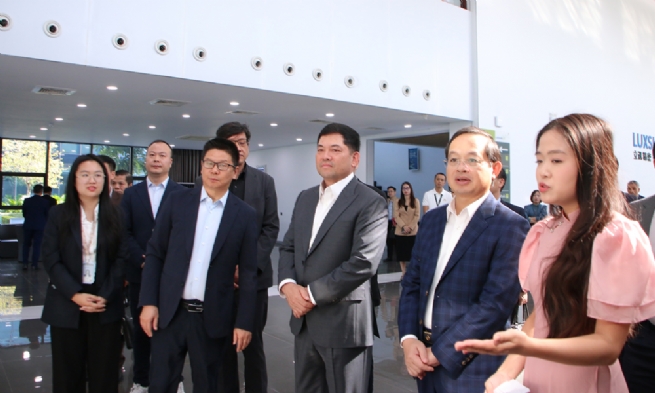
Provincial Party Secretary Nguyen Hong Thai visits the product showcase of Luxshare ICT Company
From electronics center to high-tech hub
In the first ten months of 2025, Bac Ninh maintained strong momentum with over US$16.2 billion in registered FDI, ranking second nationwide and leading in new FDI projects. To date, the province’s industrial zones have attracted 2,805 FDI projects with total registered capital of US$44.85 billion, despite the global FDI slowdown. The presence of leading technology corporations such as Samsung, Canon, Amkor, Foxconn, Sunwoda, Goertek, and Amphenol has created one of the country’s largest ecosystems for electronics, telecommunications, and smart device manufacturing.
While 2013-2020 was the “Samsung cycle,” when Bac Ninh grew rapidly due to a single major project, 2025-2030 marks the “FDI repositioning cycle,” as the province shifts from attracting investment by quantity to competing through quality and technology. Capital from South Korea, Japan, Singapore, and Europe continues to flow under the “China+1” model, giving Bac Ninh the opportunity to move from traditional electronics to semiconductors, smart devices, clean energy, and biotechnology.
Notably, industrial production has recovered strongly, with the production index in October 2025 up 20.84% and up 16.45% over the first ten months. Meanwhile, 6,060 new enterprises were established, a sharp increase compared to the same period last year. These signals indicate that FDI momentum is not only driving new project inflows but also spreading into the domestic business ecosystem, laying the foundation for long-term growth.
Supporting industry, green standards and infrastructure drive FDI upgrade
To become a leading high-tech and sustainable industrial hub by 2030, Bac Ninh has identified upgrading supporting industries and adopting green standards as essential priorities. The province currently has 33 approved industrial parks covering a total area of 10,566 ha, with an average occupancy rate of 56.56%. Under the new plan, the number of industrial parks will expand to 50, covering 15,202 ha, strategically positioning the province to attract large-scale high-tech investment over the next 20 years.
Bac Ninh has set new requirements for industrial park developers, including increasing green space and water surfaces, enhancing social infrastructure for workers, and integrating essential services such as healthcare, education, and cultural and sports facilities. This represents a shift from focusing solely on technical infrastructure to creating comprehensive infrastructure that meets international standards for green industrial parks.
Project selection prioritizes sectors such as next-generation electronics, semiconductors, biotechnology, new materials, renewable energy, and projects with R&D centers. The province also reserves space in each industrial park for small and medium enterprises and innovative startups, ensuring connectivity within the value chain - an area that was previously less emphasized.
Another breakthrough is Bac Ninh’s recommendation to the central government for the early passage of the Industrial Park and Economic Zone Law, which will eliminate overlaps between land, investment, construction, and environmental regulations. A unified legal framework will shorten project implementation times, reduce compliance costs, and enhance competitiveness compared with regional destinations such as Thailand, Indonesia, and Malaysia.
Selective investor-oriented approach
Bac Ninh is shifting from a reactive approach to actively guiding, supporting, and serving businesses. In the coming years, the province will promote investment professionally, focusing on markets such as Japan, South Korea, the EU, the United States, Singapore, and the UAE, which are known for high technology and strict environmental standards. Bac Ninh aims to attract at least two multinational high-tech companies to invest in R&D centers or large production facilities between 2026 and 2030.
At the same time, the province emphasizes retaining existing investors, who have generated over VND1,600 trillion in industrial output to date. Regular problem-solving initiatives related to labor, materials, markets, and finance help enterprises maintain stable operations amid global economic fluctuations.
Workforce development remains a long-term priority. Bac Ninh works closely with universities and vocational colleges to create high-skilled technical training programs and promote an enterprise-customized training model. This approach is highly valued by multinational companies such as Samsung, Canon, and Foxconn because it directly impacts their ability to expand production in the future.
With long-term industrial planning, modern industrial park infrastructure, a selective project strategy, and a focus on green development, Bac Ninh is building a strong foundation to reposition itself on the regional FDI map. The province aims to be not just the electronics center but also Vietnam’s high-tech, sustainable, and smart industrial hub for the next decade.
By Ngo Khuyen, Vietnam Business Forum
 April 24–25, 2026
 Kinh Bac Cultural Center, Bac Ninh Province


 Vietnamese





