

3:42:03 PM | 12/19/2025

Dien Bien’s agriculture and environment sector is entering a breakthrough stage of development, gradually affirming its central role in driving economic growth, protecting natural resources, and supporting businesses on the path toward sustainable development.
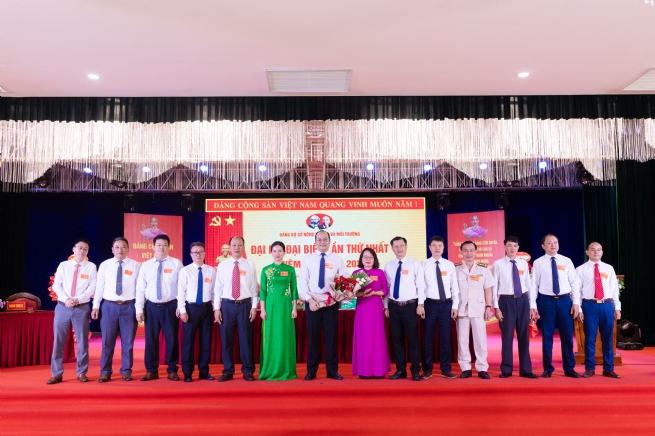
The Party Committee of the Dien Bien Department of Agriculture and Environment holds its First Congress for for the 2025-2030 term
Restructuring for effective operations
In line with Resolution 224/NQ-HDND dated February 20, 2025, the Dien Bien Department of Agriculture and Environment was officially established and put into operation on March 1, 2025, following the merger of the Department of Agriculture and Rural Development and the Department of Natural Resources and Environment. The department has reorganized its structure toward greater efficiency, effectiveness, and streamlined operations. Subordinate units, including the Agricultural Sub-Department, Regional Agricultural Service Centers, Regional Land Registration Office Branches, and Regional Forest Protection Units, have been comprehensively restructured.
As of July 1, 2025, the Department of Agriculture and Environment’s new structure includes one director, five deputy directors, four professional divisions, four sub-departments, eleven public service units, and four state financial funds. This new organizational model has proven effective, ensuring smooth professional operations and strong performance of the province’s political tasks. It has also laid a solid foundation for effectively implementing economic and social development programs and plans.
In the first six months of 2025, the sector achieved remarkable results. The total value of agricultural, forestry, and fishery production (at 2010 constant prices) was estimated at VND1.25 trillion, up 1.71% compared to the same period in 2024.
In crop production, the province cultivated more than 32,800 ha of grain crops, with winter-spring rice output reaching nearly 60,000 tons, exceeding the annual plan. Long-term industrial crops such as macadamia, coffee, and tea continued to expand, including over 1,500 ha of newly planted macadamia. Output of rubber latex, tea buds, and fruit crops also recorded growth compared to the same period last year.
The livestock sector remained stable, with a total herd of nearly 576,000 cattle and over 5 million poultry. Total meat output reached 14,235 tons, while aquaculture production exceeded 2,500 tons. Notably, three aquaculture facilities in Dien Bien have been certified under VietGAP standards.
In forestry, the province has maintained over 800 ha of planted forests, naturally regenerated more than 2,600 ha, and produced over 1.6 million seedlings. National target programs have also delivered positive outcomes, with two communes meeting the model new rural standards and five achieving advanced new rural standards, while the poverty rate decreased to 19.3%.
In irrigation, more than 9,450 ha received sufficient water during the winter-spring crop season. The proportion of rural residents with access to hygienic water reached nearly 93%. Land, mineral, and environmental management have been implemented comprehensively and effectively across the province.
Promoting administrative reform
Dien Bien has favorable land resources, climate, and ecological conditions for developing commercial agriculture, particularly perennial crops such as macadamia, coffee, tea, and cinnamon. The Muong Thanh Field, the largest rice-producing area in the Northwest, offers a major advantage for forming raw material zones connected with processing and consumption.
The province also has strengths in livestock farming and aquaculture, supported by favorable terrain and abundant water resources. With more than 60% of its natural area covered by forest land, Dien Bien has great potential to expand the cultivation of medicinal plants and develop a forest-based economy.
In terms of minerals, Dien Bien currently has 63 mining sites with over 20 different types of mineral resources. To date, 36 mining licenses have been issued. Construction materials extracted locally have met most of the province’s internal demand, creating jobs and contributing to budget revenues.
For the 2025-2030 period, Dien Bien identifies agriculture as a priority sector for investment attraction, particularly in developing raw material zones and deep processing. In the mining sector, the province will continue surveying, zoning, and auctioning mining rights toward sustainable and efficient exploitation.
To enhance investment attraction, Dien Bien continues to accelerate administrative reform and strengthen business support. Following the merger, the Department of Agriculture and Environment submitted 21 proposals for provincial-level administrative procedure decisions, all of which have been publicized online. To date, more than 4,200 administrative dossiers have been processed, with no overdue cases reported.
The province has comprehensively implemented online public services, with all 249 eligible procedures now available for full or partial online processing. The Department of Agriculture and Environment has also proposed cutting processing times and simplifying documentation for three business-related procedures.
At the same time, enhancing the capacity and professionalism of officials and civil servants remains a top priority. The Department of Agriculture and Environment regularly conducts training courses to reinforce administrative discipline and public service ethics. Performance assessments are closely linked to work outcomes and the satisfaction of citizens and enterprises.
“The success of enterprises is also the success of our sector and the province. With a strong commitment to innovation and service, we will continue to create clean land reserves, facilitate investment, simplify administrative procedures, and support businesses in accessing incentive policies. The Department of Agriculture and Environment also acts as a bridge linking enterprises with farmers and cooperatives to develop sustainable value chains,” said Le Xuan Canh, Director of the Department of Agriculture and Environment.
|
Effective Implementation of Forest Environmental Service Payments The Dien Bien Forest Protection and Development Fund, under the Department of Agriculture and Environment, has implemented innovative solutions to ensure the effective operation of the Forest Environmental Service Payment (FESP) policy. With more than 419,000 ha of forest, Dien Bien is among the provinces with the largest forest areas, most of which are located in border communes inhabited by ethnic minorities. In 2024, the fund disbursed over VND211 billion to forest owners, and the 2025 plan targets VND273.7 billion. Thanks to this policy, by the end of 2024 nearly 97,000 households had directly participated in forest protection, helping residents secure stable incomes, reduce illegal logging, and strengthen community responsibility for forest conservation. PFES not only improves forest management, protection, and development but also links local livelihoods with environmental stewardship, contributing to social stability, security, and sustainable socioeconomic growth in Dien Bien. |
By Ngo San, Vietnam Business Forum


 Vietnamese





