10:30:16 AM | 12/26/2025

Vietnam is no longer seen as a destination for easy capital. The country is repositioning itself as global investment shifts, and foreign investors are now expected to bring technology, expertise, and social responsibility, not just money. This was the key message at a recent forum in Hanoi held by Business Forum Magazine on improving policies to attract next-generation FDI into industrial parks.
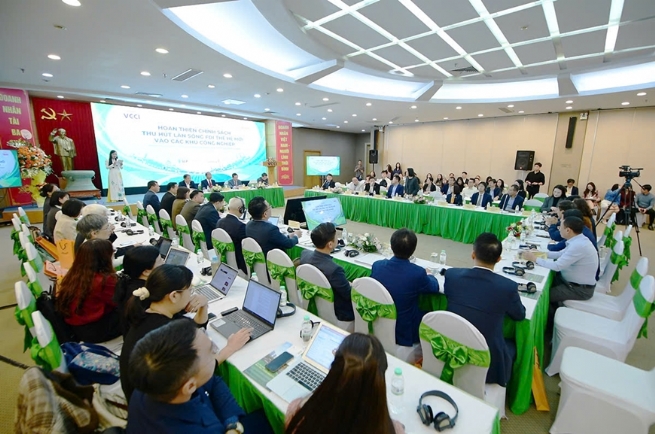
Overview of the forum on improving policies to attract next-generation FDI into industrial parks
Not attracting foreign capital “at any cost”
Nearly four decades of openness have shaped Vietnam’s industrial landscape through a steady flow of foreign capital. The introduction of Resolution 50-NQ/TW in 2019, which focuses specifically on FDI, marked an important shift from passive attraction to equal cooperation.
According to Hoang Quang Phong, Vice President of the Vietnam Chamber of Commerce and Industry (VCCI), next-generation FDI now meets stricter standards. It is no longer about labor-intensive factories but centers on core technology, green governance, and sustainable development commitments. The 2021-2030 foreign investment strategy implements this approach through “green lanes” and special incentives for semiconductor technology, a necessary step as the global economy restructures around green and digital priorities.
Although Vietnam has developed industrial parks for 29 years since the 1996 Foreign Investment Law created the first legal framework, the Net Zero 2050 target is pressuring the government and Ministry of Finance to review the entire incentive system. The concept of “incentives” is being redefined in draft decrees to recognize emissions reduction costs and industrial symbiosis models. This signals Vietnam’s readiness to reject billion-dollar projects that could harm the environment, creating room for truly high-quality investors. Looking at the actual numbers, Vietnam remains attractive. In the first ten months of 2025, total registered FDI reached US$31.52 billion, up 15.6% year-on-year, with a record disbursement of US$21.3 billion.
According to data from the Central Policy and Strategy Commission, while the absolute value of FDI has grown, its share of total social investment declined from a peak of 17.9% in 2018 to 16.5% in 2024, indicating a slowdown in growth contribution relative to the overall economy despite strong new registration figures.
Furthermore, the quality of this capital raises sustainability concerns. The localization rate of FDI enterprises is only 20-25%, significantly lower than in other East and Southeast Asian countries at a similar development stage, showing that Vietnam remains focused on assembly rather than deeper integration into value chains.
Nguyen Ba Hai, Deputy Director of the Trade and Investment Promotion Center (Ministry of Industry and Trade), said that Vietnamese firms mainly engage in low value-added stages. Dependence on imported materials and assembly-based production limits knowledge transfer from FDI to domestic enterprises. Although FDI firms pay wages about 20% higher than the national average, their focus on hiring unskilled labor constrains the long-term development of specialized skills among Vietnamese workers.
In Hai Phong, Nguyen Thi Bich Dung, Deputy Director of the Hai Phong Economic Zone Authority, reported that the city has attracted nearly 1,740 projects with total capital exceeding US$50.1 billion. Although high-tech investments have consistently represented 70-80% of inflows in recent years, local enterprises still struggle to meet the stringent requirements of multinational corporations, underscoring the need for targeted support policies and pilot cooperation models for wider replication.
Similarly, Truong Manh Hung, Director of the Quang Ninh Economic Zone Authority, offered a strategic view on this transition. With total FDI of US$17 billion, Quang Ninh is restructuring to prioritize industrial services over industrial utilities. Hung emphasizes the focus on specialized economic zones, such as the Quang Yen Coastal Economic Park and Viet Hung Industrial Park, which are developing automotive supply chains. However, while local capital is growing strongly, FDI tends to decline, making it essential to select strategic investors with clean technology and modern management to reverse this trend.
Infrastructure and workforce bottlenecks
Interest from major markets is real and growing, but it comes with rising caution. Nguyen Xuan Thanh Tung, Vice Chairman of the Vietnam-China Business Council (VCBC), said that over 50% of surveyed Chinese companies plan to invest in Vietnam within the next 2-3 years. This wave brings expectations of forming clusters in high-tech sectors such as electric vehicles and robotics, with Chinese firms often bringing entire supply chain ecosystems. However, He highlighted a major workforce gap. Investors see that local labor cannot immediately meet the needs of high-tech factories, so they must either bring in foreign experts for direct training or work closely with universities. Both options require significant time and money.
Sharing similar concerns about infrastructure but from the energy and regulatory perspective, Seck Yee Chung, Vice President of the Singapore Chamber of Commerce in Vietnam (SingCham), emphasized the importance of national grid capacity. As Vietnam develops energy-intensive high-tech manufacturing and data center projects, upgrading the power grid and completing the legal framework for public-private partnerships is crucial to optimize private investment in energy infrastructure.
SingCham also acknowledged recent legislative efforts, including Decree 19/2025/ND-CP on enhancing industrial park quality and Decision 232/QD-TTg on the carbon market. However, administrative procedures, particularly for permitting and land use, still require significant improvement to prevent bottlenecks at the regulatory entry point.
A clear national criteria set needed
Phan Huu Thang, former Director of the Foreign Investment Agency (Minstry of Finance) and Chairman of the Vietnam Industrial Park Financial Association, emphasized that next-generation FDI is closely tied to green investment and high technology. He urged the government to issue the 2025-2035 next-generation FDI strategy soon, with a key component being the establishment of a concrete “national criteria set” to act as an effective filter, aligning capital flows with the specific characteristics of each region rather than applying uniform nationwide policies.
Additionally, Nguyen Duc Hien, Vice Chairman of the Central Policy and Strategy Commission, recommended establishing sandbox mechanisms for pioneering sectors such as AI, digital technology, and green energy. Investment incentives should shift fundamentally: instead of focusing primarily on tax breaks, Vietnam should emphasize cost-based incentives (e.g., R&D, asset depreciation, workforce training) or output-based incentives. This modern approach, employed by developed economies, encourages investors to actively invest in research and develop intrinsic capabilities rather than merely exploiting tax benefits.
Importantly, as the Net Zero 2050 commitment approaches, experts emphasized a key provision in the new draft decree: recognizing the costs of emissions reduction activities and industrial symbiosis models. This is expected to give businesses strong financial incentives to adopt clean technology. Phan Huu Thang also recommended that the Ministry of Finance complete the legal framework for green and eco-industrial parks and introduce specific tax incentives for innovation. Only with a full legal framework can Vietnam turn environmental commitments into competitive advantages and attract high-tech investors looking for truly sustainable production bases.
|
Nguyen Quoc Khanh, Chairman of DTJ Group, G20 Industrial Alliance
Vietnam has successfully attracted foreign investment and achieved significant results. However, to draw high-quality FDI into industrial parks, it is necessary to optimize land use and regional production planning to enhance supply chain efficiency. Currently, local enterprises are dispersed, leading to high costs and low productivity, while U.S. tariffs are prompting international investors to shift operations to Vietnam. Harmonizing regional planning, raw materials, labor, and surrounding ecosystems is therefore essential to improve productivity and reduce costs. Provinces should designate separate recycling zones to optimize resources and capital for foreign investors. At the same time, regulations classifying enterprises within eco-industrial parks need standardization, land allocation for specific industries should be optimized, and unique industry codes established for each area, enabling local businesses to participate effectively in FDI supply chains. Nguyen Phuong Nga, Deputy General Director of CNCTech Group
Today, industrial infrastructure cannot be limited to providing clean land or standard factories. Next-generation FDI investors, particularly in high-tech sectors, require a comprehensive ecosystem: international-standard infrastructure, modern logistics, full support services, technology integration capabilities, and compliance with green standards and ESG principles. Building on this approach, we have developed an integrated infrastructure model with more than 24 services, fully meeting investor needs from project preparation to factory operation, significantly shortening the time to bring factories online to 1-3 months. CNCTech also focuses on constructing high-quality factory spaces tailored to investors in the electronic components sector. To make FDI policies more effective, I propose three key points: First, accelerate digitalization of investment procedures, implementing consistent processes for licensing, company establishment, and fire safety inspections. Second, prioritize the development of high-quality human resources. Third, create support mechanisms for developers building eco-industrial parks, as these models require significant costs and resources. In addition to attracting high-tech companies, Vietnam should focus on attracting entire value chains, especially in the semiconductor sector, to ensure investors can access a complete production ecosystem.
Truong Khac Nguyen Minh, Deputy CEO of Prodezi Long An Joint Stock Company A major challenge today is the lack of consistency in the policy framework and interpretation across different management levels. Concepts such as “eco-industrial park” or “industrial symbiosis” have not yet been standardized, leading to inconsistent evaluation and certification processes. Without a clear national set of criteria and without widespread adoption of UNIDO’s international guidelines, investors face difficulties in making systematic investments in circular infrastructure. In addition, the legal framework for trading scrap and recycled materials still has many barriers, making it difficult for symbiotic business models, where companies use each other’s by-products, to grow. The domestic service ecosystem also falls short of international standards, as logistics, maintenance, and materials in many localities do not meet ESG, Service Level Agreement, or ISO requirements. This increases the cost of certification and capability development. Investing in intelligent monitoring systems (IoT/AI) to manage energy, water, and waste in real time requires significant resources, while the integration and sharing of operational data raise cybersecurity concerns, especially regarding sensitive production data. First, it is essential to issue a national criteria set for eco-industrial parks soon, incorporating international standards to ensure uniformity. The government should also simplify procedures for scrap exchange while establishing mandatory data governance mechanisms aligned with cybersecurity standards to build investor confidence. Green financing packages with fast-track approval, competitive interest rates, and tax and land incentives for pioneering projects are necessary if Vietnam aims to attract high-quality FDI and offset conversion costs for businesses. Tran Dai Nghia, Investment Project Legal Expert, CEO of FII Vietnam Investment Consulting Company
Vietnam is emerging as a key investment destination in the region thanks to strong infrastructure and a favorable geographic location. Through consulting FDI companies, we have observed that businesses pay close attention to investment incentive policies. Therefore, it is necessary to focus on the types of investment and sources of capital rather than just the “location” of investment. Attracting FDI requires not only eco-industrial and green industrial parks but also synchronized investment in supporting infrastructure to meet the living, entertainment, and recreational needs of experts, as well as housing for technology-sector workers. From the very planning stage of industrial parks, land should be allocated for social housing. Currently, at the 10th session of the National Assembly, discussions are taking place on the amended Investment Law, which is expected to directly impact FDI attraction. Vietnam has already introduced special investment procedures for the high-tech sector, which should be applied more broadly given that investment-related regulations have become more open to businesses, helping shorten procedural timelines. Nguyen Le Hang, External Relations Director of SLP Vietnam
SLP, a developer and operator of modern industrial and logistics infrastructure, has adopted ESG as a core commitment. Meeting comprehensive ESG standards enables the company to effectively attract international investors, particularly corporations with high requirements for green supply chains and sustainable infrastructure. The long-term value lies in stronger customer connections, deeper participation in global supply chains, and enhanced competitiveness of industrial parks. Vietnam has introduced many policies on sustainable development and has made strong commitments through 2050. However, gaps remain between policy and implementation, requiring more concrete actions to turn policies into practical support for businesses. Recent climate change impacts have clearly affected production activities, such as rising water levels and flooding in certain areas, highlighting the need for close coordination between industrial park investors and local authorities to ensure safe operations and minimize risks within the ecosystem. Compliance with ESG regulations in key localities is still uneven, particularly regarding procedures for fire safety, technical inspections, and other regulatory approvals, causing operational delays. Looking ahead, establishing regular dialogue mechanisms between businesses and regulatory agencies is expected to help resolve obstacles, improve the investment environment, and increase Vietnam’s appeal to high-tech and green FDI. Hiroki Kamijo, Deputy CEO of Vietnam Prosperity Joint Stock, Commercial Bank (VPBank)
The financial and banking sector plays a key role in developing industrial parks and attracting next-generation FDI, focusing on two main areas: First, green finance, through preferential credit packages for renewable energy, energy-efficient production, sustainable waste management, circular economy initiatives, and green buildings. These solutions are supported by international financial institutions and comply with ESG standards, enabling businesses to access capital more easily while meeting stringent sustainability requirements from Europe, the United States, and Japan. Second, social finance, which supports SMEs, women-led businesses, and projects in workforce training, healthcare, education, affordable housing, and essential infrastructure. These programs enhance the quality of industrial park development and align with Vietnam’s Net Zero 2050 vision and the National Green Growth Strategy. In 2025, VPBank raised US$1.3 billio n in sustainable finance, bringing total capital raised since 2022 to nearly US$3 billion. This enables the bank to provide competitive two-step loans to eco-industrial parks, with international market funding costs. Moody’s also rated VPBank at CIS-2, confirming its strong capacity to support industrial parks. Tran Nhi Ha, Deputy Director of Corporate Banking, Fortune Vietnam Joint Stock Commercial Bank (LPBank)
FDI capital and the industrial park system are entering a new development cycle, requiring more synchronized infrastructure, international standards, and higher competitiveness. To seize this opportunity, a corporate banking model that is “deep enough, broad enough, and fast enough” is needed to provide financial products while creating value for investors and FDI enterprises. LPBank has strategically shifted from offering traditional products to delivering end-to-end solutions, participating from the design and implementation phase to the operation and expansion of industrial parks. In addition, LPBank is committed to building a digital platform for cash flow management, integrating ERP systems, and optimizing warehouse, operations, and procurement management across the supply chain. This approach allows enterprises to enhance efficiency and reduce financial costs, positioning the bank not just as a capital provider but as a digital partner supporting smooth business operations. |
By Huong Ly, Vietnam Business Forum





 Vietnamese