

11:14:48 AM | 12/17/2025

In Quang Ninh, the conference on strengthening tax management and restructuring the tax information technology system, held on December 2-5, 2025, further clarified the roadmap for modernizing the tax administration model. The focus is on integrated management, risk-based approaches, and taxpayer-centered services. This initiative represents an important step toward aligning the tax sector with international standards, improving compliance, and reducing costs for businesses.

Restructuring processes based on data, risk, and automation
Speaking at the conference, Deputy Director of the Department of Taxation Mai Son emphasized the core principle of the new model: risk management serves as the “brain,” and business processes form the “backbone.” All procedures will be redesigned to ensure a close connection between taxpayer management and risk management, ensuring consistency from registration, declaration, and payment to obligation management and inspection.
This approach aligns with Resolution 57 NQ/TW on the development of science and technology and national digital transformation, and Resolution 68 NQ/TW on private sector development. Accordingly, the tax sector aims to build a centralized, integrated, real time data system that uses data as the basis for risk assessment and compliance while maximizing the automation of business processes.
Experience from the IMF, World Bank, and countries such as the United States, United Kingdom, Estonia, China, and Thailand shows that tax management based on big data and risk stratification reduces costs for businesses, increases efficiency for tax authorities, and improves compliance. This is the direction the Department of Taxation is committed to pursue in narrowing the gap with advanced countries.
During the conference, units reviewed process descriptions for all taxpayer groups, including enterprises, organizations, households, individuals, land-related obligations, and other tax categories. Supporting processes, compliance management, risk management, tax inspection, and data governance were carefully discussed to ensure consistency and optimization.
In managing business households and individuals by declaration, the tax authorities focus on identifying typical risk behaviors such as underreported revenue, revenue concealment, the use of third-party payment accounts, failure to issue invoices, the use of illegal invoices, and incorrect expense accounting. These complex risks require advanced data analysis tools to replace traditional manual methods.
Nguyen Thi Thu, Head of the Tax Operations Division, said that the new model is built on four principles: taxpayer centered services with reduced direct contact and improved convenience; risk and compliance management across all operations, from individual records to the entire system; data as the foundation, standardized, clean, and continuously updated; and maximum automation, from reception and processing to notifications and decisions.
According to Thu, processes will be standardized across the taxpayer lifecycle, ensuring consistency, seamlessness, and fewer errors.
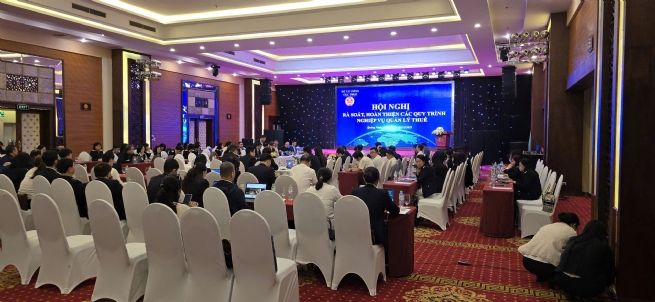
Overview of the conference on strengthening tax management and restructuring the tax information technology system
Toward international standards and sustainable tax management
At the conference, experts from the World Bank emphasized the need to shift tax administration toward output-based results rather than concentrating solely on revenue collection. Nguyen Viet Anh, Senior Specialist at the World Bank, said that in many countries, large enterprise tax offices contribute 50 to 80% of total revenue, while in Vietnam the figure is only 19.2%. This indicates that the current system has not kept pace with modern corporate structures and business ecosystems, resulting in information asymmetry.
He also emphasized that the sharp increase in data following the rollout of e invoicing requires stronger data analysis capacity, using advanced tools to process live, real-time data instead of relying on Excel.
Sharing the same view, Rick Fisher, Senior Tax Advisor at the World Bank, stressed that process redesign is not merely digitizing old procedures but involves a complete reengineering, with operations leading and IT as a supporting foundation. The ultimate goal is to increase compliance, reduce misreporting and late payments, and create the simplest, most user-friendly processes for both businesses and individuals.
Deputy Director Mai Son said that the tax sector is mobilizing maximum resources to complete the new operational process framework and the restructured IT architecture. Once finalized, the system will meet management requirements amid rapid taxpayer growth, large data volumes, and limited tax personnel. The goal is to enhance compliance, reduce business costs, and create a fair and transparent business environment.
This conference marks the next step in completing all content before nationwide implementation. With a modern approach centered on data, automation, and risk management, the tax sector is moving closer to international standards and building a modern, efficient, and sustainable tax administration model that better serves taxpayers and enterprises.
By Le Hien, Vietnam Business Forum





 Vietnamese





