

11:27:11 AM | 12/20/2025

Phu Tho Province recently held its Quarter IV 2025 dialogue conference on a large scale, directly identifying obstacles in investment and production and announcing a series of solutions to be implemented immediately within its authority, along with strong recommendations to the central government. Provincial leaders emphasized that the guiding principle is to match words with actions and to turn dialogue into concrete measures that expand opportunities for enterprise development.
 |
Open dialogue and direct identification of obstacles
On November 26, the Phu Tho Provincial People’s Committee held the Quarter IV 2025 dialogue conference with enterprises and investors, attended by more than 300 business representatives together with leaders of provincial departments and agencies. This was considered the most comprehensive dialogue of the year, focusing on core issues that are hindering investment progress and weakening enterprise competitiveness.
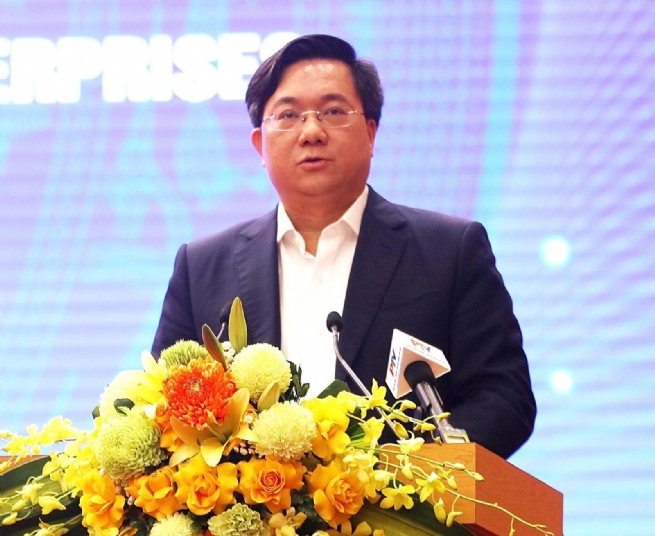
Chairing the conference, Chairman of the Provincial People’s Committee Tran Duy Dong affirmed that the local government considers enterprises a driving force for growth and “citizens of Phu Tho.” In a period of complex global economic developments, enterprises need even stronger support and partnership from the government. For this reason, the province prioritizes direct dialogue and resolves issues immediately at the conference to minimize intermediaries and delays.
The Center for Investment Promotion and Enterprise Support reported that it had received 58 groups of concerns from a wide range of enterprises, including processing industries, exporters, supporting industries, construction and infrastructure, trade and services, and FDI.
Most of the issues fall into four major categories:
The first is land clearance, which is considered a “longstanding bottleneck.” Some projects face delays in compensation plan approval, resettlement progress is not synchronized, and many cases encounter obstacles related to relocation of graves or negotiations between enterprises and residents on land prices. These issues have caused infrastructure and production projects to be delayed or incur significant cost increases.
The second is planning and land management, as many enterprises have encountered overlaps between sectoral planning and land use planning. Some applications must be revised or supplemented multiple times, prolonging the investment preparation process.
The third is administrative procedures, where cumbersome processes still exist in several areas. Enterprises reported that some procedures require working with multiple agencies on the same matter, increasing both cost and time.
The fourth is technical infrastructure and markets. Some industrial parks and clusters still lack synchronized systems for drainage, water supply, and transport connections. International market fluctuations, especially United States tax policies, have created challenges for textile, wood processing, and construction materials enterprises.
At the conference, many FDI enterprises proposed that the province consider additional incentives to strengthen competitiveness, while domestic enterprises sought faster procedures, streamlined processes, and greater transparency. These views were presented directly and openly to provincial leaders, clearly identifying each point of obstruction.
Right at the conference, leaders of relevant departments addressed each issue within their authority, provided specific timelines for resolution, and acknowledged responsibility for areas where progress has been slow. Issues beyond the province’s authority were categorized for submission to central ministries and agencies.
Turning commitments into action
In his closing remarks, Chairman of the Phu Tho Provincial People’s Committee Tran Duy Dong emphasized that dialogue must lead to action. He stated that meetings are not only for listening but for delivering results, and that every department must deliver final outcomes without leaving businesses waiting. The guiding principle is to resolve issues decisively, ensure transparency, and assign clear accountability.
For investment environment reform, the Department of Finance and the Center for Investment Promotion and Enterprise Support were tasked with proposing breakthrough administrative reforms and expanding the use of e-government tools. The province is moving toward a more flexible one-stop model that shortens processing times and raises service quality at every stage.
Phu Tho also encourages the development of special policies to strengthen its competitive edge within the region. This is viewed as a prime opportunity to capture incoming investment shifts from multinational corporations.
On investment and land procedures, the Department of Agriculture and Environment must review all processes, publicize each step, and shorten timelines. The goal is to eliminate stagnant applications and ensure that projects meet all legal requirements for the fastest possible implementation.
For industrial zones, the Management Board of Industrial Zones and the Department of Industry and Trade must work together to accelerate procedures related to investment, environment, and labor. The province considers industrial-zone enterprises a core force in its industrial base and major contributors to export performance.
Regarding credit, Tran Duy Dong requested that the State Bank of Vietnam Branch for Region IV study the expansion of preferential lending programs. Commercial banks are encouraged to simplify borrowing requirements for manufacturing and export enterprises. The Tax Department will coordinate the application of tax exemptions, reductions, and deferrals for firms affected by global market fluctuations.
Human resources development remains a high priority. The Department of Education and Training has been assigned to upgrade training quality for technical workers, especially those serving the supporting-industry sector, manufacturing, and expanding FDI facilities.
At the grassroots level, Tran Duy Dong emphasized that commune, ward, and town authorities must strengthen their support for businesses. Local governments at both levels may not shift responsibility or leave enterprises to resolve issues on their own. Any matter beyond their authority must be immediately reported to the provincial government and relevant departments.
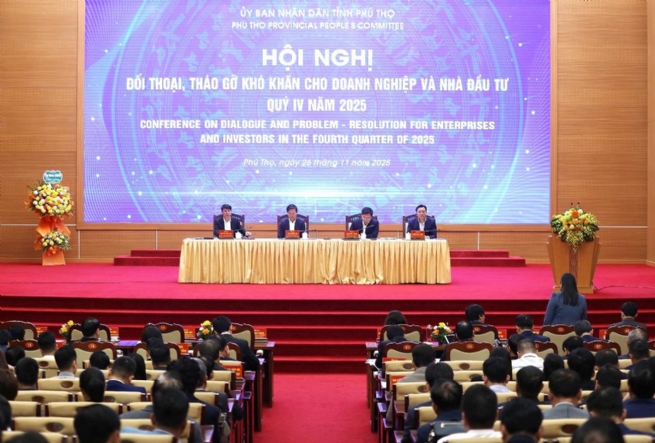
Phu Tho provincial leaders chair a dialogue conference with enterprises and investors
Enhancing enterprise competitiveness
This dialogue conference focused not only on listening but on an immediate-resolution mechanism that assigns clear responsibilities to each department and commits to firm timelines. This approach enables businesses to reduce compliance time and costs while strengthening confidence in long-term investment in Phu Tho.
With the strong commitment of provincial leaders and the determination of relevant agencies, Phu Tho’s investment environment is expected to continue improving toward greater transparency, professionalism, and flexibility. This is especially important as FDI flows continue to shift and domestic enterprises seek locations with competitive costs, fast procedures, large clean-land reserves, and an abundant labor force.
For the business community, the province’s shift from dialogue to action creates new opportunities to stabilize production, recover orders, upgrade technology, and expand markets. Strong engagement from the government is expected to generate significant momentum in 2026, particularly in key sectors such as manufacturing, supporting industries, export production, and logistics services.
Many enterprises expressed expectations that long-standing bottlenecks will be resolved following the conference, replacing the previous pattern of applications being circulated repeatedly between agencies. They also hope that open and public dialogue in this format will continue on a regular basis to maintain direct communication between the government and the business community.
By Duy Hung, Vietnam Business Forum
 April 24–25, 2026
 Kinh Bac Cultural Center, Bac Ninh Province


 Vietnamese





