

3:45:27 PM | 12/19/2025

Dien Bien has identified transport infrastructure development as a central task to create breakthroughs in socioeconomic growth and investment attraction. A series of major projects are being implemented simultaneously, expanding regional connectivity, facilitating trade, and improving residents’ quality of life.
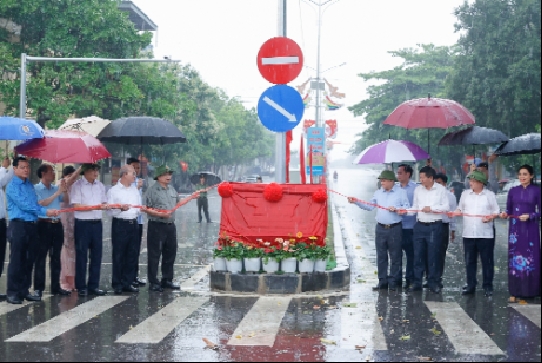
Prime Minister Pham Minh Chinh and delegates attend the plaque ceremony for the road named after former Prime Minister Pham Van Dong, April 2024
Transport leads the way
Located in Vietnam’s northwestern region, Dien Bien shares borders with Laos and China, connected through the Tay Trang International Border Gate and sub-border gates such as Huoi Puoc, Si Pa Phin, and A Pa Chai. This location gives the province a strategic advantage as both the endpoint of the northwestern border and a trade hub with the Greater Mekong Subregion, linking with the Kunming (China)-Vientiane (Laos) railway corridor.
Despite past investment efforts, the province’s transport infrastructure has faced barriers in interprovincial and regional connectivity. During 2020-2025, the province issued several thematic resolutions to address these challenges. Its consistent goal is to ensure transport development takes the lead and becomes a driving force for socioeconomic growth, national defense, and security, positioning Dien Bien as a center of the Northwest region.
The province has completed several projects to renovate and upgrade key routes, including sections of National Highway 12 (Km102-Km139+650), National Highway 279B, and Provincial Roads 143 and 147. These projects have helped reduce transport costs and strengthen regional links.
For 2026-2030, the province will prioritize research and proposals for large-scale, regionally and internationally connected projects such as the Son La-Dien Bien-Tay Trang Expressway; upgrades to National Highways 4H and 279; and investments in provincial roads 139, 144, 145B, 145D, 149, and 150 using public investment and ODA capital. These routes directly connect key border gates including A Pa Chai-Long Phu and Tay Trang-Pang Hoc, gradually completing the Northwest transport network and opening trade corridors with northern Laos and Yunnan province, China.
A decisive project expected to drive the formation of key economic zones, expand development space, and enhance investment appeal is the Hanoi-Hoa Binh-Son La-Dien Bien Expressway (CT.03), stretching about 450 kilometers. The expressway is being developed in segments and has reached Moc Chau, Son La. Son La province has also proposed a pre-feasibility report for the Moc Chau-Son La section, laying the groundwork for further extension to Dien Bien.
Construction of the Son La-Dien Bien-Tay Trang Expressway, identified in Vietnam’s Road Network Master Plan for 2021-2030 with a vision to 2050, holds strategic significance for the entire region. It ensures seamless connectivity along the CT.03 corridor, expands urban, industrial, and tourism development, reduces transport costs and travel time, enhances competitiveness and investment attraction, creates jobs and livelihoods, and strengthens border security and defense. This project has been a long-standing aspiration of people across the Northwest region.
The Dien Bien Department of Construction has proactively developed an overall investment plan, working closely with the Ministry of Construction, Ministry of Finance, and Son La province to submit proposals to the government and central agencies. The province has specifically requested medium-term public investment funding for 2026-2030 for the Son La-Dien Bien-Tay Trang Expressway section.
Based on the province’s proposal and feedback from ministries and sectors, Party General Secretary To Lam directed the inclusion of this expressway section in the 2026-2030 medium-term public investment plan. This marks an important step toward the early launch of this route.
In parallel with road projects, the Dien Bien Airport Expansion Project was completed and began operations on December 2, 2023. The upgraded airport can now accommodate A320 and A321 aircraft, improving connectivity between Dien Bien, Hanoi, and Ho Chi Minh City. This project provides strong momentum for tourism and investment while carrying special significance during the 70th anniversary of the Dien Bien Phu Victory (1954-2024).
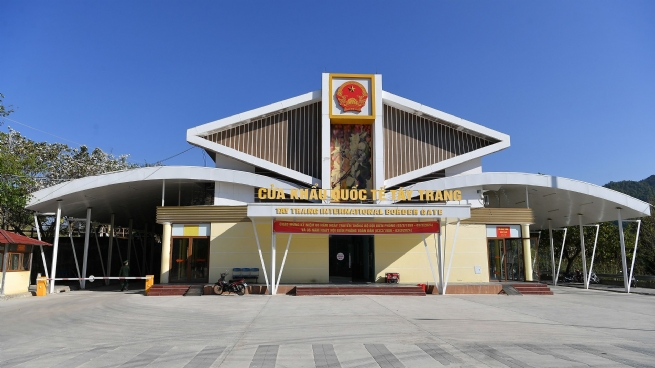
Tay Trang International Border Gate connects Vietnam with Lao via National Highway 279
Breakthrough and long-term solutions
To achieve its goal of developing a modern, synchronized transport system between 2025 and 2030, Dien Bien is focusing on a set of comprehensive and strategic measures:
First, the province will concentrate resources from the state budget. It will flexibly maximize funding from the central budget, national target programs, official development assistance (ODA), and concessional loans. These resources will be prioritized for projects with broad regional impact such as the Son La-Dien Bien Expressway and the renovation and upgrading of key national highways leading to major border gates.
Second, Dien Bien will mobilize capital from non-budget sources. Businesses are encouraged to invest under the public-private partnership (PPP) model. Contract types such as BOT, BTO, and BT will be studied and implemented appropriately, especially in industrial zone, urban, and tourism infrastructure.
Third, the province will make effective use of land funds and public assets. Land-use rights auctions, project bidding involving land, and reasonable land-use conversions will help generate more investment resources for infrastructure. At the same time, management and use of public assets will be strictly supervised.
Fourth, Dien Bien will strengthen cooperation with international organizations to access development aid and concessional loans for projects in power, water supply, rural transport, and telecommunications.
Fifth, the province will continue administrative reform and improve the investment environment. It is committed to shortening project appraisal and approval times, publicizing the list of investment opportunities, and supporting enterprises in site clearance and problem-solving.
In the new context, transport infrastructure development is the key for Dien Bien to integrate more deeply with regional and international markets. Once infrastructure bottlenecks are removed and its strategic advantages are fully utilized, Dien Bien is poised to enter a period of strong growth, becoming a dynamic development center of the Northwest region. This is also the shared aspiration that the provincial Party Committee, government, and people are striving to realize.
By Binh Minh, Vietnam Business Forum


 Vietnamese





