

8:45:24 AM | 1/19/2026

Despite ongoing challenges in global supply chains and rising trade protectionism, Vietnam’s import-export turnover in 2025 recorded strong momentum, surpassing US$930 billion. This outcome showed that trade promotion activities effectively served as a catalyst, supporting market expansion and strengthening Vietnam’s position in global trade.
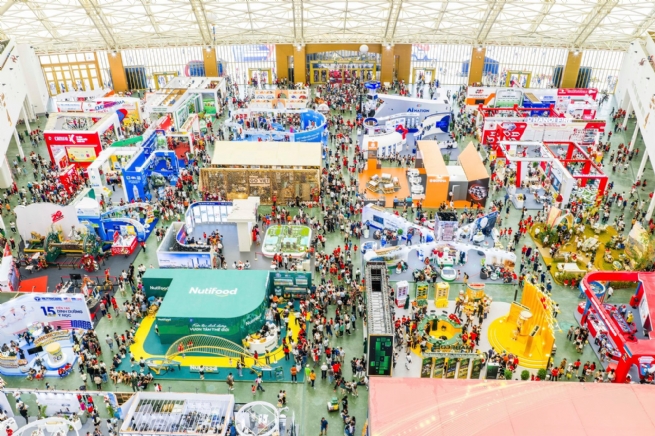
Autumn Fair 2025 features 3,000 booths from 34 provinces and cities, industry sectors, and domestic and international businesses
According to Le Hoang Tai, Deputy Director General of the Vietnam Trade Promotion Agency (VIETRADE) under the Ministry of Industry and Trade (MoIT), trade promotion activities had undergone substantial changes in mindset, implementation methods, and scale, becoming an effective instrument for enterprises to enhance brand value and strengthen Vietnam’s soft power in the international arena.
Specifically, in 2025, VIETRADE prioritized institutional refinement and accelerated administrative procedure reform to create a consistent and open legal framework for trade promotion activities. The agency advised on the issuance of two decrees and one decision by the Prime Minister, and revised three key decrees, helping enterprises cut compliance time and costs by around 30%.
On that foundation, the National Trade Promotion Program continued to deliver tangible results. During the 2021-2025 period, 630 projects with total funding exceeding VND650 billion (US$26 million) were implemented, supporting more than 41,000 enterprise participations. In 2025 alone, 114 projects were carried out, with the value of signed contracts and memoranda of understanding reaching approximately US$71 million.
Notably, trade promotion activities saw a strong shift toward digital transformation. Online trade fairs and cross-border sales via livestreaming were widely adopted, enabling enterprises to access global markets at optimized costs. A notable example was the Autumn Fair 2025, which attracted more than 2,500 enterprises and generated nearly VND1,000 billion (US$40 million) in revenue, demonstrating the organizational capacity and adaptive capability of Vietnam’s trade promotion system.
To enable Vietnamese goods to participate more deeply in global value chains, rather than remaining concentrated in low value-added stages such as processing or raw exports, Tran Thanh Hai, Deputy Director General of the Agency of Foreign Trade (MoIT), said coordination could not be limited to short-term, ad hoc support measures. Instead, it needed to focus on building long-term, sustainable development foundations. Trade promotion programs should be closely aligned with sector development orientations, requirements on standards and rules of origin, and enterprises’ capacity to meet these demands.
As Vietnam entered the 2026-2030 period, international trade was forecast to become increasingly competitive, driven by rapid digitalization and tighter technical barriers related to social responsibility, product safety, and traceability. Against this backdrop, Ho Thi Quyen, Deputy Director of the Ho Chi Minh City Trade and Investment Promotion Center, proposed maintaining regular briefings with Vietnam’s overseas trade offices, clearly identifying priority markets and sectors, strengthening two-way promotion activities, and building capacity for small and medium-sized enterprises.
From a local perspective, Nguyen Tien Dung, Deputy Director of the Quang Ninh Department of Industry and Trade, recommended granting greater autonomy to localities in organizing and participating in international trade fairs. He also called for prioritizing resources for thematic trade promotion programs, particularly the One Commune One Product (OCOP) Fair, accelerating digital trade promotion and cross-border e-commerce, and thereby supporting local enterprises in expanding production linkages and accessing both domestic and international markets.
At the macro level, Deputy Minister of Industry and Trade Nguyen Sinh Nhat Tan said that trade promotion work needed to be implemented in a more comprehensive manner, not only focusing on export activities but also creating close linkages between the domestic market and international markets.
He affirmed that the 2026-2030 period would be a “pivotal phase for the trade promotion sector to undergo strong innovation, thereby contributing to the achievement of growth targets set by the Party and the Government.” Accordingly, trade promotion should be approached with new thinking, not merely as a bridge for goods consumption, but also as a driving force for production, market shaping, and enhancing Vietnam’s national position within global value chains.
By Huong Ly, Vietnam Business Forum


 Vietnamese





