

10:33:53 AM | 4/23/2026

On April 22, 2026, in Ho Chi Minh City, under the framework of the Technical Assistance for the Design and Pilot of a Voluntary Carbon Labeling Program in Vietnam, implemented by the Southeast Asia Energy Transition Partnership (ETP), the United Nations Office for Project Services (UNOPS), in collaboration with the Department of Climate Change (DCC) under the Ministry of Agriculture and Environment, RCEE Joint Stock Company, as the key technical support provider, coordinated with the Vietnam Chamber of Commerce and Industry (VCCI) to successfully organize an intensive training course: Methodologies for Carbon Footprint Calculation and Implementation of Carbon Labels for Enterprises.
The event was not merely a standard training activity but also a significant milestone in transferring knowledge, methodologies, and technical tools, contributing to the realization of a carbon labeling ecosystem in Vietnam, toward the Government’s Net Zero target.
When “Green” Becomes a Prerequisite for Survival!
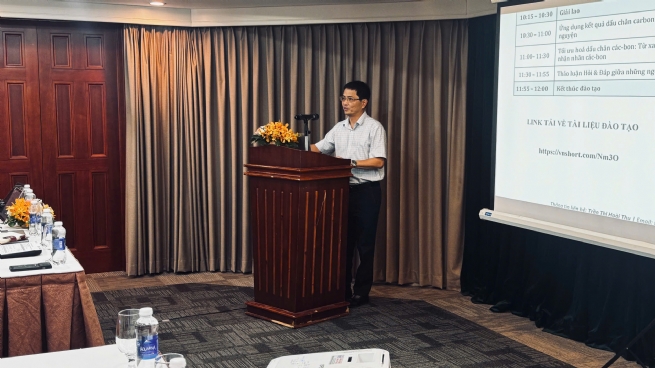
In his opening remarks, Mr. Nguyen Hung Minh – Deputy Head of the Carbon Market Division, Department of Climate Change, Ministry of Agriculture and Environment, emphasized that in the context of a global shift toward low-carbon development models, international markets are increasingly imposing stricter requirements on emissions transparency, carbon traceability, and environmental standards. This presents both challenges and opportunities for Vietnamese enterprises to enhance competitiveness and deepen integration into global value chains. According to him, carbon labeling is not only a technical tool but also brings multiple benefits, including cost optimization, enhanced reputation, market expansion, and effective risk management. At the same time, carbon labels enable enterprises to proactively comply with mechanisms such as carbon taxes, CBAM, and green standards.
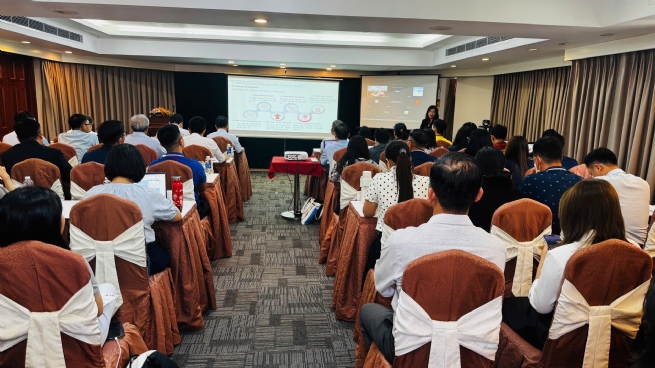
One of the key components of the program is the proposed development of the Voluntary Carbon Labeling Program (VCLP), aimed at building capacity for calculating, verifying, and disclosing product carbon footprints (PCF) for Vietnamese enterprises. Within this framework, RCEE JSC plays a central role in technical support, directly participating in methodology design, development of guidance materials, and implementation of intensive training activities. Through these efforts, RCEE JSC has contributed to establishing a structured technical foundation, enabling enterprises to gradually access and apply international standards for emissions measurement and transparency.
Focused Piloting – Toward Nationwide Scaling
According to proposals from RCEE JSC’s expert team, the VCLP will be piloted in three sectors with high emission intensity and clear transition potential: chemicals (fertilizers), food processing, and paper & pulp. This approach allows resources to be concentrated on priority sectors while creating practical pilot models that can serve as a basis for nationwide expansion in the next phase.
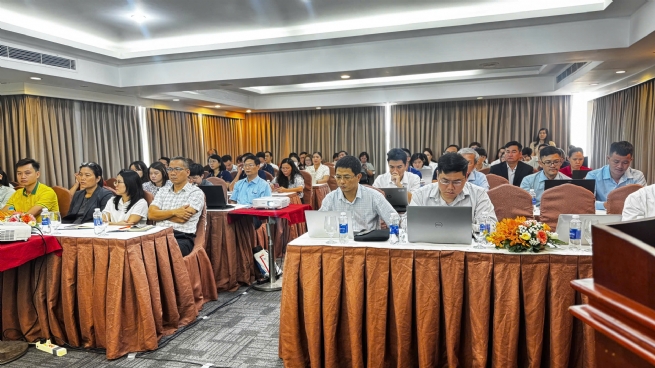
Specifically, the chemical (fertilizer) sector is selected due to high exposure to international carbon taxation mechanisms; the food processing sector has advantages in consumer communication and sustainable packaging improvements; while the paper and pulp sector is resource-intensive and requires standardization for emissions inventory and verification.
The VCLP is designed not only to support enterprises in complying with domestic regulations such as Decree No. 06/2022/ND-CP and Decree No. 119/2025/ND-CP on greenhouse gas emission reduction, but also to meet increasingly stringent international requirements for carbon traceability. Accordingly, carbon labels are expected to become a “passport” enabling Vietnamese products to enhance competitiveness and effectively access high-end export markets.
From Greenhouse Gas Inventory to a “Green Passport” for Products
During the training course, experts from RCEE JSC provided in-depth technical guidance on corporate-level greenhouse gas (GHG) inventories. The process includes four core steps: Boundary definition – Data collection – Emission factor selection – Calculation and reporting.
Experts highlighted that the biggest challenge for Vietnamese enterprises currently lies in data systems, which are often fragmented and inconsistent across accounting, production, and environmental departments. “Incorrect boundary definition leads to entirely incorrect results” was a key warning to enterprises. To address this, the training introduced methods for establishing internal Measurement, Reporting, and Verification (MRV) systems, while emphasizing the role of QA/QC (Quality Assurance and Quality Control) in cross-checking energy consumption intensities.
The training also clarified the distinction between organizational GHG inventories and product carbon footprint (PCF) calculations. PCF measures the total emissions of a product across its entire supply chain, from raw material extraction to production and distribution (typically following ISO 14067 or the GHG Protocol).
Applying PCF results brings many practical benefits to enterprises. First, it enhances market access by meeting increasingly stringent environmental transparency requirements from international buyers such as Walmart, Apple, and IKEA. At the same time, PCF strengthens green supply chain linkages by identifying “hotspots” of emissions within production processes, enabling targeted improvement measures. In addition, it serves as an important basis for accessing green finance, as many banks are offering preferential credit packages with interest rates 0.5–1.5% lower for enterprises with clear ESG strategies and Net Zero targets.
Beyond calculation, the program also introduces solutions for optimizing carbon footprints through energy transition. Models such as Energy Service Companies (ESCO) are presented as effective financial solutions, allowing enterprises to modernize systems (e.g., boiler greening, rooftop solar installation) without requiring substantial upfront investment.
Notably, emission reductions can also be transformed into financial assets. With Vietnam planning to pilot a carbon trading exchange in 2026, enterprises with carbon labels and transparent emissions data will have opportunities to participate in the carbon credit market, generating new revenue streams from environmental protection efforts.
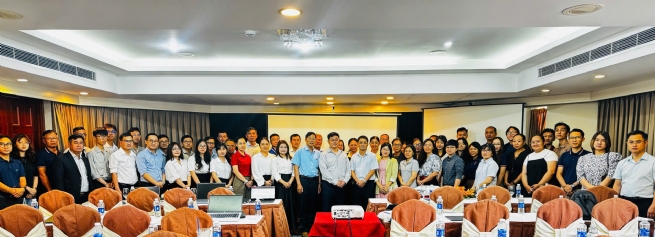
The strong participation and interest from enterprises demonstrate the proactive spirit and high sense of responsibility of the Vietnamese business community in seizing new opportunities. Through this event, RCEE JSC and its partners reaffirm their commitment to continue accompanying enterprises by providing necessary tools and technical support, enabling them not only to “survive” but also to thrive in the green economy.
By Vietnam Business Forum


 Vietnamese





