11:20:10 AM | 5/11/2026

National Tourism Year 2026, under the theme “Where the great forests meet the blue sea,” is a tourism promotion event that also reflects an important shift in Gia Lai’s development thinking: the inland Central Highlands expanding regional links with the South Central Coast. With hundreds of events, participation from more than 20 localities, and a strategy to make tourism a key economic sector, the challenge is not potential but the ability to turn it into real growth.
Large scale and a broader message beyond tourism
National Tourism Year 2026 in Gia Lai is being carried out on a large scale, with 244 cultural, tourism, and sports events taking place throughout the year. These include 18 ministry-level activities, 109 organized by the province, and 117 response activities from 22 localities. Compared with previous editions, the 2026 program has increased not only in number but also reflects a shift in approach, from promoting destinations to organizing development space with connectivity and broader impact.
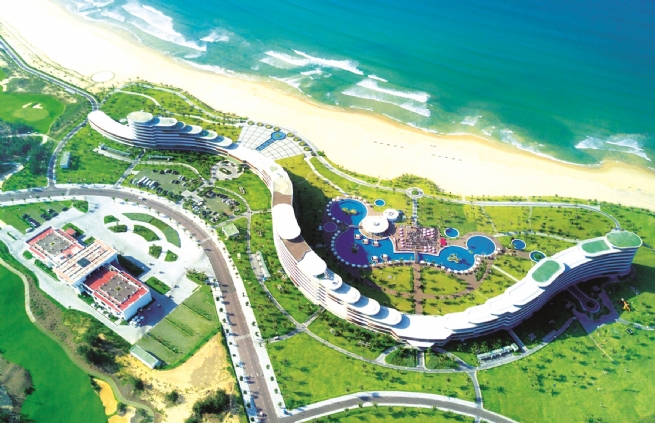
Gia Lai’s tourism infrastructure set to drive a breakthrough in the sector
The program is designed as an integrated system, with sequences of activities that connect experiences, markets, and cultural identity. This reflects a shift from short-term events to building a tourism ecosystem, where products, infrastructure, services, and communications are aligned to extend length of stay, increase spending, and improve added value.
The opening ceremony at Nguyen Tat Thanh Square in the Quy Nhon area carries symbolic meaning. The choice of a coastal location reflects a repositioning of development: Gia Lai is placing itself along a strategic connection axis between the highlands and the South Central Coast. This provides a foundation to expand economic space, reshape market structure, and redefine the locality’s role in regional linkages.
On March 28, 2026, speaking at the opening ceremony of the National Tourism Year, Minister of Culture, Sports and Tourism Nguyen Van Hung said this is not only the start of a tourism year, but also “a milestone of strategic significance,” reflecting a new vision for Vietnam’s tourism sector as a leading economic sector and a “bridge of connection” between regions, cultures, and markets. He described “highlands - sea” as both a communications image and a development direction.
At the macro level, Deputy Prime Minister Ho Quoc Dung said this marks a “historical opportunity” for Gia Lai, as linkages between the Central Highlands and the coastal region become more clearly defined. The “forest - sea” advantage not only expands space but also supports a more diversified and sustainable growth structure.
From the local perspective, Chairman of the Gia Lai People’s Committee Pham Anh Tuan said the theme “Where the great forests meet the blue sea” is not only the slogan for the tourism year, but also a consistent development orientation: connecting resources, expanding economic space, and forming integrated tourism routes from forest to sea. The development approach is clear: “culture as the foundation, nature as the advantage, people at the center.”
National Tourism Year 2026 is no longer a standalone event, but has become a driving force for restructuring development: promoting deeper regional linkages, attracting strategic investors, developing high-value tourism products tied to identity, and raising Gia Lai’s image and position on the national and international tourism map.
From a market perspective, early signals show a clear impact. In the first quarter of 2026 alone, Gia Lai welcomed around 4.2 million visitors, with revenue reaching VND8,710 billion, up 17 percent, reflecting the program’s early impact and its ability to stimulate demand on a broad scale.
Overall, the greatest significance of National Tourism Year 2026 lies not in its scale, but in the fact that, for the first time, a tourism theme has been designed in direct connection with an interregional development space linking “highlands - sea.” This marks a shift from point-based development to spatial development, and from resource use to value chain organization.
“Highlands - Sea”: from geographic linkage to an economic ecosystem
From a regional economic perspective, “Highlands Meet the Blue Sea” is gradually taking shape as a clearly structured East-West development corridor, linking the inland Central Highlands with the South Central Coast through the Pleiku-Quy Nhon axis. This corridor serves both as a key transport route and as a foundation for reorganizing flows of production, energy, industry, and services.
Gia Lai covers more than 21,500 square kilometers and is projected to have a population of around 3.5 to 3.6 million by 2050, creating conditions for multi-sector development and the formation of different functional zones. The western center is Pleiku, where urban infrastructure, services, and connectivity hubs are concentrated. Surrounding areas include large-scale agricultural zones with coffee, rubber, and pepper, along with distinctive ecological sites such as Bien Ho, Chu Dang Ya, and Kon Ka Kinh National Park.
To the east, Quy Nhon serves as the maritime gateway for the entire Central Highlands. Nhon Hoi Economic Zone is being expanded as a coastal growth pole, integrating industry, seaports, logistics, urban areas, and services. A proposal to add about 3,500 ha of industrial land in the revised plan shows a clear direction to strengthen investment attraction, particularly in processing industries, clean industries, and exports. With its seaport system, warehouses, and logistics services, the area is becoming a direct link between domestic production and international markets.
The linkage between the two spaces is driven by infrastructure, especially the Quy Nhon-Pleiku expressway, which is being adjusted in route and investment scale with total capital of nearly VND7,000 billion. Once completed, this route will significantly reduce travel time between the Central Highlands and the coast, while lowering logistics costs, currently the main bottleneck in regional economic development. At the same time, the aviation system, including Pleiku Airport and Phu Cat Airport, contributes to a more complete multimodal connectivity network.
As infrastructure improves, interregional value chains begin to take shape. In agriculture, key products from the western region such as coffee, pepper, and rubber are no longer limited to raw exports but are transported to coastal industrial zones for deeper processing before export, thereby increasing added value. In industry, energy from the Central Highlands becomes an important input for production in coastal economic zones. In logistics, goods flows are reoriented along the East-West axis, reducing reliance on traditional transit hubs.
At the same time, this corridor opens up a new tourism model, where experiences are no longer confined to individual destinations but are organized into continuous journeys from the highlands to the sea. This “corridor tourism” model not only extends length of stay but also increases spending and creates linkages across service sectors.
A notable aspect is that the formation of the “highlands - sea” corridor is guided by planning adjustments aimed at expanding development space and adding infrastructure, energy, and industrial land. The alignment of provincial, regional, and national planning shows a deliberate structure for development, aimed at reorganizing economic space in a more integrated and efficient way.
The resource-rich western region, once constrained by limited connectivity, is gradually overcoming these barriers. As infrastructure and market constraints are addressed, economic space not only expands but is also reorganized along value chains. As a result, “Highlands Meet the Blue Sea” is no longer a symbolic image, but a practical interregional development model where geography, infrastructure, and the economy are integrated into a functioning ecosystem.
Realizing the “highlands - sea” corridor
The formation of the “highlands - sea” space has moved beyond the conceptual stage, but turning it into real growth depends on implementation capacity based on updated planning and regional development direction.
First, infrastructure remains a prerequisite. Under the revised Gia Lai provincial plan for 2021-2030, with a vision to 2050, the province has added strategic projects such as the Quy Nhon-Pleiku expressway and updated energy projects in line with the National Power Development Plan VIII to ensure alignment with national planning. However, East-West connectivity still relies heavily on National Highway 19, keeping logistics costs from the Central Highlands to Quy Nhon Port relatively high. Therefore, beyond accelerating the expressway, it is necessary to develop a coordinated logistics system, including transit centers, warehouses, and multimodal connections linked to Nhon Hoi Economic Zone.
Second, interregional coordination needs to be developed into a practical operating mechanism. New planning frameworks place Gia Lai within the Central Highlands-South Central Coast linkage and, more broadly, within a regional economic corridor. The participation of more than 20 provinces and cities in National Tourism Year 2026 shows expanding linkages, but also reveals limits in long-term coordination. A more institutionalized regional coordination model is needed, rather than relying on short-term cooperation programs.
Third, moving from potential to concrete products requires the formation of value chains. It is necessary to connect Gia Lai’s raw material regions with processing and export systems in Quy Nhon. In tourism, instead of developing sites such as Bien Ho or Chu Dang Ya separately, integrated highland-culture-sea routes should be built to create complete experiences and increase spending. The target of around 18.5 million visitors by 2030 shows tourism has been positioned as a leading economic sector.
Fourth, the investment environment and policy execution capacity play a decisive role. Planning frameworks focus on expanding development space through improved mechanisms, mobilizing social resources, and improving land-use efficiency. This requires the locality to take on a stronger enabling role, reduce administrative procedures, and create conditions for businesses to participate in infrastructure, energy, logistics, and tourism. In practice, economic corridors function effectively when the private sector becomes the main driver.
Finally, human factors and organizational capacity form the foundation but are often overlooked. Emerging sectors such as renewable energy, logistics, and experiential tourism require a skilled workforce and modern operational capabilities. Therefore, infrastructure investment must go hand in hand with workforce training, digital transformation, and improved governance capacity.
“Where the great forests meet the blue sea” is not only a development orientation but a process of restructuring economic space. When infrastructure, institutions, value chains, and implementation capacity are aligned, the Pleiku-Quy Nhon corridor will become a true growth axis, contributing to reshaping the economic structure of the entire Central Highlands-South Central Coast region.
By Vietnam Business Forum





 Vietnamese