10:41:41 AM | 8/8/2026

By introducing digital mapping, completing land data, assisting residents in using public services, and publicly disclosing compensation and site clearance information, Thuong Tin Commune is addressing a range of concrete tasks to enhance new-style rural development, facilitating production, business activities and people’s daily lives.
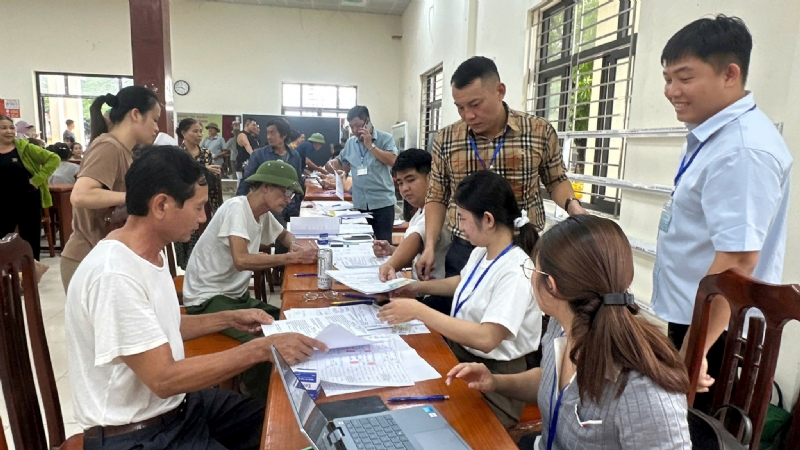
Completing Compensation and Support Procedures for Site Clearance
Bringing Digital Transformation to Villages and Hamlets
Following the rearrangement of administrative units, Thuong Tin Commune covers an area of 28.29km² and has a population of 70,739. The large area, along with multiple major projects being implemented simultaneously, has increased the workload at the commune level, requiring the locality to innovate its working methods and shorten the time needed to process administrative procedures.
On August 6, 2026, Thuong Tin Commune put its digital map into operation and launched a 100-day peak campaign to carry out key digital transformation tasks. On the map, the locality is gradually updating information on agency headquarters, schools, healthcare facilities, historical and cultural sites, craft villages, OCOP products, and production and business locations.
The digital map makes it easier for residents to search for information while also supporting the promotion of craft villages and signature products. Fully updated addresses, telephone numbers, products and directions will create additional opportunities to reach customers. Information on the map needs to be regularly reviewed to avoid omissions or delays in updates.
During the peak campaign, the commune aims to support at least 30% of businesses, business households, small and medium-sized enterprises, and traditional craft villages in adopting digital technologies. The results need to be reflected in the number of households using cashless payments, putting products on e-commerce platforms, or reaching new customers.
“Digital Literacy for All” classes held in August 2026 provide guidance on using electronic identification, online public services, cashless payments, and recognizing online fraud risks. Community digital transformation teams directly assist elderly people and households that are still having difficulty using smartphones.
At lower secondary schools, the “Students Help Grandparents Learn Digital Skills” model mobilizes students to guide elderly people in installing and using necessary applications. This approach is familiar and easy to implement, helping technology literacy reach individual households rather than stopping at training sessions.
For craft villages and OCOP entities, the training content needs to be linked to sales, traceability, electronic payments and customer information protection. Only when producers know how to clearly present products and publicly disclose their origins can the digital map effectively support business activities.
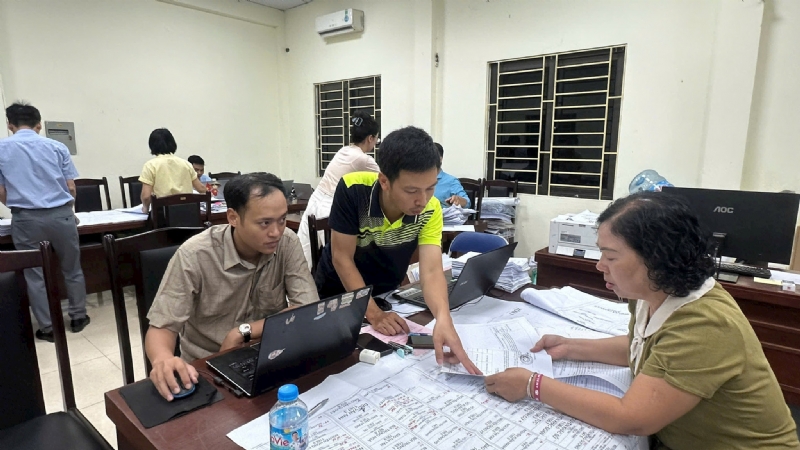
Thuong Tin focuses on cleaning up land data
Urgently Cleaning Up Land Data
One of the heaviest workloads currently facing Thuong Tin is completing land data. According to the review results, the entire commune has 31,092 non-agricultural land parcels for which data needs to be developed. As of August 16, 2026, the commune had created data for 18,663 parcels; 17,607 parcels had been connected with population data. Of these, 13,206 parcels met all five requirements, while 5,457 parcels still need to be checked and supplemented.
Chairman of the Thuong Tin Commune People’s Committee Phan Thanh Tung said that completing land data is a key task aimed at modernizing state management, promoting digital transformation, and improving the quality of services for residents and businesses. The data must ensure that it is “correct, complete, clean, live, consistent and shared,” while also being connected with population, tax, notarization and other relevant sectoral information.
Current difficulties include some areas still using old cadastral maps; incomplete handover records; and land parcels that have not been surveyed or whose users are absent. Records related to Ring Road 4, the sports urban area, National Highway 1A and social housing projects have also rapidly increased the workload.
The commune is reviewing records and cross-checking information on land users, striving to basically complete the work before August 30, 2026. Accurate data will help residents reduce travel time and avoid having to make repeated declarations, while also facilitating the processing of procedures and compensation and site clearance.
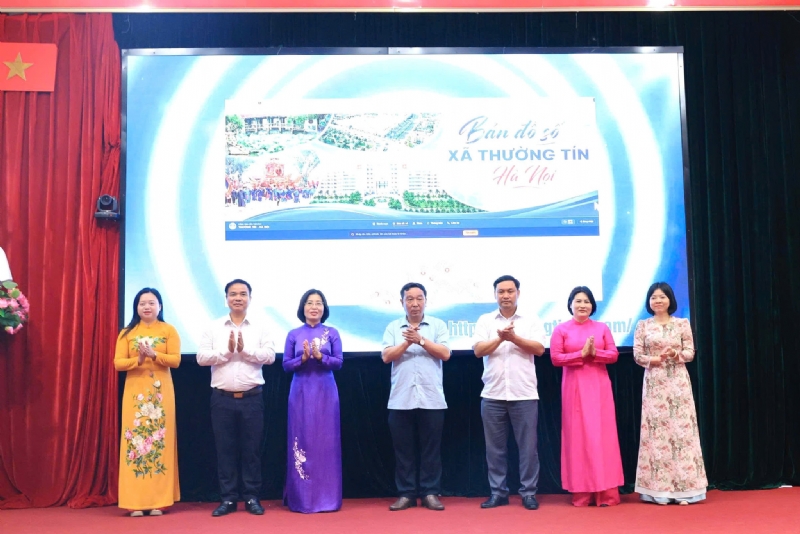
Thuong Tin launches Digital Map
Transparency to Build Consensus
Site clearance is being carried out on a very large scale in Thuong Tin. As of August 5, 2026, the commune had approved compensation and support plans covering 1,304.9ha out of a total of 1,321.17ha under the Hanoi International Sports Urban Area project. In Thuy Ung and Khanh Van, 259 households and individuals received VND360 billion in payments, with the list publicly posted.
After about 60 rounds, disbursement had reached nearly VND5,000 billion out of the projected total funding of VND9,700 billion, corresponding to approximately 800ha. Land recovery notices had been issued for 1,310ha, involving 11,900 households, reaching 99%. Land parcel records, inventory results and compensation plans must be carefully cross-checked.
At dialogues, residents requested clear provision of the detailed 1/500-scale planning, plans for vocational and employment conversion after land recovery, plans to upgrade existing residential areas, and the land fund serving craft villages. These are issues that need to be addressed alongside the payment schedule. For farming and craft households, land recovery is not only related to assets but also directly affects employment, income and places of production.
Thuong Tin also reorganized 26 schools and 26 party cells into 11 public schools and 11 school-level party committees. The number of units was reduced by 15, equivalent to 57.7%, while still managing 552 party members. The locality requires the handover of records and assets and the stabilization of teaching and learning, without affecting the 2026-2027 academic year.
Maintaining security at the grassroots level is also being implemented in parallel with development tasks. During the 2026 All-People National Security Protection Festival, the commune continued to strengthen self-management models, encourage residents to provide information, and use technology to prevent violations. A safe area, clear procedures and transparent information are practical conditions for residents to live with confidence and for businesses to maintain stable production.
Building new-style rural areas is not merely about expanding roads or improving the landscape. Results are also reflected in the handling of land records, use of public services, technology literacy, and transparency regarding land recovery projects. When these tasks are properly addressed, they will create more favorable conditions for craft villages, OCOP products and the local economy to develop.
| This page is produced in coordination with the Hanoi Coordination Office for New-Style Rural Development |
By Minh Ngoc, Vietnam Business Forum