10:22:53 AM | 7/28/2026

Rather than stopping at obtaining star ratings for products, Doai Phuong Commune is gradually reorganizing production, standardizing processes and expanding markets for agricultural products with local advantages. From Kim Son honey to salt-baked chicken and smoked pork knuckle, the OCOP journey shows that local specialties can only achieve sustainable value when quality, branding and supply capacity are strengthened together.
From Local Honey to Marketable Products
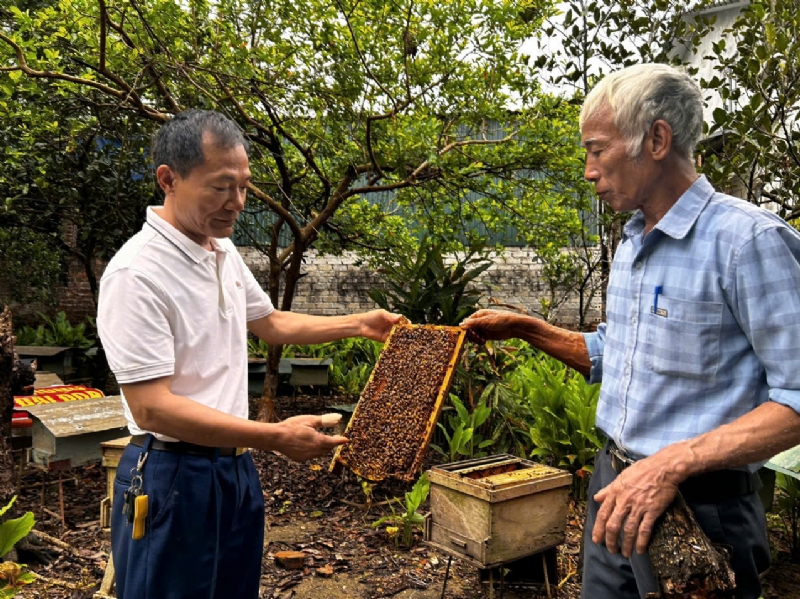
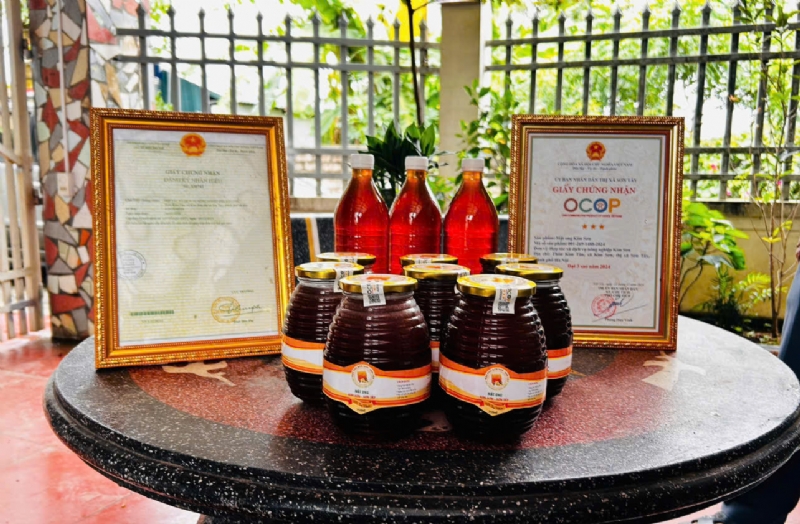
The Kim Son area of Doai Phuong Commune is located near Ba Vi National Park and has abundant natural flower resources, creating favorable conditions for beekeeping and honey production. From small-scale production methods, households have formed links through the Kim Son Agricultural Services Cooperative, agreeing on husbandry techniques, harvesting times and quality requirements. The cooperative currently brings together about 40 professional beekeeping households, with a total of more than 2,000 hives. Kim Son honey has been recognized as a three-star OCOP product.
At the end of 2019, the Intellectual Property Office of Vietnam granted protection for the collective trademark “Kim Son Honey.” Alongside establishing intellectual property rights, beekeepers have invested in processing. The family of Nguyen Van Nam currently has more than 500 hives, with annual output of approximately 4,000-5,000 liters of honey. Its refining system is capable of removing impurities and reducing moisture content to below 18%, thereby limiting fermentation and crystallization and increasing product stability.
From containers of honey sold to familiar customers, Kim Son honey now has packaging, a brand and a presence at safe agricultural product fairs and OCOP sales points. The star rating provides an initial boost in consumer confidence, but it is the cooperative that plays the key role in organizing production, maintaining quality and protecting the collective reputation.
Deep Processing to Expand the Market
Alongside products based on traditional trades, Doai Phuong is developing a group of processed products to meet new consumer demand. Pham Thi Nhan’s household business started up in 2022, initially mainly processing products for distributors. After repeatedly adjusting recipes, investing in machinery and developing its own brand, the facility now has two three-star OCOP products: salt-baked chicken and smoked pork knuckle.
Each month, the facility sells about 30 tons of finished chicken and 2-3 tons of smoked pork knuckle. Its products are now available in Hanoi, Hai Phong, Bac Giang, Ho Chi Minh City and several other localities. This sales scale shows that OCOP certification can help small businesses expand their markets if their products meet requirements for quality, food safety and supply capacity.
According to Pham Thi Nhan, being recognized as a three-star OCOP producer has helped the facility build customer trust and expand its market. The facility continues to focus on quality and food safety while researching new products suited to consumer demand.
The case of Pham Thi Nhan’s facility shows that deep processing is an appropriate way to increase value in peri-urban rural areas. By taking control of recipes, processes, packaging and distribution channels, producers retain more added value locally. In return, the facility must strictly control raw materials, production conditions, storage, shelf life and traceability, especially as the market expands to multiple provinces.
The foundation of OCOP remains a well-organized production sector. In the 2026 Spring crop, Son Dong General Agricultural Business and Services Cooperative introduced six-row rice transplanters for cultivation across 35 hectares. Machine transplanting reduces labor requirements from 20-30 labor-days to just 2-4 labor-days per hectare; the amount of seed is reduced from 1.5-1.8kg to 0.7-1kg per sao. Lower costs and greater uniformity in varieties and planting schedules create the conditions for developing commercial-scale production.
Upgrading Star Ratings Must Go Hand in Hand with Market Capacity
According to Tran Anh Tuan, Vice Chairman of the Doai Phuong Commune People’s Committee, the locality currently has 10 products recognized as OCOP products. The commune has identified developing products based on existing local advantages and linking them with advanced new-style rural development as priorities; it also supports producers in accessing policies, applying scientific and technical advances, improving packaging and labeling, and participating in trade promotion activities.
For 2026-2030, Doai Phuong aims to have 25 to 30 products rated three stars or higher; it will support producers in improving marketing and promotional skills and putting products on e-commerce platforms. This target creates additional opportunities for honey, livestock products, processed foods and specialties of the Xu Doai region, but it also requires careful screening from the outset.
Potential products need to be assessed simultaneously in terms of raw material areas, standardization capacity, producer capabilities and market demand. The locality should prioritize products with distinctive characteristics, stable supply capacity and producers with sufficient management capabilities, rather than simply completing documentation to obtain certification.
Doai Phuong also has conditions for linking OCOP with tourism. The commune’s 2026 Tourism Year is themed “A Green Rendezvous in the Heart of Xu Doai”; the locality has Kim Son honey, Van An fine woodcraft, arrowroot vermicelli and Vietnamese pork sausage. When organized into experiential destinations and product display spaces, OCOP products can become part of a tourism journey rather than simply being present at retail counters.
E-commerce is a distribution channel, not a substitute for quality. Products brought onto digital platforms must provide transparent information, traceability codes and stable order fulfillment capabilities. Effectiveness should be measured by sales, customer repeat rates and the ability to expand distribution.
Moving from 10 existing products to a target of 25-30 products by 2030 is a long journey. The results of the OCOP Program in Doai Phuong will not be measured solely by the number of products receiving star ratings, but by whether local residents’ incomes increase, production facilities can remain competitive in the market, and the distinctive values of the Xu Doai countryside are preserved throughout the development process.
| This page is produced in coordination with the Hanoi Coordination Office for New-Style Rural Development |
Source: Vietnam Business Forum