4:14:43 PM | 7/26/2026

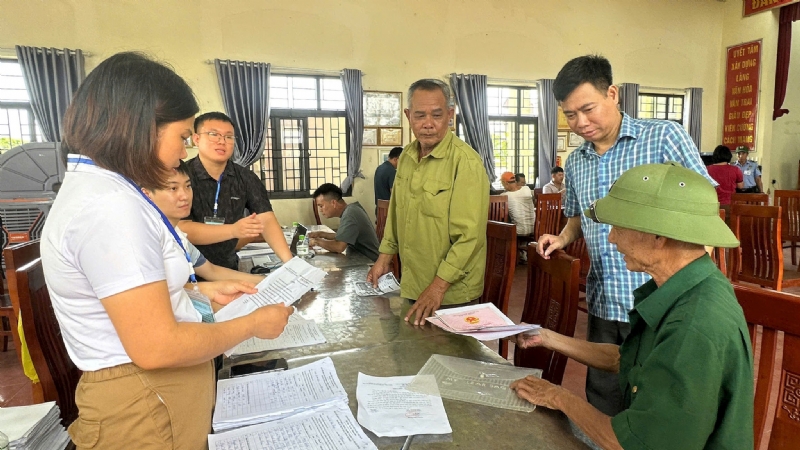
The Hanoi International Sports Urban Area Project requires the clearance of 1,321.17 hectares of land in Thuong Tin Commune, affecting approximately 12,000 households and 3,500 graves. The scale of the work is substantial and the implementation timeline is tight, while land acquisition directly affects the production, income, livelihoods and well-being of many local residents.
Phan Thanh Tung, Chairman of the Thuong Tin Commune People’s Committee, said that after six months of implementation, the commune had issued notices for the recovery of 1,310 hectares of land, involving approximately 11,900 households, equivalent to 99% of the total area subject to acquisition. The locality had approved compensation plans and issued decisions to recover 1,286 out of 1,321.17 hectares from approximately 9,500 households, with total compensation payments of nearly VND 9.7 trillion.
In Ngoc Dong Village, 432 households and individuals who had been allocated agricultural land under Decree No. 64/CP have a total of 101.5 hectares within the land acquisition area. Total compensation and support payments under the regulations are estimated at approximately VND 554.7 billion.
Nguyen Tien Phong, Head of Ngoc Dong Village, said the project would recover all of the village’s agricultural land, initially causing concern among many residents because they would have little or no remaining means of agricultural production. The commune authorities, village officials and mass organizations organized numerous communication and information sessions to explain compensation and support policies as well as the locality’s development plans. By the end of July 2026, 100% of households subject to land acquisition had received compensation and handed over the site.
Dam Viet Thuan, a resident of Ngoc Dong Village, said that after receiving information and explanations from the early stages, his family cooperated in completing the required documentation, dismantling structures, handing over the entire agricultural land area and receiving compensation in accordance with regulations.
According to Nguyen Toan Thang, Chairman of the Vietnam Fatherland Front Committee of Thuong Tin Commune, site clearance has been identified as a key priority. A Steering Committee for the site clearance of key projects and a Compensation, Support and Resettlement Council have been established, while progress is reviewed daily to promptly address emerging problems.
The work is carried out according to the principle of “clear people, clear tasks and clear responsibilities.” The commune People’s Committee and relevant professional agencies review land origins, conduct inventories and prepare compensation plans; the Vietnam Fatherland Front and socio-political organizations conduct communication and dialogue; while Party cell secretaries, village heads and Front Work Committees coordinate the verification of documents and mobilize residents to hand over land.
Working groups proactively visit individual households and families to listen to their concerns and provide explanations. Dialogues in Ngoc Dong, Van Giap, Do Ha and Khanh Van villages have focused on structures and workshops built on agricultural land, land-use origins and plans to expand cemeteries. Professional officials have also assisted residents in completing the necessary procedures to receive compensation.
The most challenging task is the relocation of graves, as this involves not only site-clearance procedures but also the customs, beliefs and emotional attachments of individual families and lineages. As of July 24, 2026, the commune had inventoried and counted 3,400 of the 3,500 graves; 80 graves had been relocated; and compensation and support plans had been approved for 358 graves, with a total cost of VND 4.1 billion.
Mobilization efforts are conducted according to each locality and family lineage, based on respect for customs and the protection of legitimate rights and interests. Public outreach in site clearance, therefore, cannot stop at encouraging people to comply. It must go hand in hand with policy transparency, listening, responding to petitions and ensuring accountability among grassroots officials.
Within the project area, most of the land to be acquired is agricultural land. Farmers are therefore both directly affected and a decisive force in determining the progress of site handover. On April 18, 2026, the Thuong Tin Commune Farmers’ Association organized an information and communication session on the project and encouraged its members to cooperate in the site-clearance process.
Le Van Tao, Chairman of the Thuong Tin Commune Farmers’ Association, emphasized the responsibility of each official and member to set an example by complying with policies, building consensus and communicating with residents so that they clearly understand compensation plans and the schedule for land handover. The role of the Association is not merely to convey policies. It must also understand members’ concerns, report emerging issues and help residents stabilize their livelihoods after land acquisition.
The situation in Ngoc Dong shows that residents’ primary concern is not simply the level of compensation, but also their livelihoods once they no longer have agricultural land. Therefore, consensus during the site-clearance phase needs to be followed by solutions for vocational training, employment transition, service-sector development and opportunities for residents to participate in and benefit from new development opportunities generated by the project.
This is also a consistent requirement in new rural development: residents should not merely be beneficiaries or a group mobilized to make contributions, but should be recognized as key stakeholders who participate in, monitor and help determine the sustainability of the development process. Rural infrastructure and spatial development can change rapidly, but the ultimate quality of development must still be measured by people’s livelihoods, employment, environment and satisfaction.
The site-clearance results in Thuong Tin demonstrate that complex tasks can be resolved when authorities operate transparently, officials remain close to the people, and legitimate interests are given full consideration. Consensus, therefore, does more than clear the way for a project; it creates the social foundation necessary for stable and sustainable local development.
| This page is produced in coordination with the Hanoi Coordination Office for New-Style Rural Development |
Source: Vietnam Business Forum