Each Formula 1 team starts the new season by setting their collective aspirations (strategic objectives) for the coming year. Based on historical data and data collected during the first few training weeks of the new season, the team measures how big the gap is between today's performance and their aspirations. After thorough analysis of the data, the team will initiate initiatives to help close their performance gap. So what is the difference between a Formula 1 team and your organisation?
How organisations can learn from Formula 1
Many organisations have too many initiatives; organisations barely know which initiative adds real value. Often this stems from organisations having a lack of clear strategic focus. Although the Formula 1 industry is a multi million dollar industry, teams only invest in initiatives that will help fulfil their strategic objectives. Money will not be spent on ideas that are generated independently by individuals for purposes other than meeting their strategic objectives. But sadly, many organisations continue to do so in the absence of a formal strategic execution process.
PwC's extensive experience in helping organisations execute their strategy find that many organisations struggle with executing far too many initiatives. Each business unit or organisational level is able to initiate initiatives. This results in unclear or lack of ownership and extremely high strategic costs without understanding the contribution to the strategic objectives. Organisations can easily save millions of dollars by only executing those initiatives that possess significant value proposition or help close the gap towards achieving their aspirations.
|
Organisations with a formal strategy execution process out-perform their peer group with 70% (Source: BSCol Research)
|
Kaplan and Norton reported that 54% of the organisations who have a formal strategy execution process in place perform much better than organisations that don’t. So, how do you successfully drive your organisation’s strategy into action?
Formula 1 teams define a few strategic themes to help them communicate and achieve their strategic objectives. Strategic themes can help organisations prioritise and even more importantly, select initiatives that add value. Strategic themes are those few areas an organisation needs and wants to focus on to achieve their strategic objectives, e.g. customer centricity and operational excellence.
When defining a strategy for the coming 3 to 5 years, organisations need to understand which key areas that the organisation needs to excel at or develop extensively to achieve their strategic objectives. By defining strategic themes and translating these onto a strategy map, with clear cause-and-effect relationships between key value drivers, organisations are able to initiate initiatives focused on creating value for their stakeholders. Besides, by using the strategy map, organisations are also able to validate each existing initiative against the strategic themes and key value drivers.
This may sound high-level and difficult to execute for many organisations. So how does this work in practice? For example, an organisation has the strategic theme 'customer centricity' to help them increase their profit by X% (one of the strategic objectives). First of allthe organisation should ask themselves; what are the key value drivers within the different perspectives (e.g. the balanced scorecard (BSC) perspectives: financial, customer, internal processes and learning & growth) that will support the strategic theme 'customer centricity'. Moving sequentially through the four BSC perspectives may lead you to arrive at the following causally linked key value drivers; (1) increase profit in selected customer segments, (2) increase customer value in selected customer segments, (3) optimise customer process quality and customer access and (4) enhance capabilities to deliver client value. By examining each individual key value driver, we can define the following initiatives (see a to i):
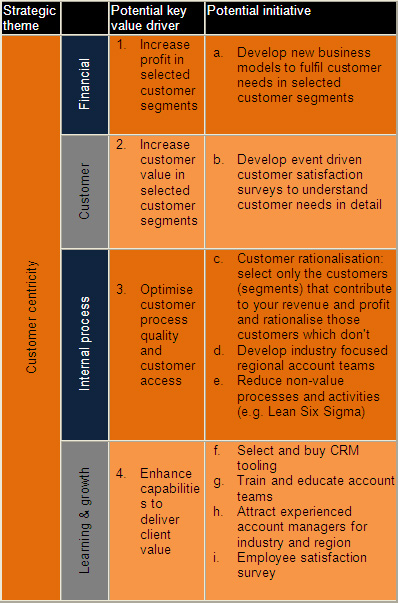
PwC is helping organisations succeed in executing their strategy effectively and efficiently by taking the following steps:
· Choose strategic initiatives: identify, prioritise and select new strategic initiatives for each strategic theme while rationalising existing ones to strategic priorities
· Validate each initiative against your strategy map
· Appoint strategic theme owners to oversee and manage initiative portfolio
· Appoint initiative owners to manage and monitor the execution of each initiative
· Allocate and make resources available
· Allocate STRATEX, besides CAPEX and OPEX
· Identify a sponsor for each initiative from the senior management team
· Communicate your strategic themes, key value drivers, initiatives and benefits 7 times in 7 different ways
Will your organisation take its first pole-position and become a world champion in the coming season? It may by having clear strategic focus and executing only those initiatives that add real value to your organisation’s aspirations!
Stephen Gaskill - Bart Ziemerink
|
(*) Stephen Gaskill is a Partner and Bart Ziemerink is a Manager at PwC Consulting. Both have extensive working experiences in advising organisations in Europe and South East Asia. The research mention in this article is conducted by PwC focussing on how organisations are managing their strategy execution process.
|


 Vietnamese





