

9:41:32 AM | 9/26/2025

Tay Phuong commune was formed by reorganizing the former communes of Huong Ngai, Lam Son, Thach Xa, Quang Trung, and Phung Xa (formerly Thach That district), along with parts of Quoc Oai town, Ngoc Liep, and Phuong Son (formerly Quoc Oai district). The commune is gradually developing into a center for traditional craft villages, particularly those linked with tourism, innovation, digital transformation, and environmental protection.
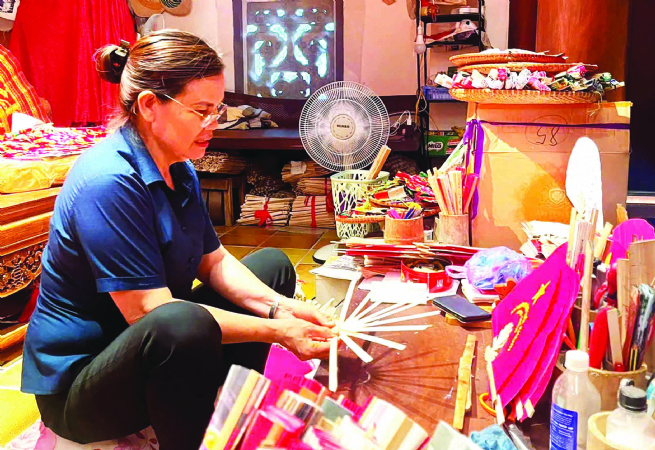
Fan-making craft village in Tay Phuong commune
By effectively leveraging its industrial, handicraft, and trade-service potential, the commune has identified sustainable economic development as the central goal, contributing to improving people’s income and quality of life.
Gathering heritage essence and industrial strength
Right after its establishment, Tay Phuong commune, with a spirit of solidarity, innovation, initiative, and creativity, saw Party committees, authorities, officials, Party members, and residents unite to overcome difficulties, implement comprehensive solutions, thoroughly carry out the resolutions of Party congresses for the 2020-2025 term, and meet or exceed many targets and tasks. In particular, industry, handicrafts, and basic construction remain the main drivers, accounting for a large share of the commune’s total production value. Local Party committees and authorities have focused on comprehensive measures to support industrial and handicraft development and to resolve challenges facing businesses.
In terms of new rural development, the former Huong Ngai and Di Nau communes were recognized as exemplary rural communes in 2023, while the former Phung Xa commune achieved advanced new rural standards in 2024. OCOP products (One Commune One Product Program) have also been a focus of brand building, development, and trade promotion. Tay Phuong commune currently has 90 OCOP products, including 18 rated 4-star.
Chairman of the Tay Phuong Commune People’s Committee Can Van Huong said that so far the commune has one industrial park and six craft village industrial clusters in operation, providing production space for 1,235 enterprises and business households. To support craft village development, the commune has proposed and received approval from the city to establish seven more industrial clusters, including: Chang Son Industrial Cluster (Phase 2), Huu Bang Industrial Cluster, Binh Phu I Industrial Cluster (Phase 2), Di Nau Industrial Cluster, Huong Ngai Industrial Cluster, Canh Nau Industrial Cluster (Phase 2), and Thach Xa Industrial Cluster.
The commune is also proposing to the city the establishment of the Phung Xa and Can Kiem Industrial Clusters. In 2025, the total value of industrial and handicraft production is estimated at more than VND34 trillion. At the same time, more than 4,350 business households are operating in mechanics, metalwork, carpentry, garment processing, cuisine, transportation, and tourism, creating jobs and improving incomes for local people.
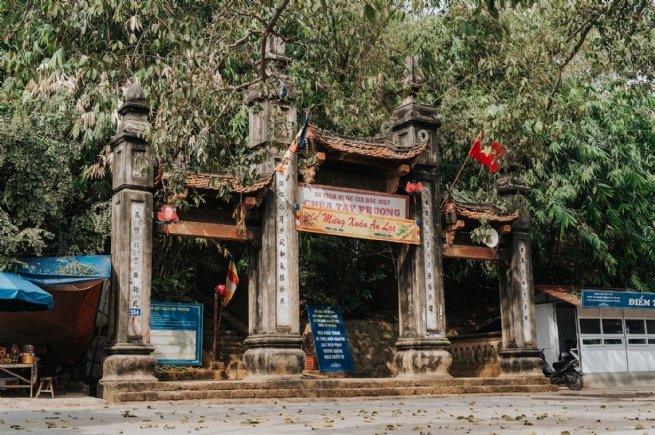
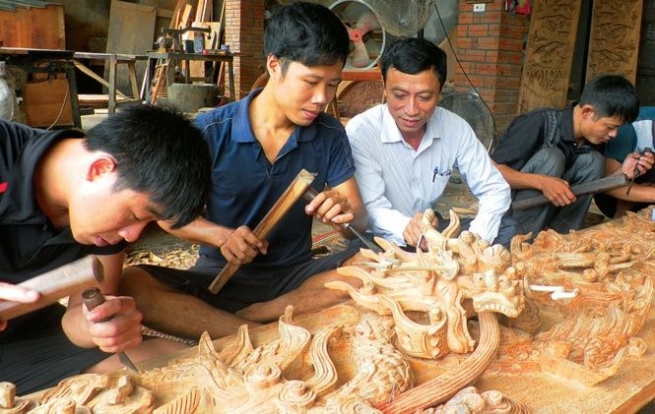
Not only renowned for Tay Phuong Pagoda, an architectural masterpiece from the 8th century, the locality is also recognized as the cradle of many traditional craft villages such as Thach Xa che lam (traditional sweet), Chang Son fans and wooden furniture, and Phung Xa mechanics and metalwork. In 2015, the Thach Xa che lam brand was granted trademark protection by the Intellectual Property Office under the Ministry of Science and Technology. At present, the Village Craft Association consists of about 60 production and business households, creating stable jobs for 200 to 300 local workers. With guaranteed quality, Thach Xa che lam products have been certified under the OCOP program and are increasingly trusted and favored by consumers.
Developing craft village tourism
In the next term, Tay Phuong commune aims for an average annual economic growth rate of 15.03%, with industry contributing 13.6%; and the industrial-handicraft sector accounting for 59.8% of the economic structure. In addition to its strengths in industry, handicrafts, and craft villages, Tay Phuong also has significant tourism potential with notable destinations such as Tay Phuong Pagoda, Hoang Long Ecological Site, and craft village tourism. These areas are being invested in and upgraded in terms of landscape, security, and promotion of local cultural-historical values.
To achieve its set goals, Tay Phuong commune is focusing on mobilizing and efficiently using all resources to promote socio-economic development, with an emphasis on increasing the value share of trade, services, tourism, industry, and handicrafts, while gradually reducing the share of agriculture. At the same time, the commune is pushing digital technology adoption, automation, and advanced techniques in production and processing; effectively implementing the advanced new rural development program in association with OCOP.
The commune is strengthening international cooperation, promoting tech innovation and transfer, and developing tourism tied to craft village culture with diverse products, local branding, and sustainable tours. It also encourages enterprises to apply IT and expand e-payment methods like internet banking and e-wallets, gradually shaping a digital economy.
Speaking at the First Congress of the Tay Phuong Commune Party Committee for the 2025-2030 term, Do Anh Tuan, Director of the Hanoi Department of Home Affairs, emphasized that the commune must become the growth nucleus of the region, playing a driving role in craft village development and serving as a dynamic industrial-service center in the western part of the city. At the same time, Tay Phuong must establish itself as a new growth pole, a center for craft village development linked with innovation, digital transformation, and environmental sustainability.
With determination, innovation, and the aspiration to rise, Tay Phuong commune is writing new chapters of development worthy of its traditions and expectations. In the near future, it promises to become a model locality in economic development linked with the preservation and promotion of cultural-historical values, accompanying the city and the country in firmly advancing into a new national era.
By Minh Ngoc, Vietnam Business Forum
|
This special section is supported by Hanoi Department of Agriculture and Environment |





 Vietnamese





