

3:31:58 PM | 12/19/2025

As Dien Bien moves into a new stage under its two-tier administrative model, financial and budget management face higher demands. In this context, the Department of Finance plays a very important role in ensuring flexible budget administration, maintaining fiscal stability, and developing investment attraction mechanisms that foster business growth and drive the province’s economic momentum. This provides a foundation for both the finance sector and the province to achieve stable and sustainable socioeconomic development in the coming years. Nguyen Phi Song, Director of the Dien Bien Department of Finance, shared insights into the department’s key tasks.
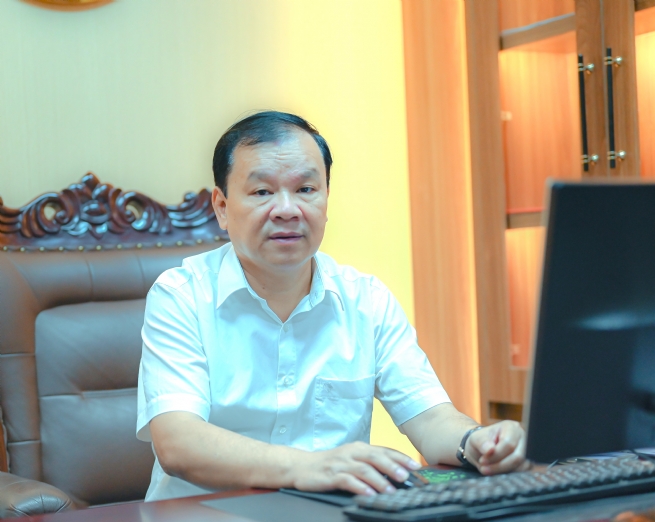 Mr. Nguyen Phi Song, Director of the Dien Bien Department of Finance |
After the merger with the Department of Planning and Investment, what steps were taken to ensure organizational stability and operational efficiency?
The merger aligns with Resolution 18-NQ/TW of the Party Central Committee on streamlining the organizational structure of government agencies. For Dien Bien, this is particularly meaningful as the province implements the two-tier local government model, which requires coherent and efficient institutional coordination.
Immediately after the merger decision, we moved swiftly to restructure our organization. Under Decision 18/2025/QD-UBND, the Department of Finance now includes ten specialized divisions and one affiliated public service unit. The leadership team consists of a director and several deputy directors to ensure centralized and unified direction.
Most importantly, the merger process did not disrupt daily operations. Professional activities, budget advisory functions, and fiscal management continued seamlessly. Streamlining the structure has reduced administrative intermediaries, optimized staffing, and strengthened management effectiveness. We view this restructuring as an opportunity to innovate and create a shift toward more modern public financial governance, with a stronger focus on serving citizens and businesses.
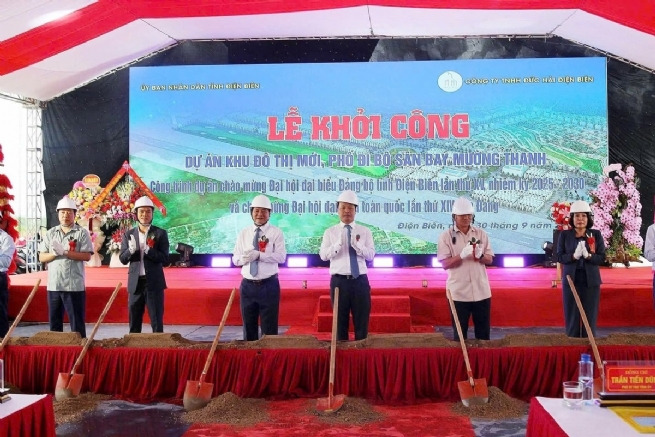
Alongside investment promotion and attraction efforts, Dien Bien province also focuses on supporting investors in project implementation. In the photo: Groundbreaking ceremony of the Muong Thanh Airport New Urban Area and Walking Street Project
Within the two-tier government framework, what measures has the finance sector implemented to ensure budget balance while fulfilling public investment plans?
This is indeed our core mission. We must simultaneously secure regular expenditures, maintain development investment resources, and fulfill obligations related to salary reform, social welfare, and other financial responsibilities.
A series of coordinated measures have been introduced. First, we advised the Provincial People’s Council to issue Resolution 03/2025/NQ-HDND on the decentralization of revenue sources and expenditure responsibilities for communes and wards. This resolution provides an essential legal foundation for local fiscal autonomy. A total of over VND556 billion has already been temporarily allocated to 45 newly established communes and wards to cover salaries, allowances, and operational expenses.
We have also guided local authorities in handling budget settlements during administrative restructuring. We have also organized training sessions on financial and accounting regulations for commune-level officials and project management boards to ensure smooth budget execution under the new governance model.
A notable initiative was our proposal for the province to use the 2024 budget surplus to support salary reform and assist surplus staff affected by administrative restructuring. We also recommended that the central government allocate additional funding to ensure timely improvements in facilities and policy implementation.
Regarding public investment, the department advised the provincial leadership to establish an intersectoral Steering Committee to coordinate, hand over, and finalize project settlements. The medium-term public investment plan for 2021-2025 has been reviewed and adjusted, while the plan for 2026-2030 is being finalized. These efforts are designed to prevent disruptions to key projects and ensure that public funds are used effectively.
Overall, these initiatives have helped maintain fiscal balance amid rising expenditure demands while creating fiscal space for Dien Bien to continue investing in infrastructure and other priority sectors.
Could you share an overview of Dien Bien’s advantages and investment orientation for the 2025-2030 period? How is the province renewing its investment promotion efforts to meet new development goals?
Dien Bien holds a strategic position in Vietnam’s Northwest region, serving as a gateway for trade with Laos and China and a bridge to ASEAN markets. The province covers more than 9,500 square kilometers and has a population of approximately 640,000 people, representing 19 ethnic groups. Its system of international and national border gates provides favorable conditions for developing cross-border trade and logistics.
The province also holds substantial potential in agriculture, forestry, renewable energy, and mineral resources, along with rich historical and cultural tourism assets, most notably the Dien Bien Phu Battlefield. These serve as key resources for sustainable development.

From 2025 to 2030, Dien Bien will pursue a selective investment attraction strategy focusing on priority sectors such as high-tech agriculture and agro-processing, sustainable and eco-friendly tourism, renewable energy, logistics, and urban infrastructure. The expansion of Muong Thanh Airport and the planned Son La-Dien Bien-Tay Trang Expressway are expected to be major growth drivers.
Within the new two-tier governance model, the province has made substantial reforms to modernize investment promotion. The administrative apparatus has been restructured toward greater professionalism, with transparent disclosure of planning information and project portfolios. Administrative procedures have been streamlined and digital transformation accelerated to shorten processing times and provide consistent support for investors from project survey to operation.
The province also actively organizes local investment promotion conferences and seminars while participating in major domestic and international events to connect with strategic investors. Its consistent principle is: “The success of investors is the success of the province.”
What message would you like to convey regarding your department’s responsibility and commitment to Dien Bien’s breakthrough development goals?
In this new context, we have clearly defined the finance sector’s pioneering role in ensuring transparent, efficient public financial management and flexible budget administration, which form the foundation for Dien Bien’s sustainable development.
Every budget allocation must be used effectively and for the right purpose to deliver the greatest benefit to the community. That is our foremost responsibility. At the same time, we remain committed to advancing administrative reforms, applying digital technologies, and reducing time and costs for both citizens and businesses.
e will also proactively coordinate with other departments and agencies to address financial, regulatory, and pricing obstacles, ensuring a favorable investment environment. With a strong service-oriented mindset, we aim to give investors confidence to operate and grow in Dien Bien.
Ultimately, the finance sector will continue to serve as a solid source of support and resources, working alongside the province to achieve its socioeconomic development goals and build a modern, professional, and people-centered administration.
Thank you very much!
|
Despite ongoing challenges, Dien Bien’s budget management has remained proactive and flexible, closely aligned with the province’s socioeconomic and welfare goals. In the first nine months of 2025, total state budget revenue in the province was estimated at VND1.217 trillion, up 10.68% year-on-year and equivalent to 59.05% of the annual target. Local budget expenditures reached an estimated VND11.923 trillion, up 25.09% and achieving 77.69% of the plan. Total social development investment capital was estimated at VND12.073 trillion, with the non-state sector accounting for 62.28%, an increase of 12.81%. Notably, public investment disbursement reached 53.03% of the planned figure, laying the foundation for advancing many key projects and infrastructure developments. |
By Huong Giang, Vietnam Business Forum
 April 24–25, 2026
 Kinh Bac Cultural Center, Bac Ninh Province


 Vietnamese





