

9:41:41 AM | 1/5/2026

In 2025, amid a slow global economic recovery and rising strategic competition, economic diplomacy continued to be identified by Vietnam as an important lever to expand markets, attract high-quality resources, and enhance national standing.
The upgrading of partnership relations with many countries, together with an approach that closely links external relations with investment and trade promotion, created new space for sustainable growth. In 2025, Vietnam continued to implement a comprehensive foreign policy, in which economic diplomacy played a pillar role, directly serving development.
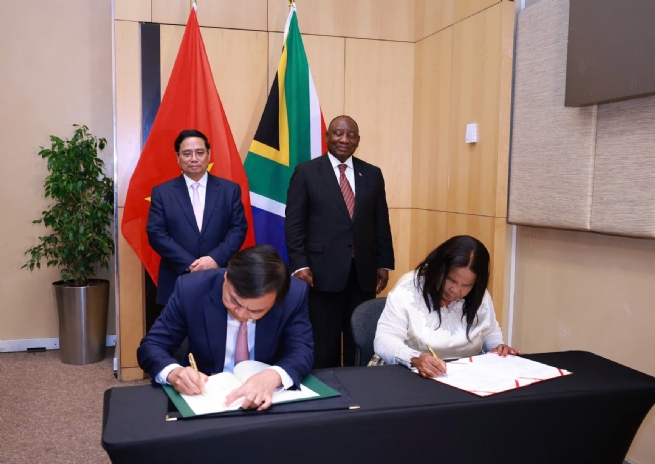
Prime Minister Pham Minh Chinh and President of South Africa Matamela Cyril Ramaphosa witness the signing of an MOU on agricultural cooperation between Vietnam’s Ministry of Agriculture and Environment and the South African Department of Agriculture, November 2025
Upgrading partnerships: from political messages to market space
The year 2025 marked an important step in Vietnam’s foreign policy as Vietnam upgraded its relations to Comprehensive Strategic Partnership with New Zealand, Indonesia, Singapore, Thailand, and the United Kingdom, and established Strategic Partnerships with many other countries. Among these, the deepening of relations with partners that have large trade and investment scale and a high level of supply chain integration with Vietnam, such as Singapore, Thailand, the United Kingdom, and several European partners, stood out. The new cooperation frameworks not only expanded the political and diplomatic space but, more importantly, created a stable and transparent institutional foundation for long-term economic cooperation.
In the agreements signed and upgraded in 2025, economic cooperation remained central. Cooperation with Singapore, Vietnam’s leading investment partner for many consecutive years, focused on the development of financial centers, logistics, digital transformation, and the green economy. Relations with Thailand were deepened to strengthen regional supply chain connectivity and expand investment in processing and manufacturing industries and energy. Meanwhile, with the United Kingdom, commitments on trade, finance, and energy transition were expected to better utilize the potential of the UK-Vietnam Free Trade Agreement (UKVFTA), contributing to the diversification of export markets amid increasingly fragmented global trade.
The upgrading and expansion of the strategic partnership network in 2025 reflected Vietnam’s consistent approach: prioritizing the quality of relations and focusing on partners capable of delivering high value added in capital, technology, and markets, rather than spreading efforts broadly. On that basis, economic diplomacy continued to be defined as an important pillar, directly serving the goals of growth and sustainable development.
According to Deputy Minister of Foreign Affairs Nguyen Minh Vu, the current upgrading of partnerships is being carried out in a substantive manner, with economic cooperation as the core. Strategic Partnership and Comprehensive Strategic Partnership frameworks not only strengthen political trust but also create a stable and transparent corridor for businesses on both sides to confidently expand investment and business activities and participate more deeply in regional and global value chains.
From an expert perspective, Can Van Luc, Chief Economist of the Bank for Investment and Development of Vietnam (BIDV), said that Vietnam’s upgrading of relations with many partners amid heightened global economic volatility carries particular significance for stability and growth. According to him, strategic partnership frameworks help Vietnam diversify export markets, sources of capital, and technology, while reducing risks associated with dependence on a limited number of traditional markets. “The higher the level of partnership, the greater the trust, thereby facilitating trade, investment, and supply chain cooperation,” Can Van Luc said.
In practice, within the upgraded relationship frameworks, economic cooperation has not been spread thinly but has focused on areas aligned with Vietnam’s development priorities, such as high-tech processing and manufacturing, innovation, digital transformation, renewable energy, and logistics. This is seen as a direction that enables economic diplomacy not only to expand markets in breadth but also to improve the quality of integration in depth.
Promoting high-quality FDI inflows
A prominent feature of economic diplomacy in 2025 was the increasingly close linkage between high-level external activities and investment and trade promotion and business connectivity. Visits and engagements by Vietnam’s senior leaders with international partners all devoted substantial attention to economic content, accompanied by meetings with large corporations, business associations, and strategic investors.
At a dialogue with European enterprises held in March 2025 in Hanoi, Prime Minister Pham Minh Chinh called on European businesses to increase high-quality investment, accelerate the transfer of advanced technologies, and support the development of high-quality human resources for Vietnam, particularly in the green economy, digital economy, circular economy, creative economy, sharing economy, new energy, and green finance.
This orientation was clearly reflected in the structure of FDI inflows. In 2025, investors from Singapore, Thailand, and Europe continued to expand their presence in Vietnam in sectors such as electronics, high-tech components, data centers, logistics, and renewable energy. Several large-scale wind and solar power projects, along with digital infrastructure projects supporting the digital economy, were advanced within the framework of cooperation with partners possessing strengths in green technology and digital transformation.
Chairman of the European Chamber of Commerce in Vietnam (EuroCham) Bruno Jaspaert said that Vietnam’s continuous upgrading of strategic partnerships, together with institutional reform efforts and improvements to the investment environment, has significantly reinforced the confidence of European investors. According to him, policy stability and a sustainable development orientation are key factors that have kept Vietnam an attractive destination for long-term investment projects.
Economic diplomacy in 2025 therefore did not stop at expanding relations or signing cooperation frameworks, but was translated into concrete investment projects, capital flows, and tangible business opportunities for enterprises. As high-level external activities became increasingly linked with investment and trade promotion and business connectivity, upgraded partnerships continued to be converted into growth drivers. On that basis, completing the institutional framework, improving capital absorption capacity, and strengthening the role of domestic enterprises will be decisive factors for economic diplomacy to deliver sustainable results in the coming period.
Thu Huyen (Vietnam Business Forum)
 April 24–25, 2026
 Kinh Bac Cultural Center, Bac Ninh Province


 Vietnamese





