

9:38:17 AM | 1/5/2026

As Lunar New Year travel demand increasingly shifts toward culturally rich experiences, hospitality products and services are emerging as a key driver of higher value creation, longer visitor stays, and a stronger image for Vietnam as a destination.
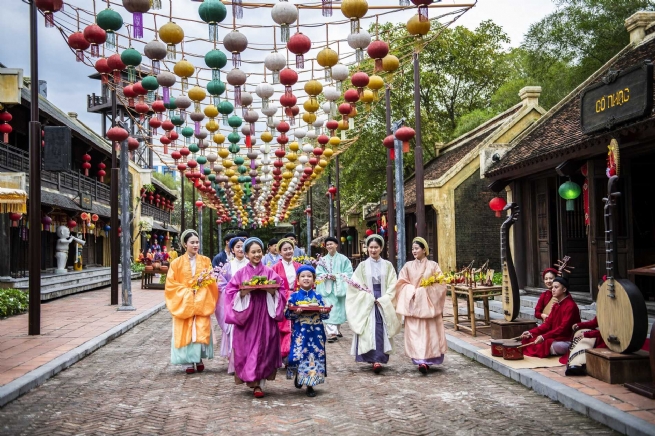
Many travel companies design all-inclusive Lunar New Year packages featuring tours that highlight local identity and festive traditions
The Lunar New Year festival is not only a sacred moment in the spiritual life of the Vietnamese people, but is increasingly regarded as a “golden season” for the tourism industry. As Lunar New Year 2026 approaches, the tourism market has seen a clear shift in consumer behavior: travelers are no longer simply seeking short leisure trips, but are looking for products and services with cultural depth that foster a sense of family reunion and connection with traditional values.
Commenting on this trend, Minister of Culture, Sports and Tourism Nguyen Van Hung said that the tourism sector must develop products with strong cultural identity, aligned with visitor preferences and leveraging local cultural strengths, to create clear competitive differentiation.
In practice, even though Lunar New Year 2026 is still ahead, many localities have already proactively developed tourism products with distinct seasonal characteristics. In Hanoi, Hue, and Hoi An, the festive atmosphere is brought to life through cultural festivals, traditional Lunar New Year markets, folk art performances, and early-spring heritage tours. In mountainous and eco-tourism regions such as the Northwest and Northeast, Lunar New Year offerings are being refreshed through experiences of indigenous customs, New Year celebrations with local communities, and nature-based retreats.
A notable feature of recent Lunar New Year tourism seasons is the growing role of businesses in “designing experiences.” Instead of offering standalone services, many companies have introduced all-inclusive packages built around Lunar New Year themes. These include Vietravel’s Lunar New Year heritage tours highlighting local identity, holiday wellness retreats at the Fusion Resort Phu Quoc system, and community-based Lunar New Year tourism products developed by Saigontourist Group’s member units across many destinations.
In the high-end accommodation segment tied to highland Lunar New Year experiences, Glenda Tower Moc Chau Hotel is positioned as a premium destination offering Northwest highland experiences for Lunar New Year 2026. Alongside its high-standard rooms, the hotel provides Lunar New Year packages that combine accommodation and dining, featuring traditional holiday cuisine at La Cham Restaurant, New Year’s Eve celebrations, and relaxation amenities such as an indoor pool and herbal steam baths. The hotel also offers promotional room-meal-experience packages, vouchers, and length-of-stay incentives to attract visitors during the Lunar New Year peak season.
Geoffrey Nguyen, CEO of Viet Orient Hospitality, believed that Lunar New Year tourism should be positioned as a comprehensive cultural experience journey, rather than merely providing accommodation services. Products that are professionally invested in management, service quality, and local storytelling will help Lunar New Year tourism increase value, extend length of stay, and elevate destination image.
Practical experience during recent Lunar New Year seasons shows that well-invested service products have helped extend visitors’ average length of stay to five to seven days, and even longer for tours combining interregional spring travel. This is an important factor enabling the tourism industry to ease seasonal pressure and generate greater spillover value for related sectors such as transportation, cuisine, commerce, and handicrafts.
However, alongside these bright spots, the quality of Lunar New Year products and services still presents significant challenges. Localized overcrowding at some popular destinations during peak days, together with uneven experience quality across localities, remains an issue that needs to be addressed promptly. Some Lunar New Year products are still overly focused on form rather than substance, lacking cultural depth and offering experiences that are not truly distinctive from ordinary days.
The Ministry of Culture, Sports and Tourism has identified in-depth product development, with experience and identity at the core, as a consistent orientation of the sector’s development strategy. Accordingly, Lunar New Year tourism is positioned within the broader framework of culture-linked economic development, both leveraging heritage and national traditions and contributing to improved livelihoods and living standards for local communities at destinations.
Experts believed that for Lunar New Year tourism to truly become a long-term growth driver, a comprehensive set of solutions must be implemented. Priorities include improving the quality of tourism human resources, strengthening regional linkages among destinations, and accelerating the application of digital technologies in promotion and product distribution. In parallel, businesses need to continue investing in service quality, personalizing visitor experiences, and building distinctive cultural narratives for each Lunar New Year tourism product, rather than stopping at purely seasonal service packages.
More importantly, the development of Lunar New Year tourism must be anchored in sustainability principles, respecting indigenous cultural values and protecting the environment. Only when tourism products deliver balanced benefits to businesses, communities, and visitors can Lunar New Year tourism become a distinctive and competitive advantage for Vietnam.
By Giang Tu, Vietnam Business Forum


 Vietnamese





