

9:42:41 AM | 1/19/2026

In 2025, Hai Phong continued to affirm its position as a locality upholding strict budgetary discipline, sustaining revenue growth, achieving public investment disbursement exceeding 100% of the plan, and proactively leveraging special financial mechanisms to expand new investment and business space. To learn more, our reporter spoke with Nguyen Ngoc Tu, Director of the Hai Phong City Department of Finance.
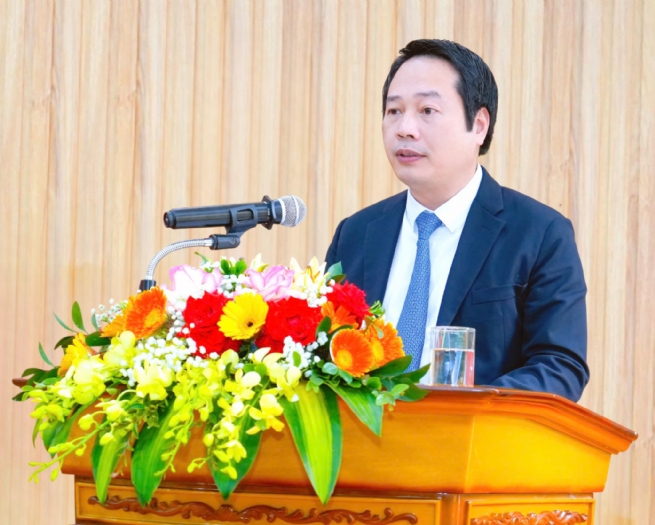
In 2025, Hai Phong continued to maintain strong budget revenue growth and on-schedule public investment disbursement. Could you share positive aspects in financial and budget management, particularly experience in ensuring capital balance for the development of new investment and business space?
Ensuring capital balance for the development of new economic space in Hai Phong was built on a foundation of financial and budgetary discipline together with proactive and flexible management thinking.
First, the city consistently implemented solutions to strengthen revenue management and prevent revenue loss and budget leakage. The establishment of the Steering Committee for Strengthening State Budget Revenue and thematic task forces created clear improvements in revenue collection and payment discipline, expanding fiscal capacity for development investment.
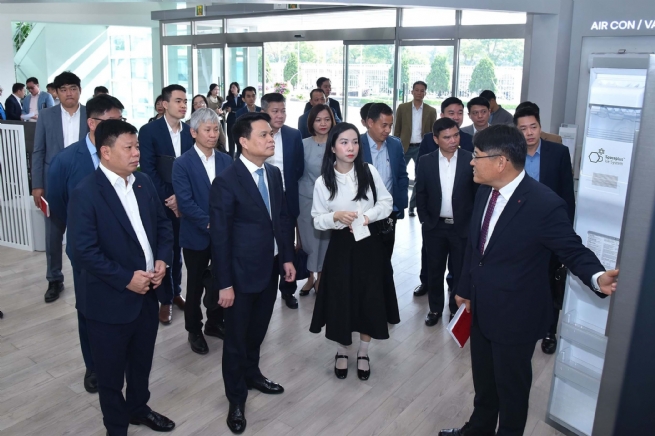
Chairman of Hai Phong People's Committee Le Ngoc Chau and the working delegation listen to leaders of LG Electronics Vietnam Hai Phong introduce the company’s main products, November 2025
In 2025, total state budget revenue collected in the city reached VND196,911.318 billion (US$7.88 billion), equivalent to 133.6% of the estimate assigned by the central government, 132.6% of the estimate approved by the City People Council, and 129% compared with the same period of 2024. Of this total, domestic revenue amounted to VND104,091.117 billion (US$4.16 billion), up 36.1%, indicating a more sustainable growth trajectory of the local economy.
At the same time, the city directed budget expenditure toward reducing recurrent spending and increasing development investment, concentrating resources on strategic infrastructure projects with broad spillover effects and strong regional and international connectivity. Total budget expenditure in 2025 was estimated at VND76,693 billion (US$3.07 billion), of which development investment expenditure reached VND38,631 billion (US$1.55 billion), accounting for more than 50% of total spending.
Hai Phong also remained among the leading localities nationwide in public investment disbursement. As of December 31, 2025, the city had disbursed VND37,808 billion (US$1.51 billion) in public investment capital, reaching 105.3% of the plan assigned by the Prime Minister, reflecting strong implementation capacity and strict financial discipline.
In 2026 and the following years, which mechanisms and solutions will you focus on advising to serve growth model transformation and expansion of new economic space?
The main focus in the 2026-2030 period is restructuring the budget toward development, treating public investment as seed capital guiding social investment. The city aims for development investment expenditure to account for around 60% of total budget spending by 2030.
We will continue advising on focused and prioritized allocation of public investment capital, giving priority to key infrastructure projects with regional and international connectivity and projects creating long-term development capacity for industry, logistics, urban development, and the marine economy.
At the same time, Hai Phong will comprehensively implement special financial and budgetary mechanisms under National Assembly Resolution No. 226/2025/QH15 to mobilize lawful resources to the fullest extent. The city is oriented toward shifting the revenue structure in a sustainable direction, gradually reducing dependence on import-export revenue and increasing domestic revenue from production, business, and services, together with effective use of land resources and public assets.
Another consistent priority is investment in people, science and technology, and innovation, ensuring annual budget allocation for digital transformation and forming a growth model based on total factor productivity (TFP), with a target of 57% by 2030.
In response to requirements for developing economic zones, free trade zones, and specialized economic zones, which financial models is the Department of Finance advising to attract strategic investors?
In a context of constrained state budget resources, public-private partnership (PPP) serves as a key pillar for Hai Phong to expand its development space.
The Department of Finance has coordinated with relevant departments and agencies to review and propose a portfolio of technical infrastructure, social infrastructure, and science and technology projects suitable for PPP implementation, applying flexible models such as build-operate-transfer (BOT), build-transfer-operate (BTO), build-transfer-lease (BTL), build-own-operate (BOO), and operate-maintain (O&M), in accordance with applicable legal regulations.
The objective is to strengthen public sector facilitation and oversight while effectively leveraging private sector capital, technology, and governance capacity, easing budgetary pressure, improving public service quality, and enhancing long-term investment efficiency.
Over the long term, Hai Phong aims to build a modern public-private financial ecosystem in which the public sector plays a guiding role and enterprises act as strategic partners in key areas such as logistics, high-technology industry, digital infrastructure, smart urban development, and green growth.
Hai Phong is expanding international cooperation in logistics, green infrastructure, and the materials industry. How is the management and coordination of international capital sources being carried out?
The city proactively cooperated with major development partners such as the World Bank (WB), the Asian Development Bank (ADB), and the Japan International Cooperation Agency (JICA) to mobilize official development assistance (ODA) and concessional loans for foundational infrastructure, environmental projects, climate change adaptation, and smart urban development.
In parallel, Hai Phong attracted new-generation FDI focused on high-technology industry, logistics, research and development (R&D), and new materials, thereby improving growth quality and strengthening its position in global supply chains.
The Department of Finance advised on unified coordination mechanisms among ODA, FDI, and PPP financing, closely linked with medium-term financial planning and budget balance capacity, ensuring efficient use of each unit of capital while avoiding overlap and waste.
Could you share Hai Phong’s long-term vision for building a modern and transparent public finance system centered on enterprises and residents?
Hai Phong has identified the goal of building a disciplined, transparent, and efficient public finance system in which the state budget serves not only as a management instrument but also as a driver of development.
During the 2026-2030 period, total budget revenue in the city is projected to exceed VND1,130,000 billion (US$45.2 billion), while total local budget expenditure is expected to reach nearly VND500,000 billion (US$20 billion), with an increasing share allocated to development investment. The city will maintain prudent control to ensure financial safety and long-term development capacity.
More importantly, all financial and budgetary reforms are directed toward better service for residents and enterprises, fostering a transparent and stable investment and business environment, and advancing the objective of positioning Hai Phong as a national center for the marine economy, logistics, and modern industry.
Thank you very much!
Ha Thanh (Vietnam Business Forum)


 Vietnamese





