

10:01:38 AM | 1/19/2026

The Vietnam National Assembly’s approval of a pilot free trade zone not only grants Hai Phong a special policy framework but also positions the city at the forefront of institutional reform, trade integration, and modern logistics development. The seminar “Hai Phong Free Trade Zone - A Destination of a New Era,” held on December 11, 2025, marked an important milestone, affirming Hai Phong’s strategic vision and ambition to reach international stature.
The seminar took place in a special context. Resolution No. 226/2025/QH15, dated June 27, 2025, of the National Assembly officially allowed Hai Phong to pilot a number of special mechanisms and policies for urban development, including the establishment of a free trade zone. This represents a concrete step in implementing the Party’s major orientations on improving institutions of the socialist-oriented market economy, advancing deep international integration, and aligning with the spirit of the Resolution of the 13th National Party Congress, as well as the conclusions and directives of the Central Committee on developing new growth poles.
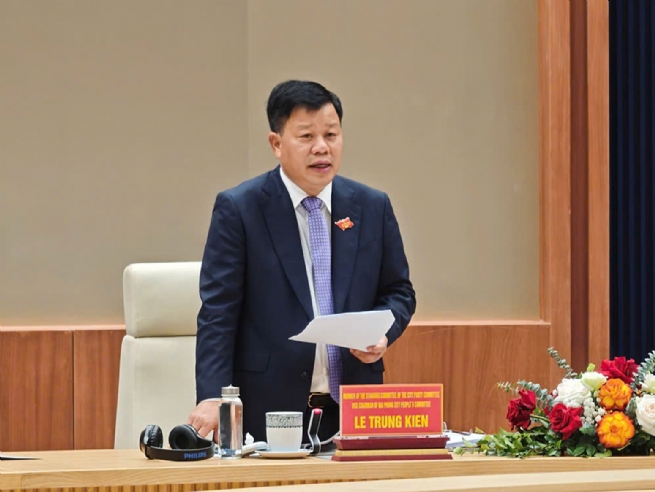
Vice Chairman of Hai Phong City People’s Committee Le Trung Kien addresses the seminar on Hai Phong Free Trade Zone
New thinking, new model and new responsibility
Le Trung Kien, Vice Chairman of the City People’s Committee, stressed that Resolution 226 not only opens a “policy gateway” but also assigns Hai Phong a pioneering mission. The establishment of the Hai Phong Free Trade Zone (Hai Phong FTZ) reflects the Government’s confidence in the city’s leading role in driving development in the Northern Coastal region and nationwide.
According to Le Trung Kien, the Hai Phong FTZ is not simply an expansion of preferential space but a fundamental shift in management thinking and the development model, moving from traditional industrial zones toward a free trade, logistics, innovation, and high-technology hub operating in line with international standards.
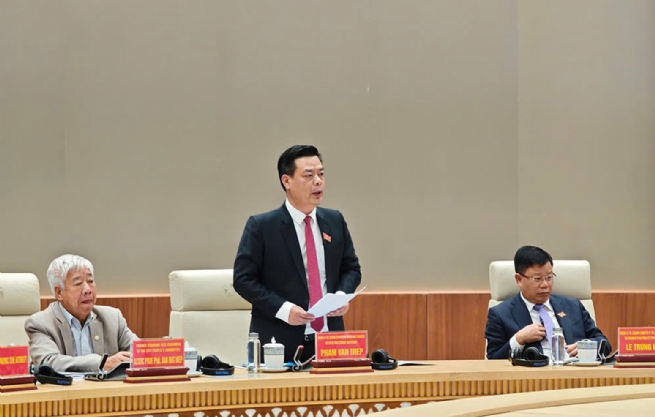
Director of Hai Phong EZ Authority (HEZA) Pham Van Thep affirms HEZA’s commitment to supporting investors and enterprises
Pham Van Thep, Director of the Hai Phong Economic Zone Authority, said that to date, Hai Phong has attracted nearly US$50 billion in FDI from 40 countries and territories, along with more than US$20 billion in domestic investment. The city has become a destination for leading multinational groups such as LG, Bridgestone, Pegatron, AEON, and DEEP C.
These figures reflect the sustained appeal of Hai Phong’s investment environment, built on synchronized infrastructure, decisive administrative reform, and consistent support from authorities at all levels. This provides the foundation for the city to move forward with the free trade zone under higher standards, broader scope, and more demanding requirements.
Under the master plan, the Hai Phong FTZ covers 6,292 ha and is arranged across three adjacent strategic locations linked to two key economic zones, Dinh Vu-Cat Hai and the Southern Coastal Economic Zone of Hai Phong. Notably, 17 special policies under Resolution 226 create an advanced legal corridor, allowing the application of preferential mechanisms in taxation, land use, customs procedures, investment, labor, and innovation, aligned with international practices.
New growth driver for Hai Phong and Northern Coastal region
From the perspective of the state authority in charge of foreign investment, Nguyen Anh Tuan, Deputy Director General of the Foreign Investment Agency under the Ministry of Finance, assessed that Hai Phong represents a successful model in attracting FDI, built on three solid pillars: strategic location, synchronized infrastructure, and strong reform determination by local authorities.
According to Nguyen Anh Tuan, the Hai Phong FTZ will become a new growth driver, not only accelerating the city’s economic development but also generating strong spillover effects for the Red River Delta and the Lang Son-Hanoi-Hai Phong economic corridor. The Foreign Investment Agency commits to continuing its support for investors through streamlined and transparent procedures and breakthrough policy mechanisms.
Presentations at the seminar conveyed three strategic messages: Hai Phong needs to shift decisively from “industrialization” toward “internationalization of trade and logistics”; the free trade zone must be an integral part of comprehensive national institutional reform; and the Hai Phong FTZ should possess the capacity to guide development across the Northern Coastal region.
Alongside these are three core requirements: developing the free trade zone to green, international, and digital standards; securing clean energy, modern logistics, and sustainable trade; and strengthening linkages to develop high-tech clusters, supporting industries, and port-linked supply chains.
Bruno Jaspaert, Chairman of EuroCham Vietnam, underlined that Hai Phong possesses all the conditions to pioneer a new-generation free trade zone model. European enterprises have already invested US$28 billion in the city and are prepared to expand if the free trade zone operates under standards compatible with the EU.
Representing domestic enterprises, Sao Do Group proposed stronger linkages between FDI and domestic enterprises, the development of supporting industries, and digital platforms connecting supply and demand to enhance the capacity of Vietnamese enterprises to enter global value chains.
Ha Thanh (Vietnam Business Forum)


 Vietnamese





